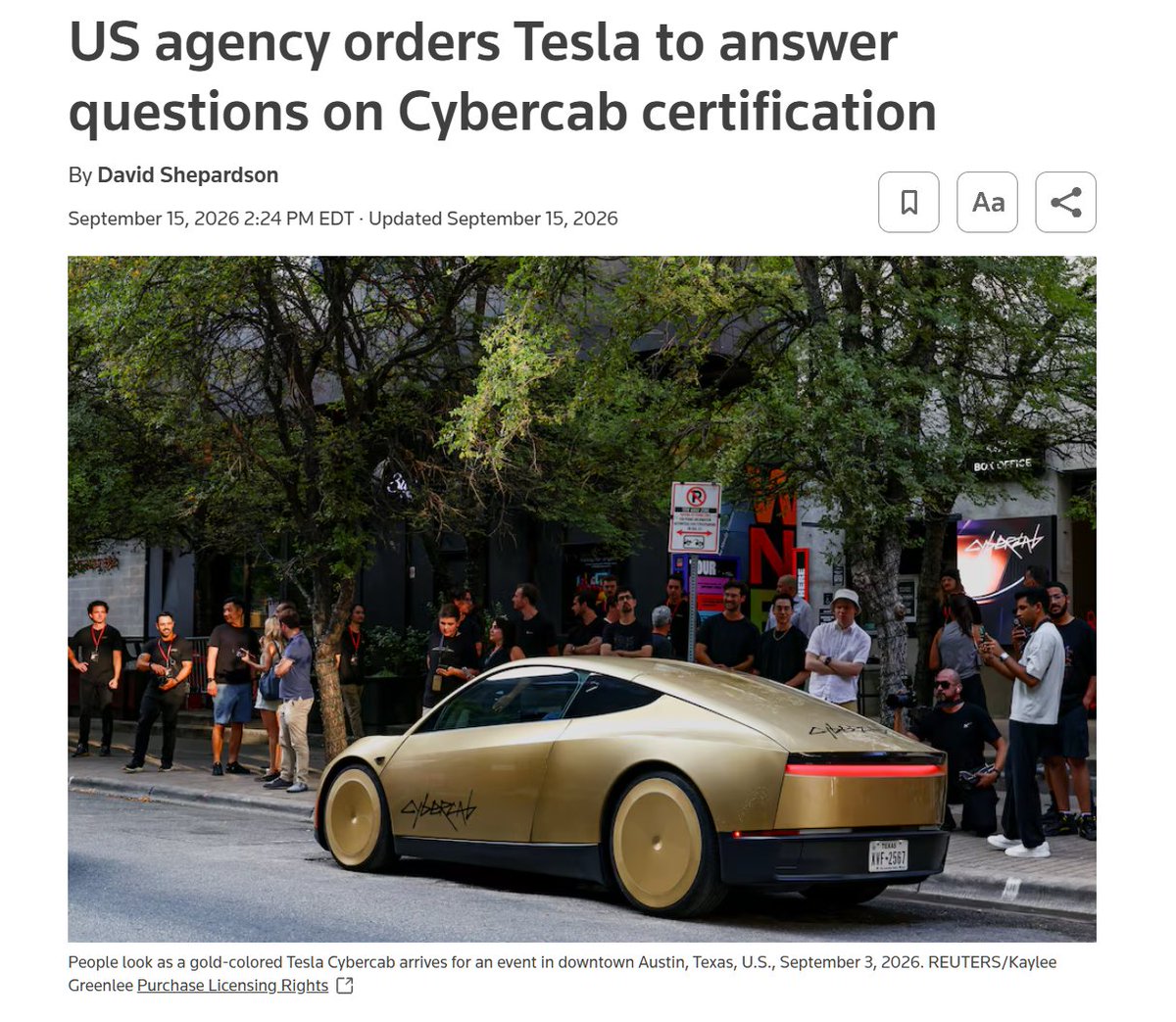
Tesla's deadline with federal regulators is today. The National Highway Traffic Safety Administration issued a formal Special Order on September 10, 2026, demanding sworn answers to 21 detailed questions about how the Cybercab was certified as road-legal — and Tesla's response is due by end of day, September 30. At the center of the inquiry: a vehicle designed with no steering wheel, no pedals, and no mirrors, and the federal safety standard that says brakes must be activated by a foot control.

What NHTSA Is Actually Asking
NHTSA's Special Order (Audit Query AQ26002) was opened on September 4, 2026 — one day after Tesla began offering paid Cybercab rides in Austin, Texas. The agency escalated quickly. Within six days, NHTSA Chief Counsel Peter Simshauser signed off on a formal Special Order with 21 specific requests.
The core legal tension is straightforward: Federal Motor Vehicle Safety Standard No. 135 requires that "the service brakes shall be activated by means of a foot control." The Cybercab has no foot controls. NHTSA wants to know, in sworn testimony, how Tesla self-certified the vehicle as FMVSS-compliant despite that gap.
Regulators are also pressing on a specific scenario: whether Tesla temporarily installed human driver controls — a steering wheel, pedals — solely to pass certification testing, then removed them before commercial deployment. If that's what happened, NHTSA wants to understand how Tesla believes that satisfies the spirit and letter of the safety standards.
As @DirtyTesLa noted, the brake pedal question is almost darkly funny on its face — but the underlying legal question is anything but. Noncompliance or evasive answers carry potential civil penalties of up to $139 million.
The Cybercab's Regulatory Position Right Now
| Item | Detail |
|---|---|
| NHTSA inquiry opened | September 4, 2026 |
| Special Order issued | September 10, 2026 |
| Tesla response deadline | September 30, 2026 |
| Questions in Special Order | 21 detailed requests |
| Key FMVSS at issue | FMVSS No. 135 (foot-operated brake control) |
| Potential penalty | Up to $139 million for non-compliance |
| Commercial rides launched | September 3, 2026 (Austin, TX) |
| Registered Cybercabs in TX | ~45 as of August 2026 |
What This Means for Cybercab Riders and the Broader Rollout
If you're in Austin and have taken a Cybercab ride — or are planning to — the service is still operating as of today. NHTSA has not issued a stop-sale or suspension order. The inquiry is investigative, not a shutdown directive. Tesla continues to run approximately 45 registered Cybercabs in its Texas robotaxi fleet.
That said, the outcome of today's response will shape the trajectory of every future Cybercab market. Tesla has been targeting expansion beyond Austin, and NHTSA's satisfaction — or dissatisfaction — with these answers will directly influence whether that expansion faces a clear regulatory path or a prolonged legal challenge. The agency's response to Tesla's filing is, as @DirtyTesLa put it, the more consequential next step to watch.
The Cybercab runs FSD version 15 (unsupervised) on a modified Hardware 4 platform, with a camera-only autonomous system. It holds two passengers, targets an operating cost under $0.30 per mile, and secured an EPA Certificate of Conformity as a Zero Emission Vehicle in May 2026. The vehicle's technical credentials aren't in question — it's the certification process itself that NHTSA is scrutinizing.
What to Watch Next
Tesla's sworn response lands today. Here's what to track in the days that follow:
- NHTSA's acknowledgment and follow-up timeline. The agency may accept Tesla's answers, request supplemental information, or escalate to a formal investigation. Each path has a different implication for the Austin service and any planned expansion cities.
- Whether Tesla's certification argument holds. If Tesla used temporarily installed controls for FMVSS certification, its legal rationale for removing them post-certification will be the pivotal document in this inquiry. Watch for any public filing or press statement from Tesla's legal team.
- Legislative or rulemaking response. NHTSA could use this inquiry to fast-track a formal rulemaking that updates FMVSS No. 135 for autonomous vehicles — which would actually benefit Tesla long-term by creating a clear compliance framework for pedal-free vehicles.
The brake pedal question sounds absurd when applied to a car that was designed from the ground up to never need one. But it's also exactly the kind of regulatory gap that determines whether autonomous vehicles scale nationally or get bottlenecked market by market. Tesla's answers today are the first real test of how that gap gets resolved.
🚕 Following the Robotaxi rollout? See every operating city, launch date and announced market in our Tesla Robotaxi Tracker.
Related Gear
Gear up your Tesla with tested, custom-fit BASENOR accessories — shop Tesla accessories →
Sources & reporting notes
The links below identify the material source records used for this report.
- @DirtyTesLa on X (2026-09-29T23:04:35.000Z) — Direct source
Source links are preserved as published or accessed. See our editorial standards and corrections policy.
The BASENOR Editorial Desk covers Tesla, SpaceX, and related technology, curating reporting from primary sources — official accounts, regulatory filings, and software release data. Every article passes source-record and fact-checking review before publication. About the newsroom.
This report was curated by the BASENOR Editorial Desk from the sources listed above. Read our editorial standards or email editorial@basenor.com to report an error.