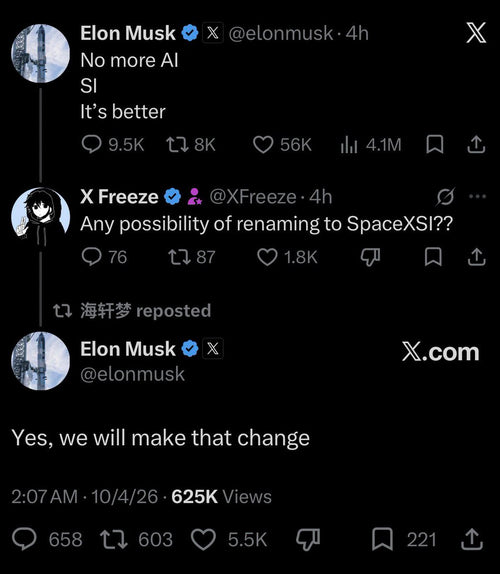
SpaceXAI dropped two meaningful updates on August 21: Grok 4.6 is now available through Google Cloud's Vertex AI platform, and Grok Bot — the autonomous AI agent launched in beta just ten days ago — has expanded to more subscription plans with a free trial for everyone else. Here's what you need to know about both.

What exactly is Grok 4.6?
Grok 4.6 is SpaceXAI's latest flagship model, released on August 12, 2026, and now officially available on Google Cloud Vertex AI as of today. It's built for coding, visual web tasks, and long-running agent workflows — the kind of multi-step jobs that require a model to stay coherent across a large context. According to x.ai, it carries a 500,000-token context window, accepts both text and image inputs, and supports function calling and structured outputs.
Why does the Vertex AI listing matter?
Vertex AI is Google Cloud's managed ML platform — the place enterprise developers already go to deploy and run models at scale. Landing there means Grok 4.6 is now accessible to teams that have built their infrastructure on Google Cloud without requiring them to integrate a separate API or switch providers. It puts Grok 4.6 directly alongside other frontier models in an environment enterprises already trust for compliance, billing, and deployment tooling. According to background research, pricing starts at $2 per million input tokens and $6 per million output tokens.

What is Grok Bot and how is it different from Grok the chatbot?
Grok Bot is an AI agent that runs on its own cloud computer. Rather than answering questions in a chat window, it can sign into applications, browse the web, and execute multi-step tasks autonomously — closer to a digital worker than a conversational assistant. It launched in beta on August 11, 2026, initially limited to macOS on Apple Silicon. As of today, Windows and Linux desktop versions are also available, with an Android release planned for the future.
Who can access Grok Bot now?
Access has expanded significantly. According to x.ai, Grok Bot is now included with SuperGrok Plus, Cursor Pro+, and all Cursor Teams plans (both Standard and Premium tiers). It's also available through Cursor Ultra at $200/month for individuals, Cursor Premium Teams at $120 per seat per month, and SuperGrok Heavy at $300/month. For everyone outside those plans, there's now a 7-day free trial with limited usage — a credit card is required to activate it, but you won't be charged unless you choose to start a paid subscription.
Is there a usage cap on Grok Bot?
Subscriptions include a weekly usage allowance. Once that's exhausted, additional usage is billed based on model and token costs. According to background research, there is currently no specific spend cap in place for Grok Bot usage beyond the weekly allowance — something worth keeping in mind before running long autonomous tasks.
What does any of this mean for Tesla owners specifically?
Grok is already integrated into Tesla vehicles through the in-car voice assistant on newer models, so the underlying model quality matters for owners who use it daily. A more capable 4.6 model with a larger context window and stronger coding and visual reasoning could eventually translate to a more useful in-car assistant — particularly for complex, multi-step requests. The Vertex AI expansion and Grok Bot's broader availability also signal that SpaceXAI is moving quickly to establish Grok as an enterprise-grade platform, which tends to accelerate the pace of model improvements across the board.
Sources & reporting notes
The links below identify the material source records used for this report.
- @grok on X (2026-08-21T19:11:48.000Z) — Direct source
- @SpaceXAI on X (2026-08-21T19:36:10.000Z) — Direct source
Source links are preserved as published or accessed. See our editorial standards and corrections policy.
The BASENOR Editorial Desk covers Tesla, SpaceX, and related technology, curating reporting from primary sources — official accounts, regulatory filings, and software release data. Every article passes source-record and fact-checking review before publication. About the newsroom.
This report was curated by the BASENOR Editorial Desk from the sources listed above. Read our editorial standards or email editorial@basenor.com to report an error.