📌 UPDATE — July 15, 2026
xAI has open-sourced Grok Build and reset usage limits for all users, making the full codebase and CLI Git repository publicly available. Alongside the release, xAI clarified in response to user privacy questions that Grok Build has always fully respected Zero Data Retention (ZDR) since launch — and that the ability to disable data upload in the CLI was available to all users from the start, not just enterprise tiers. Elon Musk separately confirmed the open-source release on X. The open-sourcing means the community can now independently audit and contribute to the privacy and reliability of the harness.


📌 UPDATE — July 13, 2026
Elon Musk directly addressed concerns about SpaceXAI's zero data retention fine print on X today, confirming that all user data uploaded to SpaceXAI prior to this clarification will be completely deleted — "zero anything whatsoever will remain." He acknowledged the policy language raised legitimate questions and framed the deletion as a precautionary measure. Musk also noted that retaining some data is genuinely useful for debugging, and said he would appreciate users allowing it, while stressing that privacy settings are always respected regardless.


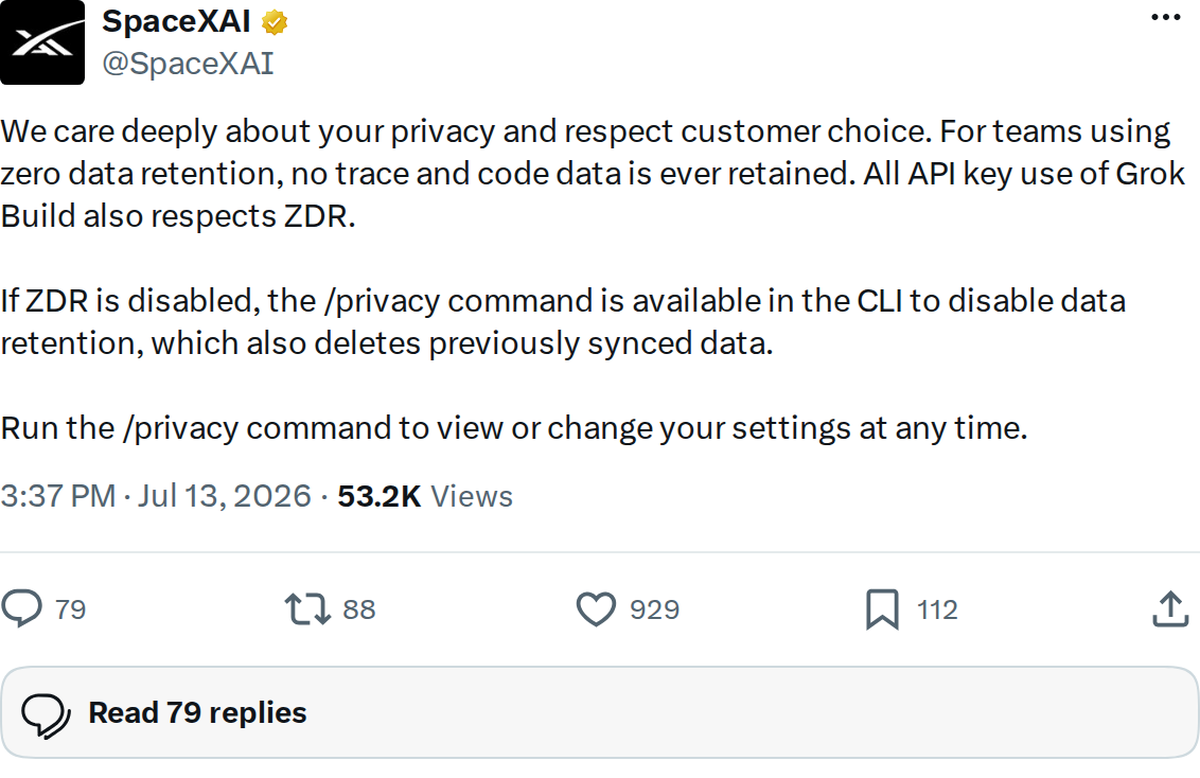
xAI has clarified how Grok Build handles your data — and the answer depends heavily on whether you're an enterprise team, an API user, or an individual subscriber. The announcement, posted by the official @SpaceXAI account, outlines three distinct privacy tiers. Here's what each one means in practice.

What is Zero Data Retention in Grok Build?
Zero Data Retention (ZDR) is an enterprise-level feature that instructs xAI's infrastructure to process API requests and responses entirely in real-time — without writing any of that data to storage. According to xAI's official documentation, this means no trace data, no code snippets, and no session logs are ever persisted on xAI's servers. When ZDR is active, API responses include an x-zero-data-retention header you can verify programmatically.
Who qualifies for Zero Data Retention?
ZDR is currently an enterprise-only feature. Individual SuperGrok or X Premium Plus subscribers do not get it automatically. Enterprise teams need to contact sales@x.ai to have ZDR enabled for their organization. Once it's active at the team level, it applies across all members — there's no per-user toggle required.
Does ZDR cover all Grok Build usage, including API keys?
Yes. According to the @SpaceXAI announcement, all API key usage of Grok Build respects ZDR when it is enabled for a team. This is a meaningful guarantee for developers building on top of Grok Build programmatically — it means the same no-retention policy that covers interactive sessions also covers automated or programmatic requests made with API keys under that team account.
What if my team doesn't have ZDR enabled — am I out of options?
Not entirely. xAI has made a /privacy command available in the Grok Build CLI specifically for this scenario. Running it disables data retention at the session level even without enterprise ZDR. It's worth noting this is a narrower protection than full ZDR — it operates at the CLI layer rather than at the infrastructure level — but it gives individual users a meaningful opt-out without needing an enterprise contract.
What does Grok Build's privacy mode actually do beyond ZDR?
Grok Build's CLI privacy mode goes further than just data retention. According to xAI's documentation, it isolates your session under a private GROK_HOME directory, disables telemetry and feedback collection, and prevents codebase uploads to remote servers. For developers who want a hard block on whole-repository uploads specifically, setting disable_codebase_upload = true in ~/.grok/config.toml acts as a persistent veto regardless of session settings.
When did Grok Build launch, and what model does it run on?
Grok Build launched in early beta on May 25, 2026, available to SuperGrok and X Premium Plus subscribers. It runs on the grok-4.5 model under the hood — the same model accessible directly through the xAI API. After May 15, 2026, requests routed to the grok-code-fast-1 model were redirected to grok-build-0.1, consolidating the coding-focused model lineup.
The layered approach here — enterprise ZDR, API key coverage, and a CLI fallback command — suggests xAI is trying to serve meaningfully different audiences with one product. Whether the /privacy CLI command offers sufficient protection for non-enterprise teams handling sensitive codebases is a question worth asking your security team before committing production workloads to Grok Build.
Sources & reporting notes
The links below identify the material source records used for this report.
- @SpaceXAI on X (2026-07-13T15:37:06.000Z) — Direct source
- @elonmusk on X (2026-07-13T18:45:00.000Z) — Direct source
- @elonmusk on X (2026-07-13T18:38:16.000Z) — Direct source
- @elonmusk on X (2026-07-13T18:35:27.000Z) — Direct source
- @elonmusk on X (2026-07-15T20:48:52.000Z) — Direct source
- @SpaceXAI on X (2026-07-15T20:44:29.000Z) — Direct source
- @SpaceXAI on X (2026-07-15T20:44:30.000Z) — Direct source
Source links are preserved as published or accessed. See our editorial standards and corrections policy.
The BASENOR Editorial Desk covers Tesla, SpaceX, and related technology, curating reporting from primary sources — official accounts, regulatory filings, and software release data. Every article passes source-record and fact-checking review before publication. About the newsroom.
This report was curated by the BASENOR Editorial Desk from the sources listed above. Read our editorial standards or email editorial@basenor.com to report an error.