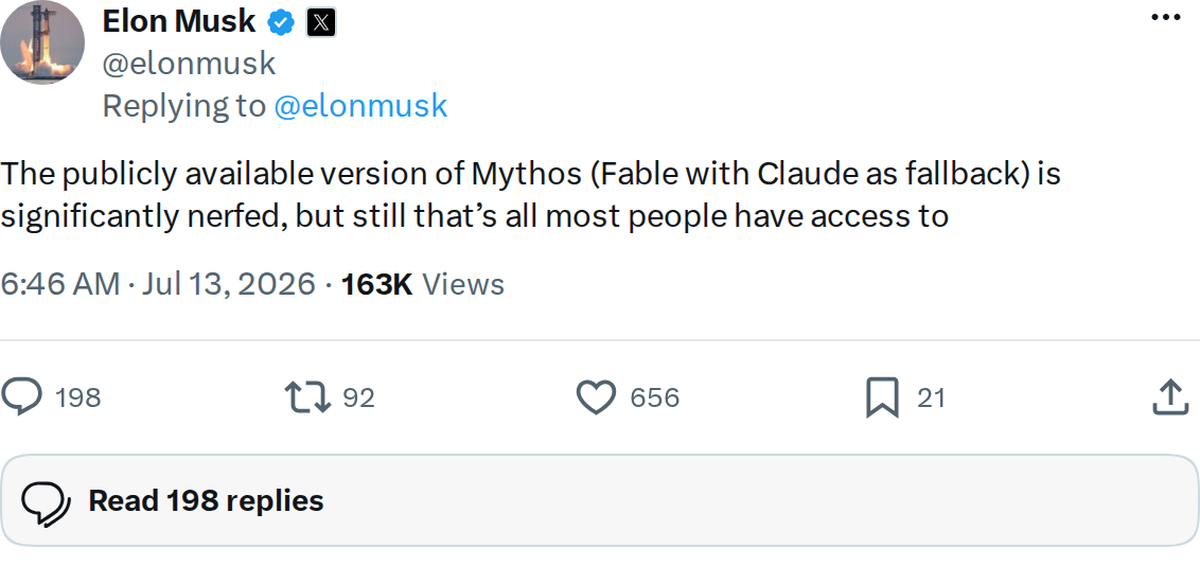
Elon Musk dropped a candid admission on Sunday: the version of Mythos that most people can actually access is a significantly restricted build compared to what exists internally. It's a rare moment of public transparency about the gap between frontier AI capabilities and what gets released to the general public — and it raises real questions about where AI development is heading.

1. What Musk Actually Said
In a brief but pointed post, Musk stated that the publicly available version of Mythos — which runs on Fable with Claude as a fallback — is "significantly nerfed" relative to its internal counterparts. He acknowledged that for most users, this restricted build is the only option available. It wasn't a complaint directed at Anthropic; if anything, it read as a straightforward explanation of why the public experience differs from what researchers and partners see behind closed doors.
2. The Two-Tier Model Structure
According to background research, Anthropic launched Claude Mythos 5 and Claude Fable 5 in June 2026. The public-facing layer is Fable 5, which operates with built-in safety classifiers that limit its output in sensitive domains — particularly cybersecurity and biology. When those classifiers flag a request, the system can automatically reroute to Claude Opus 4.8, a less capable model. Anthropic says these classifiers fire on fewer than 5% of sessions on average, but the performance ceiling is still lower than what Mythos 5 itself can do.
3. Who Actually Gets Mythos 5
The unrestricted Mythos 5 is not publicly available. Access is currently limited to cybersecurity partners and a select group of biology researchers operating under Anthropic's Project Glasswing program, along with approximately 100 vetted U.S. organizations and government agencies, according to available reporting. For everyone else — developers, businesses, individual users — Fable 5 with its safety guardrails is the ceiling. Musk's comment confirms that gap is meaningful, not cosmetic.
4. The SpaceX Infrastructure Angle
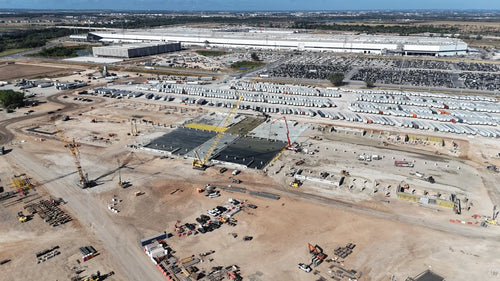
What makes this story more layered is the infrastructure relationship sitting underneath it. Anthropic has an agreement to lease the full capacity of SpaceX's Colossus 1 supercomputing facility in Memphis, reportedly paying around $1.25 billion per month through May 2029. Musk has publicly pledged not to cut off Anthropic's access to that compute. That's a significant commitment given that Musk has also been publicly praising Anthropic's models — calling it the "leader in AI" and saying "no company has released a model as good as Mythos/Fable" — while simultaneously noting the public version is substantially limited.
5. What the Public-vs-Internal Gap Tells Us
The divide between what AI labs deploy internally and what they release publicly is becoming one of the defining tensions in the industry. Safety classifiers, export control directives (Fable 5 was briefly suspended globally on June 12 before access was restored July 1 following a U.S. export control directive), and restricted access programs all create a layered system where capability and access don't move together. Musk's comment is notable precisely because it names the gap plainly rather than obscuring it. Whether that gap narrows — and how quickly — is the question that will shape how useful these tools actually become for the majority of users.
Sources & reporting notes
The links below identify the material source records used for this report.
- @elonmusk on X (2026-07-13T06:46:54.000Z) — Direct source
Source links are preserved as published or accessed. See our editorial standards and corrections policy.
The BASENOR Editorial Desk covers Tesla, SpaceX, and related technology, curating reporting from primary sources — official accounts, regulatory filings, and software release data. Every article passes source-record and fact-checking review before publication. About the newsroom.
This report was curated by the BASENOR Editorial Desk from the sources listed above. Read our editorial standards or email editorial@basenor.com to report an error.