xAI launched Grok Voice 3.0 on Tuesday, pitching it as the world's most intelligent speech-to-speech model and immediately plugging it into two of Elon Musk's largest consumer-facing operations: Starlink customer support and in-car voice inside Tesla vehicles. The model is live today in the Voice Agent API at $0.08 per minute, with sub-second response latency and a 40% latency reduction versus the previous generation.
The announcement, posted by the SpaceX Super Intelligence account, is as much a product launch as it is a confession about how much of Musk's empire is already running on voice AI behind the scenes — including, crucially, inside the car in your driveway.

What xAI Actually Shipped
Grok Voice 3.0 is a frontier speech-to-speech model, meaning audio goes in and audio comes out without an intermediate text-generation hop. That architecture is what makes the sub-second response time possible and gives the agent room to handle interruptions, overlapping speech, and tone shifts the way a human call-center rep would.
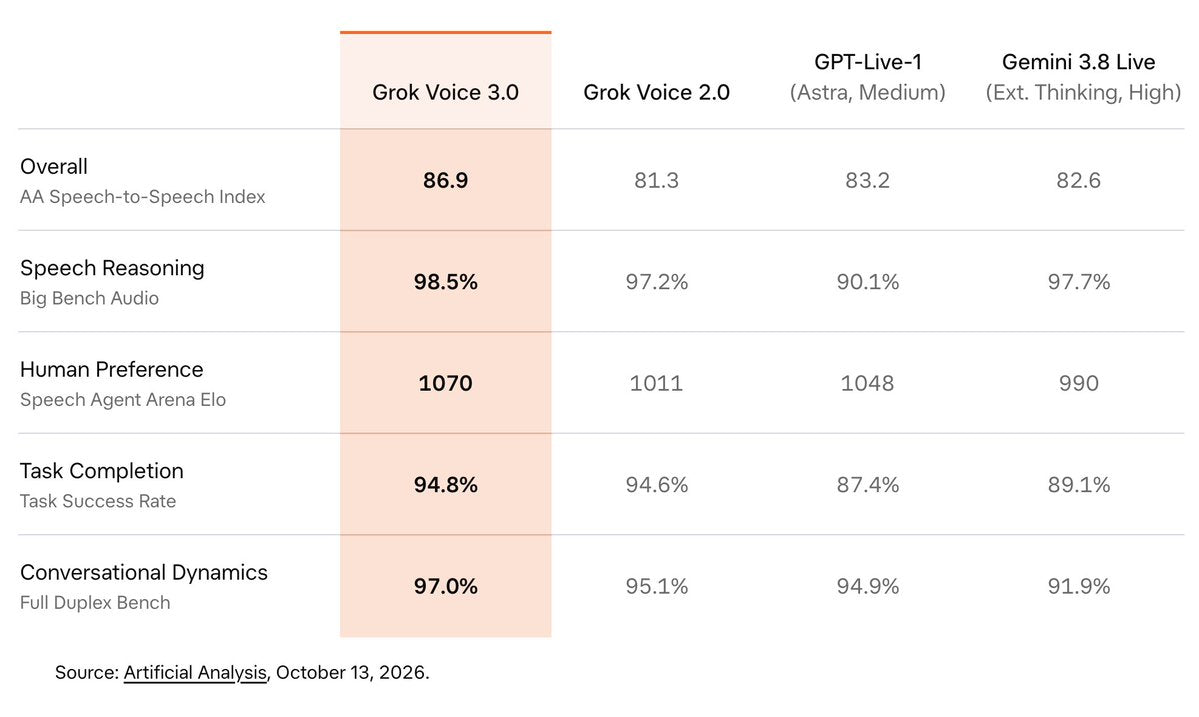
According to independent benchmarking from Artificial Analysis dated October 13, 2026, Grok Voice 3.0 ranks #1 on the Speech-to-Speech Index with a score of 86.9. It also posted 97% on the Full Duplex Bench — the test for how naturally a model handles two-way conversation — and 71.6% on τ-Voice, which measures robustness across accents and background noise. On ServiceNow's EVA-Bench for enterprise voice agents, it hit 74% accuracy, the highest of any model tested.
Pricing is unchanged from Grok Voice 2.0: $0.08 per minute, or roughly $4.80 per hour of conversation. xAI confirmed that any developer already using the grok-voice-latest endpoint was automatically migrated to 3.0 — no code changes, no new SKU.
Key Figures
| Metric | Value |
|---|---|
| API price | $0.08 / minute |
| Response latency | Under 1 second (40% lower vs. prior gen) |
| Speech-to-Speech Index score | 86.9 (ranked #1, per Artificial Analysis) |
| Full Duplex Bench | 97% |
| EVA-Bench accuracy | 74% (highest tested) |
| Starlink calls handled daily | ~20,000 |
| Starlink calls resolved without a human | ~70% |
The Starlink Proof Point
The number that will dominate every write-up of this launch is Starlink's: 20,000 customer calls per day, with roughly 70% resolved end-to-end without a human agent ever picking up. SpaceX also disclosed that one in four sales calls routed through Grok Voice ends with a purchase before the caller hangs up.

According to SpaceX, the agent can verify customers, troubleshoot hardware, issue account credits, and even ship replacement equipment — the full span of what a tier-one and tier-two human support team typically does. For a satellite internet provider that has to serve customers in dozens of countries and languages, that's a non-trivial operational unlock.
What This Means Inside Your Tesla
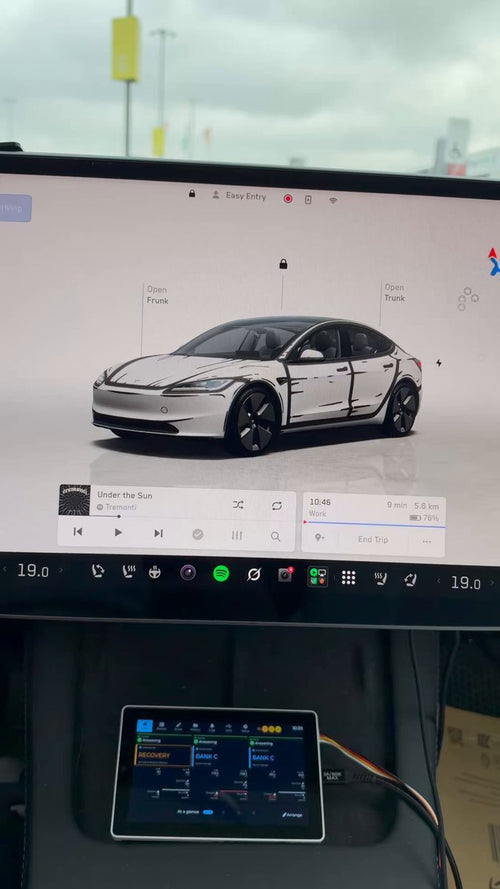
The line that should matter most to Tesla owners was buried at the end of Sawyer Merritt's thread: Grok Voice 3.0 is already handling millions of daily conversations inside Tesla vehicles.

In practical terms, that means the voice assistant in current Tesla software — the one owners use to check calendars, send messages, adjust climate, or ask Grok Bot to order coffee or book dinner — is running on the same underlying model that just topped the industry benchmarks. According to xAI's own description, drivers interact with the system through two surfaces: Connectors for routine productivity tasks and Grok Bot for open-ended requests, both fully hands-free.
Grok has also been wired into core vehicle control — climate settings, UI adjustments, and configuration changes — which is a meaningful shift from the fixed-command voice systems most legacy automakers still ship. Musk has previously confirmed plans to eventually let drivers invoke Full Self-Driving behaviors by voice, though that integration has not yet rolled out broadly.
For owners, the upgrade to 3.0 is likely to show up as faster, more conversational responses rather than a new named feature in release notes. The 40% latency improvement is the kind of change you feel — fewer awkward pauses after you finish speaking — rather than something that appears as a bullet point in an OTA.
The Strategic Picture
Tuesday's launch is a tidy illustration of the vertical integration Musk has been building toward: xAI builds the model, SpaceX uses it to run Starlink support at scale, Tesla deploys it as the in-car assistant, and the API gets sold to outside developers at a competitive per-minute rate. Each deployment generates conversation data that, in principle, feeds back into model improvements.
It also lands at an interesting moment for the voice-AI category. OpenAI, Google, and a handful of startups have all shipped frontier voice models in the past year, but few have been able to point to a live customer-facing deployment of this scale. SpaceX's 20,000-calls-per-day disclosure is the kind of operational evidence that tends to carry more weight with enterprise buyers than benchmark scores alone.
What to Watch Next
Three things are worth tracking from here. First, whether xAI publishes a safety and reliability report for the Tesla in-car deployment — handling millions of conversations in a moving vehicle is a materially different risk surface than a call center. Second, whether the promised voice-controlled FSD invocation actually ships, and in which software version. Third, whether third-party developers using the Voice Agent API start producing competitive customer-support products at the $0.08/minute price point, which would validate the economics SpaceX is claiming internally.
For now, the headline for Tesla owners is simpler: the voice assistant you've been talking to just got a quiet but significant upgrade, and it's the same model answering the phone when a Starlink customer calls support.
Related Gear
Gear up your Tesla with tested, custom-fit BASENOR accessories — shop Tesla accessories →
Sources & reporting notes
The links below identify the material source records used for this report.
- @SpaceXSI on X (2026-10-14T17:04:57.000Z) — Direct source
- @SpaceXSI on X (2026-10-14T17:04:57.000Z) — Direct source
- @SpaceXSI on X (2026-10-14T17:04:58.000Z) — Direct source
- @SawyerMerritt on X (2026-10-14T17:08:32.000Z) — Direct source
- @SawyerMerritt on X (2026-10-14T17:11:54.000Z) — Direct source
Source links are preserved as published or accessed. See our editorial standards and corrections policy.
The BASENOR Editorial Desk covers Tesla, SpaceX, and related technology, curating reporting from primary sources — official accounts, regulatory filings, and software release data. Every article passes source-record and fact-checking review before publication. About the newsroom.
This report was curated by the BASENOR Editorial Desk from the sources listed above. Read our editorial standards or email editorial@basenor.com to report an error.