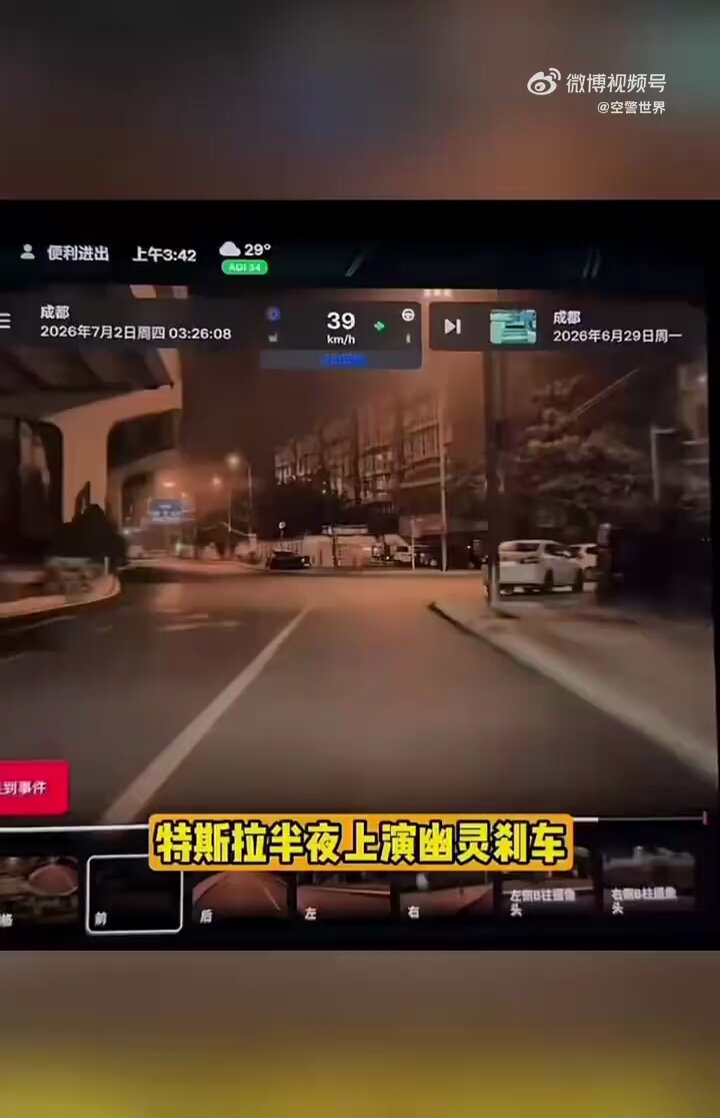
A Tesla owner in China recently noticed something strange: their car braked for no visible reason — then, a second later, a pedestrian stepped out from behind a parked vehicle. The system hadn't malfunctioned. It had predicted the crossing before it happened. Here's what's actually going on under the hood.

What is a 'shadow brake' and why did the driver think something was wrong?
A shadow brake is when the car decelerates noticeably without an obvious hazard in view. In this case, the owner saw no pedestrian, no obstacle, no traffic signal — just open road ahead. The natural reaction is to assume a glitch. What actually happened is that Tesla's FSD system had already flagged a high-probability crossing event based on indirect cues, and initiated a precautionary slowdown. The pedestrian materialized into view moments later, validating the brake entirely.
How does FSD detect a pedestrian it can't directly see?
The system doesn't need a clear line of sight to act. According to verified technical documentation, FSD processes over one million pixels of visual data every millisecond across eight external cameras. The end-to-end neural network — introduced with FSD V12 and refined through V13 and V14 — doesn't just classify what's visible; it builds a probabilistic model of what's likely to happen next. In this scenario, the parked vehicle on the right created a visual occlusion, but contextual signals — the geometry of the gap, foot traffic patterns at that location type, the speed and angle of partially visible movement — fed into a prediction that a pedestrian was about to cross. The system created what researchers describe as a time buffer of approximately 15 seconds of anticipatory processing, enough to act before the hazard became undeniable.
Is this specific to the China version of FSD?
The underlying architecture is the same globally, but the China deployment has its own context. Tesla officially confirmed FSD (Supervised) availability in China on May 21, 2026. The system is locally branded as Tesla Assisted Driving (TAD) — a name change Tesla made in late May 2026 to align with Chinese regulatory language. The owner's manual was updated to version 2026.14 in early May, covering FSD V14's full feature set. As of now, TAD is classified as a Level 2 driver assistance system under Chinese regulations, meaning the driver must remain attentive and in control at all times.
What makes FSD V14 better at pedestrian prediction than earlier versions?
Two upgrades stand out. First, the Transformer-based temporal processing layer introduced in V12 and expanded in subsequent versions allows the system to analyze historical trajectory data — not just a snapshot of the current frame, but a rolling window of how objects have been moving. This is how it infers intent rather than just position. Second, FSD V14.2.1 introduced an upgraded skeleton tracking model that maps 18 human body joints, enabling the system to read unstructured social cues like body orientation, weight shift, and even traffic police hand signals. A pedestrian leaning toward the road while partially hidden behind a car produces a detectable postural signature — one the system can act on before the person steps off the curb.
Should owners trust this behavior, or override it?
The system's proactive approach to pedestrians has drawn attention precisely because it errs on the side of caution — reviewers have described it as 'almost too polite' in mixed traffic with scooters and pedestrians. That said, TAD in China remains an L2 system requiring active supervision. If you're in the driver's seat and FSD initiates a shadow brake, the right response is to scan the environment quickly rather than assume an error. In this case, the owner's instinct to question the brake was reasonable — but the system was right. The more useful habit is to treat unexplained braking as a prompt to look harder, not a reason to override.
When will this be available to all Tesla owners in China?
A full nationwide rollout is still pending comprehensive regulatory approval. During Tesla's Q1 2026 earnings call on April 23, 2026, CFO Vaibhav Taneja stated the company is targeting Q3 2026 for that milestone — though this represents a delay from earlier projections. For owners who want access now, the one-time purchase price for Tesla Assisted Driving in China is 64,000 yuan (approximately $9,400 USD). A monthly subscription option has not yet been introduced for the Chinese market.
The pedestrian anticipation clip from China is a clean illustration of what separates a mature neural network from a rule-based ADAS system. Rules respond to what's there. Predictions act on what's coming. Whether Tesla hits its Q3 regulatory target or not, the underlying capability is already on the road — and quietly doing its job.
Related Gear
Gear up your Tesla with tested, custom-fit BASENOR accessories — shop Tesla accessories →
Sources & reporting notes
The links below identify the material source records used for this report.
- @ray4tesla on X (2026-08-19T19:53:16.000Z) — Direct source
Source links are preserved as published or accessed. See our editorial standards and corrections policy.
The BASENOR Editorial Desk covers Tesla, SpaceX, and related technology, curating reporting from primary sources — official accounts, regulatory filings, and software release data. Every article passes source-record and fact-checking review before publication. About the newsroom.
This report was curated by the BASENOR Editorial Desk from the sources listed above. Read our editorial standards or email editorial@basenor.com to report an error.