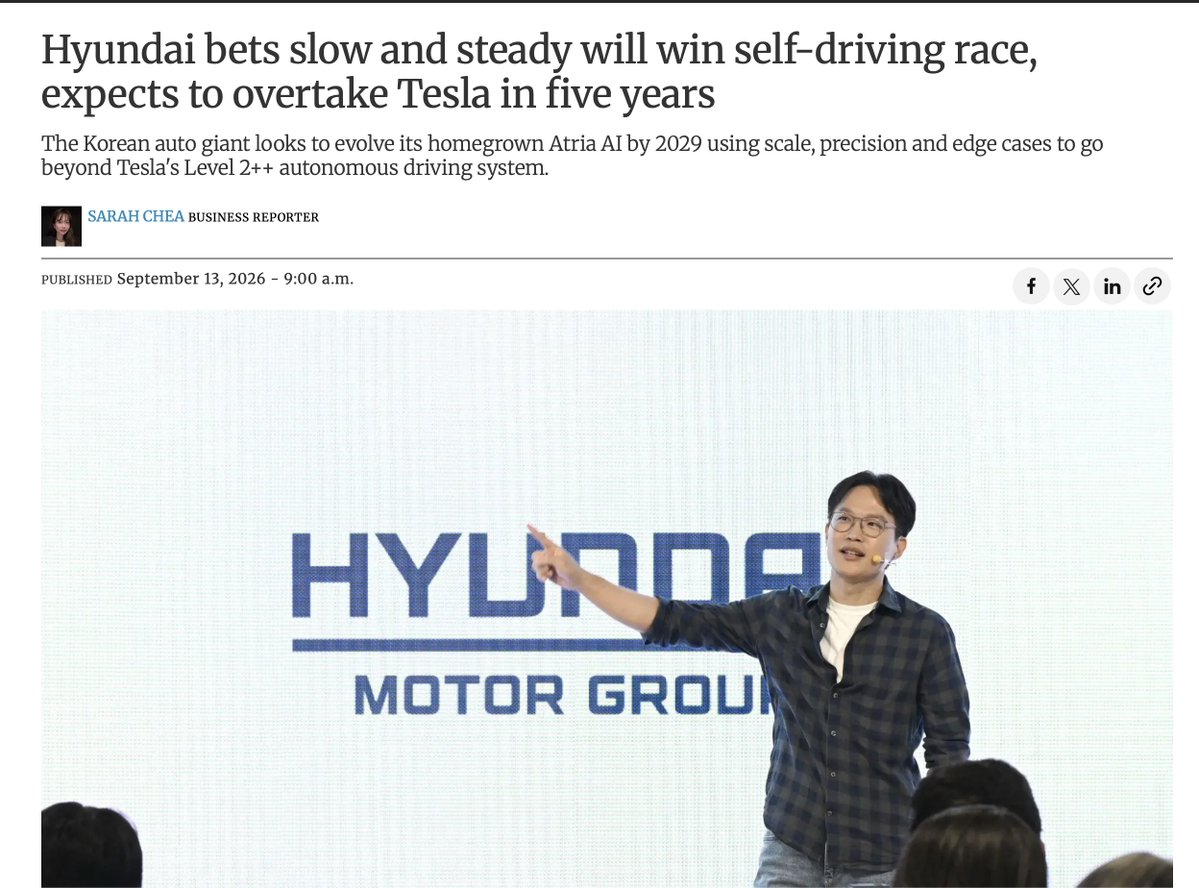
Hyundai Motor Group has made a striking admission: it is intentionally delaying its autonomous driving rollout. The bet is that a slower, data-heavy approach will let its in-house Atria AI system overtake Tesla's Full Self-Driving within five years. Here's what the strategy actually looks like — and what it means for anyone already driving FSD today.

What exactly is Hyundai delaying, and by how much?
According to reporting from multiple outlets including Korea JoongAng Daily and Hyundai's own press releases, the company pushed its in-house Atria AI autonomous driving system back by roughly two years — from a target of late 2027 to the second half of 2029. Before that, it plans to introduce Level 2+ ADAS in the first half of 2028 and Level 2++ in the second half of 2028, the latter being roughly equivalent to what Tesla's FSD does today. The delay is described as deliberate, not a setback — Hyundai wants more real-world data before it deploys at scale.
What is the "Data Flywheel" and why does Hyundai think it works?
Hyundai's Atria AI is built around a concept the company calls the Data Flywheel: a continuous loop of real-world data collection, AI model training, validation, and redeployment. The logic is that each cycle makes the system meaningfully smarter. To feed that loop, Hyundai is deploying over 200 autonomous test vehicles in Gwangju, South Korea, in the second half of 2026, expanding from roughly 40 dedicated round-the-clock data collection vehicles currently active. The company expects to surpass competitors in accumulated driving data by 2033, according to its published roadmap.
How does Hyundai's data scale compare to Tesla's?
This is where Hyundai's argument gets interesting — and where it faces its steepest challenge. Hyundai Motor Group, including Kia, sells over 7 million vehicles annually across 190 markets. That is a large fleet in theory. In practice, however, Tesla has been collecting FSD shadow mode and active intervention data from its customer fleet for years, across millions of vehicles already on the road. Hyundai's 200 test vehicles in Gwangju represent a fraction of that real-world exposure. The gap is significant, and the company is essentially wagering that quality of data infrastructure — including a 100-megawatt AI data center being built in Saemangeum, South Korea, with over 50,000 GPUs, expected operational in 2029 — can compress that gap faster than Tesla can extend its lead.
Who is Hyundai partnering with, and does it matter?
Hyundai has an expanded strategic partnership with Nvidia, co-designing technology around Nvidia's Hyperion 10 platform. Initial vehicles will use cameras, ultrasonic sensors, and radar — no lidar at first. Hyundai is exploring lidar for Level 3 systems (hands-off driving under specific conditions), but has not committed to a commercialization timeline there. The Nvidia collaboration is meaningful: data collected from Hyperion 10-equipped production vehicles will feed directly into training Hyundai's proprietary Atria software, creating a pipeline from customer cars to model improvement that mirrors, in structure at least, what Tesla does with FSD telemetry.
Should Tesla owners take this timeline seriously?
Five-year competitive claims in autonomous driving are common and frequently miss. That said, Hyundai's approach is more grounded than most: it has specific milestones (Level 2+ in H1 2028, Atria AI vehicles in H2 2029), concrete infrastructure investments (the Saemangeum data center), and a named AI platform rather than a vague roadmap slide. The honest answer is that Tesla's FSD advantage is real and substantial today — years of fleet-scale data collection, continuous over-the-air improvement, and a head start on end-to-end neural network architecture. Whether Hyundai can close that gap by 2031 depends heavily on how quickly Atria AI scales beyond controlled test environments in South Korea and into the messy, varied driving conditions that make FSD genuinely hard to build. That question won't be answered for at least two more years.
Related Gear
Gear up your Tesla with tested, custom-fit BASENOR accessories — shop Tesla accessories →
Sources & reporting notes
The links below identify the material source records used for this report.
- @SawyerMerritt on X (2026-09-13T00:30:08.000Z) — Direct source
Source links are preserved as published or accessed. See our editorial standards and corrections policy.
The BASENOR Editorial Desk covers Tesla, SpaceX, and related technology, curating reporting from primary sources — official accounts, regulatory filings, and software release data. Every article passes source-record and fact-checking review before publication. About the newsroom.
This report was curated by the BASENOR Editorial Desk from the sources listed above. Read our editorial standards or email editorial@basenor.com to report an error.