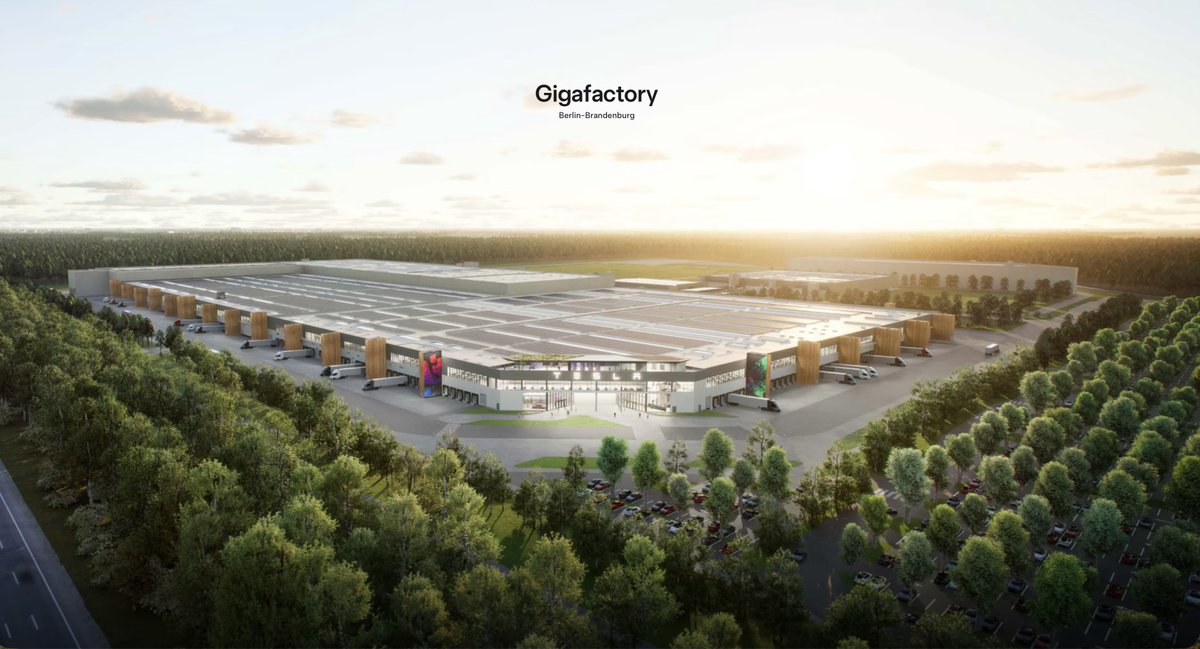
The News: German union IG Metall has failed to secure a majority in the works council election at Tesla's Giga Berlin plant.
Why It Matters: Without a union majority on the 37-seat works council, Tesla retains significant operational flexibility at its European manufacturing hub — keeping the door open for production expansion and faster decision-making.
Source: @SawyerMerritt on X
IG Metall Fails to Win Majority at Giga Berlin: Tesla's European Factory Stays on Its Own Terms
In a significant outcome for Tesla's European operations, German union IG Metall has officially failed to secure a majority vote in the works council election at Giga Berlin. The result leaves Tesla's Brandenburg factory with a non-union-majority council — the same dynamic that has defined the plant since its first election in 2024 — and, as one prominent Tesla watcher put it, means "Giga Berlin remains free to accelerate the future."

📊 Key Figures
| Metric | Value | Context |
|---|---|---|
| Works council seats (2026) | 37 | Down from 39 in 2024 |
| Majority threshold | 19 seats | IG Metall's stated target |
| IG Metall candidates fielded | 116 | Aggressive push for majority |
| IG Metall seats won in 2024 | 16 / 39 | ~39.4% of individual votes |
| Giga Berlin workforce | ~10,700 | Down from ~12,415 in 2024 |
| Election window | Mar 2–4, 2026 | Results confirmed March 4 |
What Happened — and Why IG Metall Fell Short
Voting at the Giga Berlin plant ran from Monday, March 2 through Wednesday, March 4, 2026. IG Metall — Germany's largest industrial union — put forward 116 candidates and needed to capture at least 19 of the 37 available works council seats to hold a simple majority. That majority would have given the union significant influence over working conditions, shift schedules, and operational decisions at Tesla's only European Gigafactory.
It didn't happen. The outcome mirrors the 2024 election, where IG Metall won just 16 of 39 seats despite pulling in roughly 39.4% of individual votes. Non-union workers and independent candidates dominated that council, and the 2026 result continues that trend.
The backdrop to this election was unusually contentious. Tesla and IG Metall had been locked in a public dispute over an alleged secret recording at a February 10 works council meeting — a matter serious enough that Tesla filed a criminal complaint against a union representative. The two sides agreed to a temporary truce on February 27, suspending public statements until voting closed. That truce has now expired with the results in.
🔭 The BASENOR Take
Timeline: Works council elections every 4 years — next vote expected 2030
Impact Level for Tesla Owners: 🟡 Medium — affects production capacity and vehicle delivery timelines from Europe
Confidence: High — result confirmed via primary source reporting
For Tesla owners, this result is most relevant through one lens: production. Giga Berlin is the source of Model Y vehicles for European customers, and its operational cadence directly affects delivery wait times and potential future model rollouts on the continent.
A union majority would not have shut the plant down, but it would have introduced a new layer of co-determination under German labor law. Works councils with union majorities can push harder on shift structures, overtime rules, and headcount decisions — all of which affect how quickly a factory can scale. Tesla's plant director André Thierig had openly stated that IG Metall's focus was on boosting its own membership, and Elon Musk had gone further, suggesting that plant expansion could be paused if "external organizations" pushed the company in the "wrong direction."
With the non-union bloc retaining control of the council, Tesla management keeps the flexibility it has relied on since the plant opened. Whether that translates into a visible acceleration — new models, higher weekly output, or faster ramp of new variants — remains to be seen. But the structural obstacle that a union majority would have represented is now off the table for another four years.
It's also worth noting the workforce context: Giga Berlin's headcount has dropped from approximately 12,415 employees during the 2024 election cycle to around 10,700 today. A smaller, potentially more selective workforce may have shifted the internal political calculus away from union representation. IG Metall will need to reckon with why its 116-candidate push still couldn't convert votes into seats.
📰 Deep Dive
The German works council system is unlike anything in North American labor law. Under the Betriebsverfassungsgesetz (Works Constitution Act), a works council is a legally mandated employee body with real co-determination rights — not just an advisory group. It must be consulted on everything from overtime to redundancies. A union-majority council doesn't mean a union contract, but it does mean union priorities shape the agenda. Tesla has operated without a collective bargaining agreement at Giga Berlin since the plant opened, and today's result makes that status quo more durable.
IG Metall's failure is also a data point in a broader story about union organizing at tech-adjacent manufacturers. The union has faced similar headwinds at other non-traditional employers in Germany, where younger, internationally diverse workforces don't always map onto classic industrial labor politics. Tesla's workforce at Giga Berlin skews younger and more international than a traditional German auto plant — a demographic that has historically been harder for established unions to mobilize.
The criminal complaint Tesla filed over the alleged recording at the February works council meeting remains active. That dispute — separate from the election itself — could still generate legal and reputational friction between Tesla and IG Metall in the months ahead. But with the election settled, the immediate flashpoint is gone, and both sides will likely recalibrate their strategies before the next round in 2030.
Related Gear
Gear up your Tesla with tested, custom-fit BASENOR accessories — shop Tesla accessories →
Sources & reporting notes
The links below identify the material source records used for this report.
- @SawyerMerritt on X (2026-03-04T20:49:29.000Z) — Direct source
Source links are preserved as published or accessed. See our editorial standards and corrections policy.
The BASENOR Editorial Desk covers Tesla, SpaceX, and related technology, curating reporting from primary sources — official accounts, regulatory filings, and software release data. Every article passes source-record and fact-checking review before publication. About the newsroom.
This report was curated by the BASENOR Editorial Desk from the sources listed above. Read our editorial standards or email editorial@basenor.com to report an error.