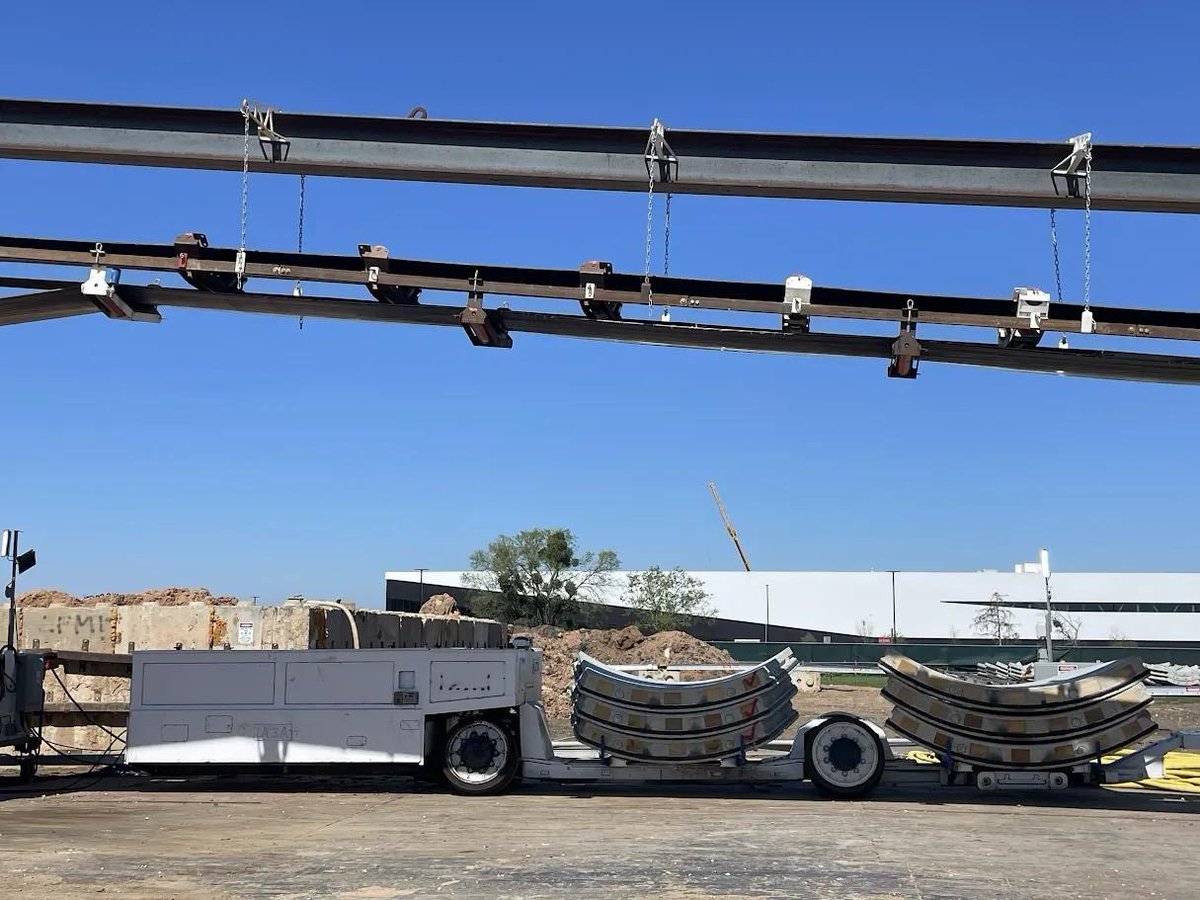
The Boring Company just pulled the curtain back on Liner Truck 3, its newest fully electric tunnel vehicle — and it's built around familiar Tesla hardware. The announcement, shared directly by the company on August 7, 2026, reveals a machine purpose-built for the brutal logistics of underground construction: moving heavy concrete tunnel segments to the boring machine without a single person in the tunnel.

1. It Runs on Tesla Model 3 Battery and Drive Units
The most immediately interesting detail for Tesla owners: Liner Truck 3 is powered by Tesla Model 3 battery packs and drive units. This isn't a coincidence — The Boring Company and Tesla share deep organizational ties, and reusing proven EV powertrain components in industrial equipment is a smart engineering shortcut. It means the drivetrain is already validated for real-world reliability, and servicing it draws on an existing supply chain rather than bespoke tunnel-vehicle parts.
2. It Hauls Over 22,000 Pounds of Concrete
Liner Truck 3's core job is moving the precast concrete segments that line the tunnel walls — the pieces that give a finished bore its structural integrity. Each run carries more than 22,000 lbs of those segments from the surface staging area to the boring machine at the tunnel face. That's roughly the weight of a loaded cement mixer, pushed through a confined underground passage. Getting that payload capacity out of a vehicle built on passenger-car battery architecture is a notable engineering achievement.
3. The 28-Mile Range Is Designed for the Job, Not the Highway
At first glance, 28 miles sounds modest for an EV. In context, it's exactly what the application demands. Tunnel liner trucks don't commute — they run repetitive short loops between the surface and the boring machine face, which is rarely more than a mile or two deep at any given project stage. A 28-mile range means multiple full round-trips per charge cycle without interrupting the construction rhythm. Over-engineering range here would just add unnecessary weight and cost.
4. Top Speed Is 12 mph — Intentionally
Liner Truck 3 is capped at 12 mph maximum operating speed. Underground construction environments have tight clearances, workers on foot, and no margin for error. A lower speed ceiling isn't a limitation — it's a safety specification. It also aligns with the vehicle's ZPIT (Zero-People-In-Tunnel) operating philosophy: when the truck is moving autonomously or under remote control, predictable, low-speed behavior reduces risk and makes the system easier to supervise from a distance.
5. It's Remotely Piloted from Texas
Perhaps the most forward-looking detail: Liner Truck 3 is operated remotely from The Boring Company's Global Operations Control Center (OCC) in Texas. That means the vehicle can be monitored and piloted without anyone physically present in the tunnel — a direct extension of the ZPIT strategy the company has been developing. According to background information on The Boring Company's operations, an upgraded ZPIT liner truck was previously tested in Bastrop, Texas, suggesting this remote-operations infrastructure has been in development for some time. Liner Truck 3 appears to be the production-ready result of that work.
Taken together, Liner Truck 3 is a concrete example — literally — of how Tesla's vehicle technology is migrating into industrial applications beyond passenger cars. The Model 3 powertrain doing duty underground in a 22,000-lb construction vehicle is a different kind of proof point for that hardware's versatility. Whether this approach scales to other heavy equipment categories is the more interesting question to watch going forward.
Related Gear
Gear up your Tesla with tested, custom-fit BASENOR accessories — shop Tesla accessories →
Sources & reporting notes
The links below identify the material source records used for this report.
- @boringcompany on X (2026-08-07T17:45:31.000Z) — Direct source
Source links are preserved as published or accessed. See our editorial standards and corrections policy.
The BASENOR Editorial Desk covers Tesla, SpaceX, and related technology, curating reporting from primary sources — official accounts, regulatory filings, and software release data. Every article passes source-record and fact-checking review before publication. About the newsroom.
This report was curated by the BASENOR Editorial Desk from the sources listed above. Read our editorial standards or email editorial@basenor.com to report an error.