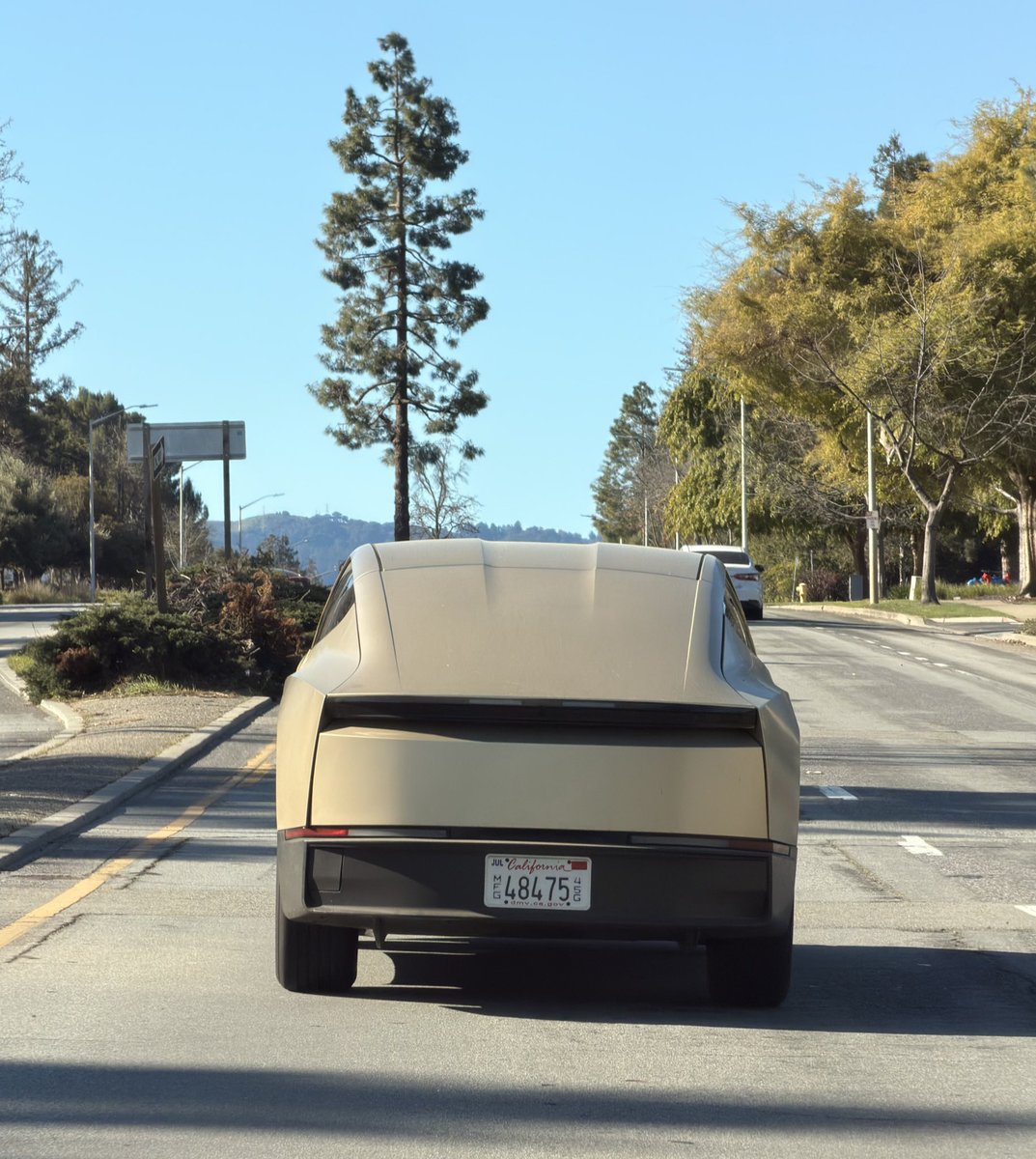
The News: A Tesla Cybercab prototype has been spotted testing on public roads in California, notably without traditional side mirrors.
Why It Matters: The mirrorless design confirms Tesla is advancing its camera-only vision system for the Cybercab — a key step toward the autonomous robotaxi it has promised.
Source: @TeslaNewswire on X

No Mirrors. No Driver. That's the Point.
A Tesla Cybercab prototype has been photographed on California public roads — and the detail that stands out immediately is what's missing: side mirrors. The vehicle is running with integrated cameras in place of traditional mirrors, a design choice that signals Tesla is serious about building the Cybercab from the ground up as an autonomous-first platform, not a retrofitted passenger car.
California is a logical testing ground. The state has some of the most permissive autonomous vehicle testing regulations in the U.S., and Tesla already operates a significant portion of its real-world FSD data collection there. Spotting the Cybercab on public roads — rather than a closed track — suggests Tesla is pushing the prototype through real-world validation at pace.
📊 Key Figures
| Detail | What We Know |
|---|---|
| Mirror Configuration | No side mirrors — camera-based system |
| Testing Location | California public roads |
| Vehicle Stage | Prototype — active road testing |
| Drive Configuration | Designed as autonomous-only (no steering wheel) |
Why Mirrorless Is a Big Deal
Removing side mirrors isn't just an aesthetic choice — it's a regulatory and engineering statement. In most U.S. states, mirrors are legally required on road vehicles. The fact that this Cybercab prototype is operating on public California roads without them suggests Tesla has obtained the necessary testing exemptions from regulators, which is a non-trivial milestone in the approval process.
From an engineering standpoint, replacing mirrors with cameras reduces drag, eliminates blind spots, and feeds directly into Tesla's Vision-only autonomy stack. The Cybercab doesn't have a driver to glance at a mirror — it needs machine vision to cover every angle, all the time. Seeing this design confirmed on a public prototype (not just a reveal-event showcar) tells us this isn't vaporware. Tesla is building the production architecture into its test fleet.
🔭 The BASENOR Take
Timeline: Active prototype testing on public roads in early 2026
Impact Level: 🟡 Medium-High — Confirms development progress; production timeline still unconfirmed
Confidence: High — Photographic evidence from California public roads
Tesla revealed the Cybercab concept at its "We, Robot" event in October 2024, promising a sub-$30,000 autonomous robotaxi with no steering wheel and no pedals. The gap between a polished reveal car and a road-legal production vehicle is where most ambitious EV projects have stumbled. Sightings like this one — a prototype that's clearly been adapted for real-world regulatory testing, not just press photos — are the kind of evidence that separates genuine progress from marketing theater.
The mirrorless confirmation also has implications for Tesla's existing fleet. If Tesla secures federal and state approval for camera-only mirror replacement on the Cybercab, it opens a regulatory pathway that could eventually benefit Cybertruck and future Model refreshes. Several other automakers have pursued similar exemptions with mixed results — Tesla getting this approved for the Cybercab would be a meaningful precedent.
For Tesla owners watching the self-driving space: this sighting doesn't change your FSD experience today, but it does reinforce that Tesla's autonomy roadmap is moving forward in hardware, not just software. The Cybercab is being built to be autonomous from the chassis up — and that design philosophy is expected to influence how Tesla thinks about FSD integration across its entire lineup going forward.
📰 Deep Dive
What makes this California sighting particularly notable is the combination of factors: public road operation, regulatory-exemption-level hardware (no mirrors), and the prototype stage of the vehicle. Tesla typically keeps its most advanced prototypes off public roads until it has a degree of regulatory confidence. The Cybercab being on public streets in this configuration suggests Tesla's conversations with the California DMV and NHTSA are progressing beyond the exploratory phase.
The camera-for-mirrors approach is also technically coherent with everything Tesla has built toward. Its Vision system — already running without radar on the current fleet — is designed to process multiple camera feeds simultaneously. Replacing mirrors with cameras doesn't add complexity to that system; it extends a capability Tesla has already validated at scale across millions of vehicles. The Cybercab is, in many ways, the purest expression of the Vision-only bet Tesla made years ago.
One open question is timeline. Tesla has indicated Cybercab production is targeted to begin in 2026, with initial robotaxi service expected to follow. Public prototype sightings at this stage of the year are consistent with that schedule — but consistent with it being ambitious, not guaranteed. Watch for California AV permit filings and NHTSA exemption requests as the cleaner signal of where production readiness actually stands.

Marcus covers Tesla's software releases, FSD rollouts, and OTA changes. Background in automotive engineering. Based in Austin.
Sources verified at publish time. Spotted an inaccuracy? Email editorial@basenor.com.