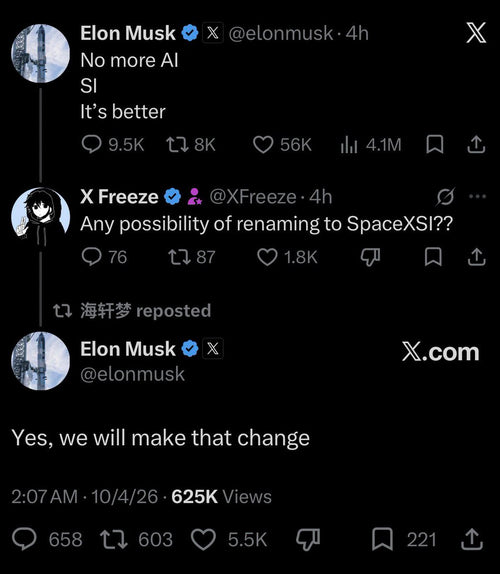
Elon Musk posted a single sentence on Monday that reframes the entire AI energy conversation. Harnessing just one-millionth of the Sun's output for artificial intelligence, he wrote, would produce intelligence more than a million times greater than all of humanity combined. It's a number so large it's almost meaningless — until you look at what Musk is actually building toward.

The Vision Behind the Math
The tweet isn't idle philosophy. It maps directly onto a concrete infrastructure strategy that Musk has been assembling across SpaceX, xAI, and Tesla. In February 2026, SpaceX acquired xAI in a deal that valued the combined entity at an estimated $1.25–1.5 trillion. The stated goal: build AI satellites that function as solar-powered orbital data centers, removing the single biggest bottleneck in AI scaling — energy access.
Musk has said publicly that within two to three years, space will become the lowest-cost location for AI compute, precisely because solar power in orbit is uninterrupted and essentially unlimited. He has outlined plans to use Starship to deploy 100 gigawatts worth of servers into orbit, with a longer-term target of terawatt-scale deployment. The mechanism: launch one million tons of satellites per year, each generating 100 kilowatts of compute power per ton.
On the ground, xAI's Colossus supercomputer in Memphis launched in September 2024 with 100,000 Nvidia H100 GPUs drawing roughly 150 megawatts. Plans call for expanding that to one million Nvidia Blackwell GPUs — a build-out that would require 2 gigawatts of power. That's the terrestrial stepping stone. The orbital vision is orders of magnitude larger.
Where Tesla Fits
Tesla's role in this architecture is supply-side. The company has set a target of 100 gigawatts per year of solar cell production, positioning it as a critical manufacturer in the energy infrastructure that would feed both ground-based and eventually space-based AI compute. If "all energy generation will be solar" — Musk's own framing — then Tesla's solar manufacturing ambitions stop being a side business and start looking like load-bearing infrastructure for the entire xAI roadmap.
For Tesla owners, the practical near-term implication is less dramatic but still meaningful: Tesla Energy's expansion, Powerwall deployments, and solar manufacturing scale all feed into the same long-term thesis Musk sketched in one sentence today. The cars are one product line. The energy platform is the backbone of something considerably larger.
A Number Worth Sitting With
One millionth of the Sun's total power output is approximately 383 trillion watts — roughly 25,000 times current global electricity consumption. Musk's framing is deliberately humbling, a reminder that the constraint on AI intelligence isn't algorithmic, it's energetic. The question his tweet implicitly poses — and that his companies are explicitly trying to answer — is whether humanity can build the energy infrastructure fast enough to find out what that kind of intelligence actually looks like.
Sources & reporting notes
The links below identify the material source records used for this report.
- @elonmusk on X (2026-06-16T14:30:06.000Z) — Direct source
Source links are preserved as published or accessed. See our editorial standards and corrections policy.
The BASENOR Editorial Desk covers Tesla, SpaceX, and related technology, curating reporting from primary sources — official accounts, regulatory filings, and software release data. Every article passes source-record and fact-checking review before publication. About the newsroom.
This report was curated by the BASENOR Editorial Desk from the sources listed above. Read our editorial standards or email editorial@basenor.com to report an error.