Tesla's Autopilot and FSD crash reports to federal regulators are tracking toward record territory — and the picture is made murkier by the fact that Tesla continues to redact contextual data for the vast majority of those incidents. The numbers come from Tesla's own mandatory reporting to NHTSA, and they raise uncomfortable questions about how much owners, regulators, and the public actually understand about the risk profile of these systems.
The Numbers, in Context
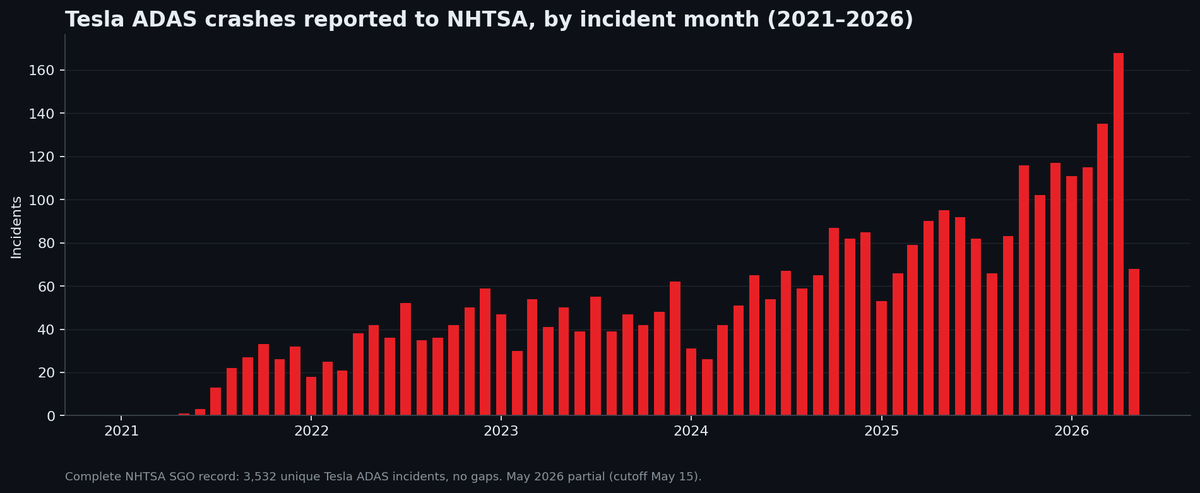
According to reporting from Fred Lambert, Tesla's ADAS crash figures for 2026 are already more than half of all of last year's total — with data only available through May 15. That's a striking pace, especially given that last year's tally was itself up 40% year-over-year.


The obvious caveat — and it's a real one — is that crash counts tend to scale with utilization. As more miles are driven under Autopilot or FSD, more incidents will statistically occur. Tesla's fleet has grown, and FSD adoption has expanded. A rising crash count does not automatically mean the systems are getting less safe on a per-mile basis.
But that caveat only goes so far. Without per-mile or per-engagement data, it is impossible to verify whether the rate of incidents is improving, holding steady, or worsening. The raw numbers are what regulators and the public have to work with — and those numbers are climbing steeply.
The Fatality Problem
Lambert's reporting flags 57 reported fatalities in the NHTSA dataset. That figure alone warrants serious attention. But the deeper issue is that the vast majority of crash reports carry "unknown" severity classifications — meaning the actual death and serious injury toll could be substantially higher, or the picture could look different with complete data. Either way, the gap is a problem.


Regulators and safety researchers rely on severity data to understand which types of scenarios are most dangerous and where intervention is needed. When the majority of entries are listed as unknown, the dataset loses much of its analytical value — for everyone except Tesla, which holds the underlying data.
A Transparency Double Standard
Perhaps the most pointed detail in Lambert's reporting is this: Tesla recently began releasing unredacted contextual data for its ADS (Automated Driving System) crash reports — the incidents involving its Robotaxi and Cybercab operations. That's a meaningful step toward accountability for its fully autonomous program.

But for ADAS incidents — the crashes involving Autopilot and FSD on privately owned vehicles driven by hundreds of thousands of customers — Tesla continues to redact all contextual information. That asymmetry is hard to explain on technical or legal grounds. The same reporting framework applies to both categories. The difference is a policy choice.
Context matters enormously in crash analysis. Was the driver attentive? Was the system engaged at the time of impact? What were the road conditions? Without those details, the NHTSA data tells regulators that a crash happened — but not much about why, or whether the automated system contributed.
What This Means for Owners
For the roughly 500,000-plus Tesla owners using Autopilot or FSD regularly, this data situation creates a frustrating information vacuum. You can't easily assess whether the system is improving on a safety basis because the denominator — total miles driven under ADAS engagement — isn't publicly available, and the severity data for individual incidents is largely missing.
What is clear: the volume of reported incidents is rising sharply. Whether that reflects a growing fleet, more aggressive feature use, or a genuine deterioration in safety performance per mile is a question the current data cannot answer. That ambiguity, more than any single number, is the core problem here.
Tesla's decision to open up ADS crash context while maintaining redactions on ADAS data suggests the company understands the value of transparency when it's strategically useful — for the Robotaxi program, which faces intense regulatory scrutiny. Extending that same openness to the much larger ADAS dataset would give regulators, researchers, and owners a far clearer picture of where these systems actually stand. Until that happens, the record-high crash counts will continue to generate more questions than answers.
🚕 Following the Robotaxi rollout? See every operating city, launch date and announced market in our Tesla Robotaxi Tracker.
Related Gear
Gear up your Tesla with tested, custom-fit BASENOR accessories — shop Tesla accessories →
Sources & reporting notes
The links below identify the material source records used for this report.
- @FredLambert on X (2026-06-16T18:25:25.000Z) — Direct source
- @FredLambert on X (2026-06-16T18:07:27.000Z) — Direct source
- @FredLambert on X (2026-06-16T18:06:45.000Z) — Direct source
- @FredLambert on X (2026-06-16T18:05:32.000Z) — Direct source
- @FredLambert on X (2026-06-16T18:03:46.000Z) — Direct source
Source links are preserved as published or accessed. See our editorial standards and corrections policy.
The BASENOR Editorial Desk covers Tesla, SpaceX, and related technology, curating reporting from primary sources — official accounts, regulatory filings, and software release data. Every article passes source-record and fact-checking review before publication. About the newsroom.
This report was curated by the BASENOR Editorial Desk from the sources listed above. Read our editorial standards or email editorial@basenor.com to report an error.