📌 UPDATE — June 16, 2026
Tesla has now issued an official public statement escalating its opposition to the New Jersey legislation, going beyond owner emails to directly accuse the bill of singling out Tesla for a market ban. In its statement, Tesla said: "Rather than prioritizing real safety outcomes and performance, this bill specifically bans Tesla from the New Jersey market. Every arbitrary roadblock is a delay for the people who need this life-changing technology most." The company framed the legislation not merely as an AV regulatory hurdle, but as targeted exclusion of its proven autonomous technology — a notably stronger characterization than its earlier owner-outreach messaging.
The statement was shared publicly on June 16, 2026, and signals Tesla is prepared to fight the bills on a broader public stage, not just through grassroots owner lobbying.

via @SawyerMerritt · June 16, 2026
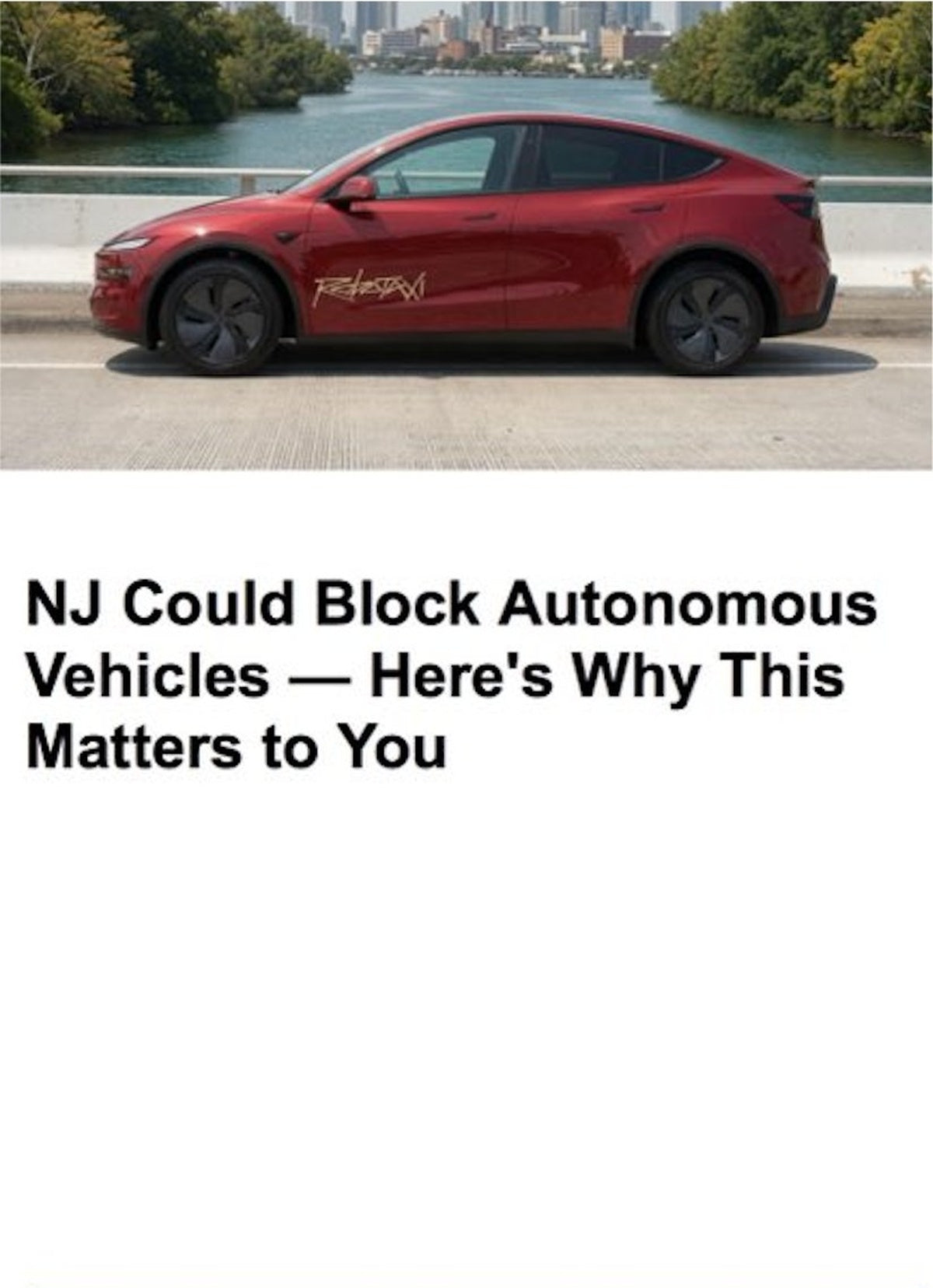
Tesla has begun emailing New Jersey owners directly, warning them that legislation currently moving through Trenton could permanently block true driverless vehicle deployment in the state. The company is asking owners to get involved before the bills advance further — making this one of the clearest examples yet of Tesla treating its customer base as a political constituency.

What the Bills Actually Say
Two companion bills are working their way through the New Jersey legislature: Senate Bill S1677 and Assembly Bill A3968. Together, they propose a three-year pilot program for fully autonomous vehicles (SAE Level 4 and 5) operating in New Jersey.
On the surface, that sounds like progress. The problem, from Tesla's perspective, is buried in the details:
- Human driver required during the initial phase. Fully driverless operation is only permitted after the pilot phase concludes without incident. That means no unsupervised FSD runs — even if the technology is ready.
- Banned in school zones, construction zones, and high-pedestrian areas. These are exactly the complex urban environments where demonstrating autonomous capability matters most.
- Self-driving trucks and vehicles larger than a personal car are prohibited entirely. This cuts off any commercial AV freight pathway in the state.
- A nine-member oversight task force appointed by the DOT and the NJ Motor Vehicle Commission would govern the program, adding a regulatory layer between Tesla and deployment approval.
- Mandatory crash reporting within five days of any autonomous vehicle collision, with monthly progress updates to state transportation officials.
S1677 was introduced on January 13, 2026, and was referred to the Senate Budget and Appropriations Committee on May 11, 2026. A3968 has already cleared the Assembly Science, Innovation, and Technology Committee. Both bills are actively moving.
Why Tesla Is Alarmed
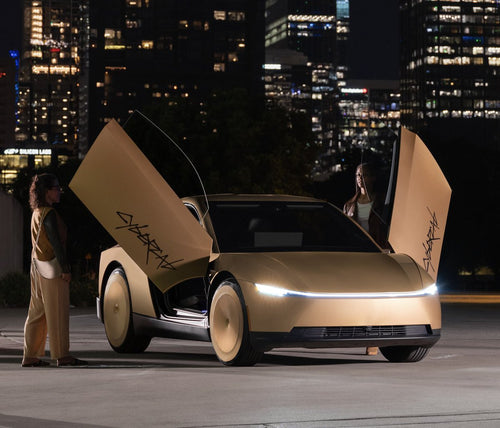
Tesla's email to owners reportedly frames the legislation as imposing restrictions "so severe that true driverless deployment would remain illegal." That's a pointed characterization, but it tracks with the bill's structure: a mandatory human-in-the-loop requirement during the pilot phase effectively means Tesla cannot operate Cybercab-style robotaxi services or fully unsupervised FSD in New Jersey until the state's task force signs off — on the state's timeline, not Tesla's.
For context, Tesla has been expanding its autonomous ambitions significantly. A regulatory framework that requires human supervision by statute — regardless of demonstrated safety performance — creates a ceiling that the company cannot engineer its way through. Other AV developers, including Waymo, have also pushed for amendments to waive the on-board driver requirement, though they've expressed general support for establishing a pilot program framework at all.
The Chamber of Progress, a tech industry group, has similarly called for amendments: allowing purpose-built AVs without steering wheels or pedals, and replacing the commercial truck ban with a structured freight deployment pathway.
What New Jersey Owners Can Do Right Now
If you received Tesla's email, the ask is straightforward: contact your state legislators before these bills move further. Here's how to do it effectively:
- Find your NJ state legislators. Go to njleg.state.nj.us and enter your address to identify your specific Senate and Assembly representatives.
- Reference the specific bills. Mention S1677 (Senate) and A3968 (Assembly) by name. Legislators and their staff track constituent contacts by bill number.
- Be specific about the human-driver requirement. The mandatory supervision clause during the pilot phase is the core sticking point. Ask your representative to support amendments that allow fully driverless operation once safety benchmarks are met — rather than requiring a fixed supervised phase regardless of performance.
- Use Tesla's email link if you received it. Tesla has reportedly included a direct action link in the owner email. That link likely routes to a pre-populated contact form — use it. Volume of constituent contacts matters in state-level advocacy.
- Follow the bill's progress. S1677 now sits with the Senate Budget and Appropriations Committee. Watch for committee hearings — public testimony windows are often short and announced with little lead time.
The Bigger Picture
New Jersey is not an isolated case. State-by-state AV legislation has become a patchwork that directly shapes where companies like Tesla can deploy autonomous services and on what timeline. A restrictive framework in a major East Coast state sets a precedent — and other state legislatures pay attention to what their neighbors do.
Tesla mobilizing its owner base as a lobbying force is a deliberate strategy. Whether you agree with the company's position on the specific bills or not, the underlying question — who decides when autonomous vehicles are safe enough to operate without a human present — is one that will define the next decade of transportation policy. New Jersey owners have a direct say in how their state answers it, but the window to weigh in is open now, not after the bills pass.
Related Gear
Gear up your Tesla with tested, custom-fit BASENOR accessories — shop Tesla accessories →
Sources & reporting notes
The links below identify the material source records used for this report.
- @SawyerMerritt on X (2026-06-16T18:30:49.000Z) — Direct source
- @SawyerMerritt on X (2026-06-16T21:05:58.000Z) — Direct source
Source links are preserved as published or accessed. See our editorial standards and corrections policy.
The BASENOR Editorial Desk covers Tesla, SpaceX, and related technology, curating reporting from primary sources — official accounts, regulatory filings, and software release data. Every article passes source-record and fact-checking review before publication. About the newsroom.
This report was curated by the BASENOR Editorial Desk from the sources listed above. Read our editorial standards or email editorial@basenor.com to report an error.