SpaceX is about to receive a massive structural tailwind from Wall Street's index machinery. On June 18 — just six days after the company's historic IPO — SpaceX is set for simultaneous inclusion in both the CRSP and FTSE Russell indices, a dual event that analysts estimate will force $10 to $16 billion in passive fund buying in a single trading session.

How We Got Here
SpaceX completed its IPO on June 12, 2026, listing on the Nasdaq Global Select Market under the ticker SPCX at $135 per share. The stock opened at $150 and closed its first day near $160-161, pushing the company's implied valuation above $2 trillion. The offering raised a historic $75 billion — the largest IPO capital raise on record.
That scale is precisely why the index inclusion is happening so fast. Both FTSE Russell and CRSP have adopted fast-entry rules specifically designed for mega-cap IPOs. Under FTSE Russell's framework, large new listings become eligible for the Russell 1000 at the market close on the fifth trading day after their IPO — which lands on Thursday, June 18. CRSP's US market indexes operate on a similar five-trading-day eligibility window, pointing to the same date.
The Forced Buying Mechanics
Index inclusion isn't optional for passive funds — it's mechanical. Any fund benchmarked to the CRSP US Total Market Index, the Russell 1000, or the broader FTSE Russell family must hold SpaceX in proportion to its weight in the index. Given SpaceX's multi-trillion-dollar market cap, that weight is significant from day one.
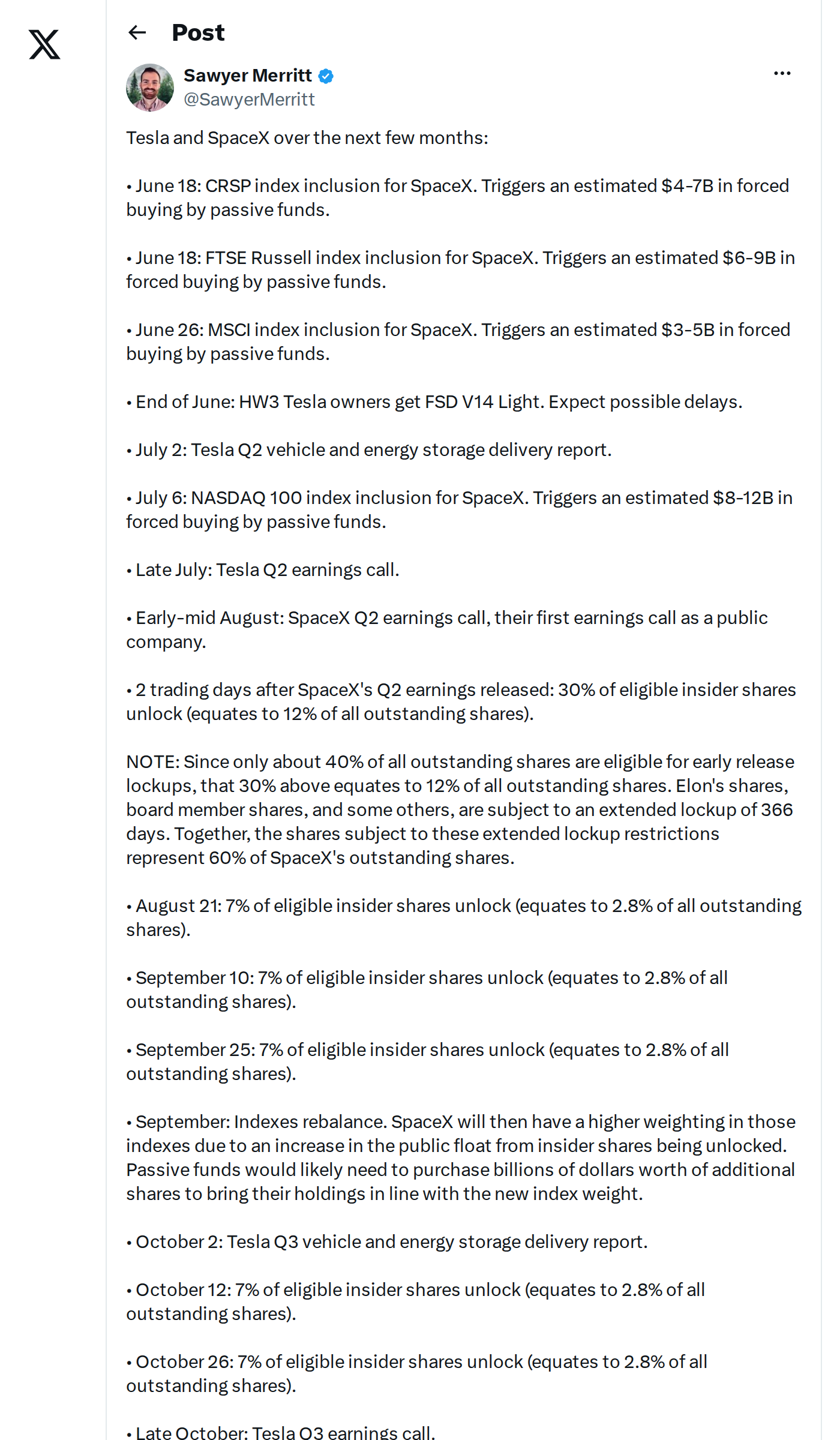
According to @SawyerMerritt, the two inclusions break down as follows:
| Index | Inclusion Date | Estimated Forced Buying |
|---|---|---|
| CRSP US Market Index | June 18, 2026 | $4–7 billion |
| FTSE Russell (Russell 1000) | June 18, 2026 | $6–9 billion |
| Combined | $10–16 billion |
To put that in context: $10-16 billion in a single session is the kind of demand event that can move markets regardless of any fundamental news on the day. The buying isn't discretionary — fund managers tracking these indices have no choice but to execute.
Why This Matters Beyond SpaceX
The CRSP indexes are the benchmarks used by Vanguard's index funds — some of the largest pools of capital in the world. The Russell 1000 underpins trillions in institutional mandates. When a company of SpaceX's scale enters both simultaneously, the ripple effects extend to existing index constituents: funds must rebalance, meaning some existing holdings get trimmed to fund the SpaceX purchase. The net effect on the broader market close on June 18 is worth watching.
For context on the speed of this inclusion: the traditional S&P 500 eligibility window requires a company to have been publicly traded for at least 12 months. SpaceX is not yet eligible for the S&P 500 under standard rules, though Nasdaq has separately adjusted its own fast-track eligibility window for the Nasdaq-100. That potential inclusion represents yet another structural demand event further down the calendar.
The June 18 session will be a stress test of just how efficiently markets can absorb a company that went from private to multi-trillion-dollar public entity in under a week — and whether the fast-entry rules that index providers designed for exactly this scenario hold up at historic scale.
Sources & reporting notes
The links below identify the material source records used for this report.
- @SawyerMerritt on X (2026-06-16T19:50:10.000Z) — Direct source
Source links are preserved as published or accessed. See our editorial standards and corrections policy.
The BASENOR Editorial Desk covers Tesla, SpaceX, and related technology, curating reporting from primary sources — official accounts, regulatory filings, and software release data. Every article passes source-record and fact-checking review before publication. About the newsroom.
This report was curated by the BASENOR Editorial Desk from the sources listed above. Read our editorial standards or email editorial@basenor.com to report an error.