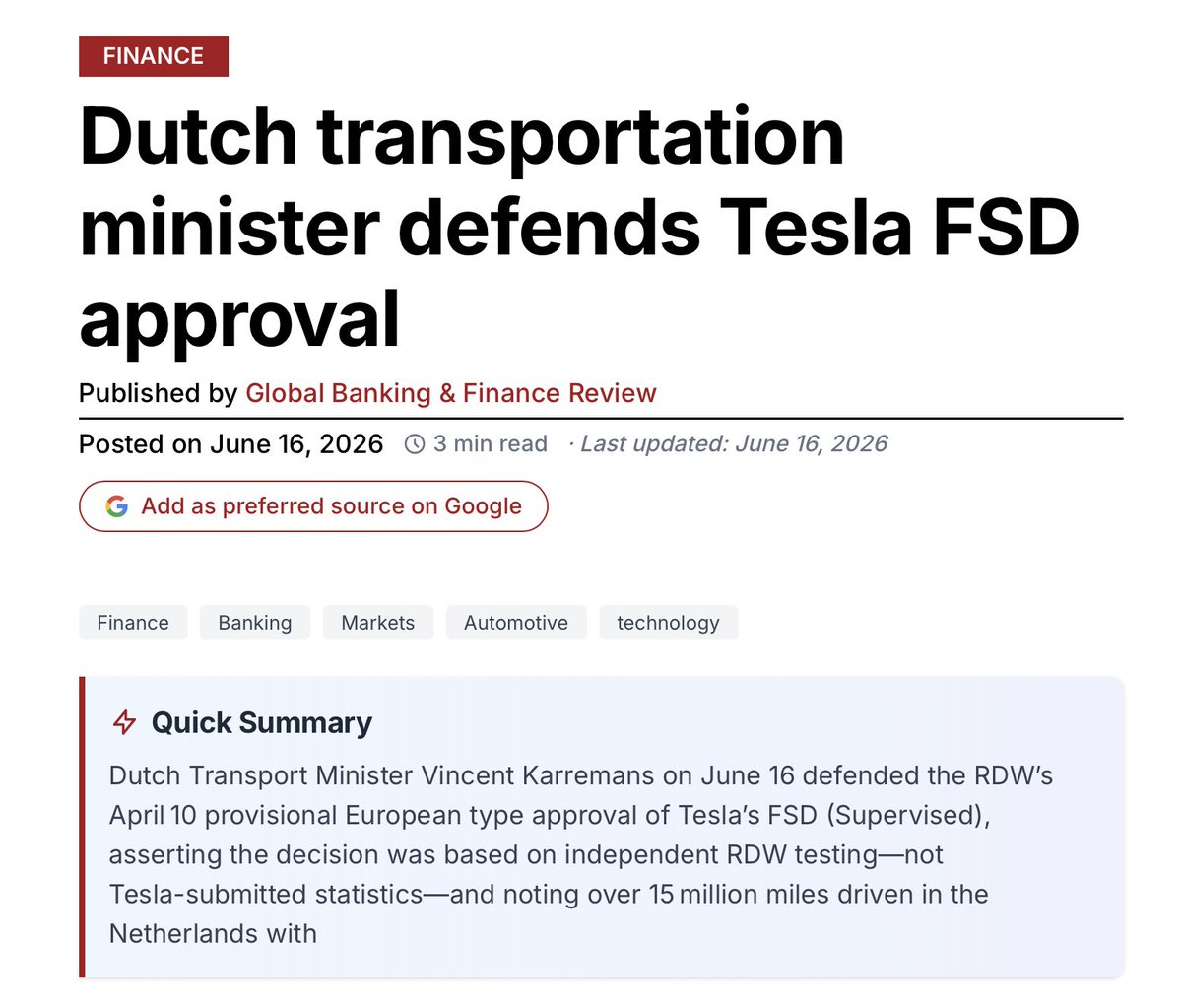
The Netherlands has become the first country in Europe to formally authorize Tesla's Full Self-Driving (Supervised) system, and the Dutch government is standing firmly behind that decision. On June 16, Transport Minister defended the RDW's provisional approval in parliament, making clear the regulator acted on its own independent findings — not statistics handed over by Tesla. The safety record backing that decision is hard to argue with.

What the RDW Actually Did
The RDW — the Netherlands Vehicle Authority — granted provisional approval on April 10, 2026, under UN Regulation 171 and an Article 39 exemption. The version approved is FSD (Supervised) 2026.3.6. But the process behind that approval is what makes this politically significant.
According to verified reporting, the RDW's evaluation included over 18 months of intensive testing: more than 1.6 million kilometers (roughly 1 million miles) of test drives on EU public roads, over 13,000 customer ride-alongs, and 4,500 closed-track test scenarios. More than 400 compliance requirements were satisfied. When the Minister faced questions in parliament about whether regulators had simply taken Tesla's word for it, his answer was unambiguous — they had not.
The Safety Numbers
The real-world data from Dutch roads is striking. As of June 10, 2026, FSD-equipped vehicles in the Netherlands had accumulated approximately 16.6 million kilometers — around 10.3 million miles — without any recorded collisions. The Minister's statement referenced 24 million miles driven "without any noteworthy incidents," a figure that appears to encompass broader FSD activity on Dutch roads beyond the collision-specific dataset.
FSD (Supervised) — Netherlands Safety Data
| Approval Date | April 10, 2026 |
| FSD Version Approved | 2026.3.6 |
| Miles Driven (no incidents) | 24 million miles |
| Collision Reduction vs. Human Drivers | 71.4% |
| Overall Safety Rate vs. Human Drivers | 3.4× safer (highways) |
| Subscription Price (Europe) | €99/month or €7,500 one-time |
Why the Independent Testing Angle Matters
Regulatory approvals for autonomous driving systems are almost always contested — by safety advocates, by competitors, and by legislators looking for political cover. The Dutch Minister's emphasis that the RDW conducted its own testing rather than relying on manufacturer-submitted data is a direct rebuttal to the most common line of attack: that automakers grade their own homework.
That framing also carries weight for what comes next. The RDW approval, under UN Regulation 171, holds provisional validity across the European Union through mutual recognition. The RDW is currently pursuing EU-wide approval on Tesla's behalf, with full availability across EU member states anticipated by mid-to-late summer 2026. An approval built on independent verification is a much stronger foundation for that broader process than one based on manufacturer data alone.
Hardware and Access
Not every Tesla in Europe can access FSD today. Currently, only vehicles equipped with Tesla's fourth-generation Autopilot hardware are eligible. Tesla has indicated an FSD V14 Lite version is planned for this summer, which would extend compatibility to older hardware configurations. For owners in the Netherlands and other European markets where the system is available, access comes via a €99/month subscription or a €7,500 outright purchase.

The Netherlands approval was always going to be a test case — both technically and politically. With the Minister now publicly defending the process and the safety data holding up under parliamentary scrutiny, the path toward broader EU authorization looks considerably cleaner than it did two months ago. The question now is whether other European regulators will move to recognize the RDW's findings before the summer deadline, or insist on running their own processes from scratch.
📋 Tracking Tesla software? See every firmware, FSD and app version in one place in our Tesla Software Update Tracker.
Related Gear
Gear up your Tesla with tested, custom-fit BASENOR accessories — shop Tesla accessories →
Sources & reporting notes
The links below identify the material source records used for this report.
- @SawyerMerritt on X (2026-06-16T17:36:56.000Z) — Direct source
- @SawyerMerritt on X (2026-06-16T17:36:57.000Z) — Direct source
Source links are preserved as published or accessed. See our editorial standards and corrections policy.
The BASENOR Editorial Desk covers Tesla, SpaceX, and related technology, curating reporting from primary sources — official accounts, regulatory filings, and software release data. Every article passes source-record and fact-checking review before publication. About the newsroom.
This report was curated by the BASENOR Editorial Desk from the sources listed above. Read our editorial standards or email editorial@basenor.com to report an error.