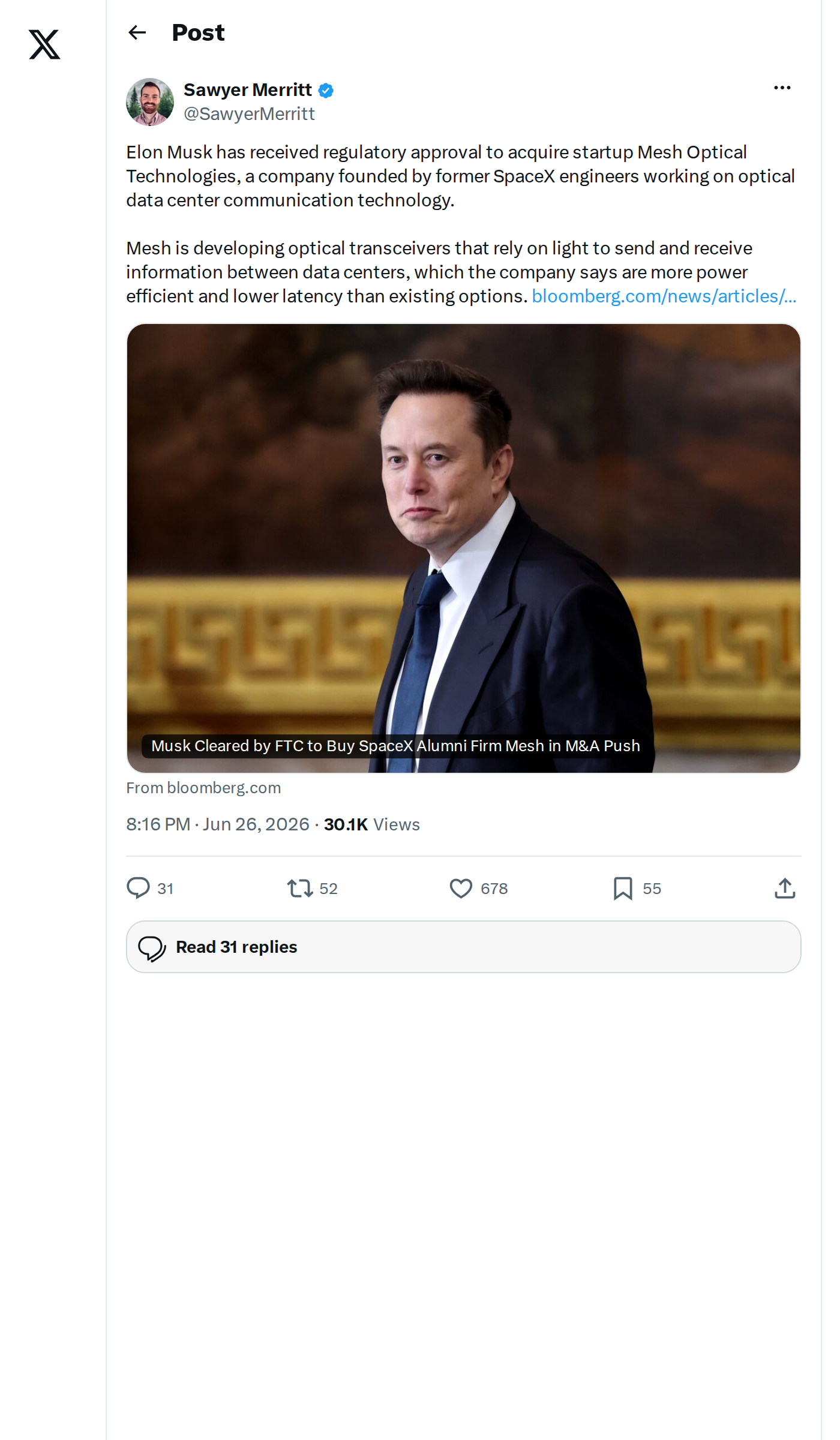
Elon Musk has cleared the final regulatory hurdle to acquire Mesh Optical Technologies, a startup built by former SpaceX engineers developing next-generation optical communication hardware for data centers. The Federal Trade Commission approved the transaction on June 25, 2026 — fast-tracking its antitrust review after determining the deal raised no significant competition concerns — with news becoming public the following day.

What Mesh Optical Technologies Actually Does
Mesh emerged from stealth in February 2026 after raising a $50 million Series A led by Thrive Capital, with Also Capital and Banner VC participating. The company's core product is the Alpha C1, an optical transceiver capable of translating electrical signals to light at 1.6 terabits per second. Its optical engine is manufactured using flip chip die bonding — a precision packaging technique that keeps the component compact and thermally efficient.
The pitch is straightforward: conventional copper-based interconnects inside data centers burn enormous amounts of power and introduce latency that compounds at AI-scale workloads. Optical transceivers replace those copper links with light, delivering better power efficiency, lower latency, and higher reliability — exactly the properties that matter when you're running inference or training at the density modern AI clusters demand.
Where This Fits in Musk's Broader Infrastructure Play
The acquisition sits at an interesting intersection of several Musk ventures. Mesh was founded by engineers who came out of SpaceX, and the technology is expected to have direct applications there — particularly for Starlink's ground infrastructure and any future space-based computing ambitions. Reports have linked Mesh's work to a project internally referred to as Starmind, a concept for space-based AI computing infrastructure.
For xAI, which operates Colossus — currently one of the largest GPU clusters in the world — optical interconnects at 1.6 Tbps would be a meaningful upgrade over conventional networking. AI training runs are increasingly bottlenecked not by raw compute but by how fast data can move between chips. Mesh's Alpha C1 targets exactly that constraint.
The FTC's decision to fast-track the review is notable in its own right. Regulators concluded the deal was unlikely to raise competitive concerns, which suggests Mesh remains a relatively early-stage company without dominant market share — making this an acqui-hire of talent and IP rather than a consolidation play.
Key Deal Facts
| Detail | Information |
|---|---|
| Acquiring party | Elon Musk |
| Target | Mesh Optical Technologies Corporation |
| FTC approval date | June 25, 2026 (Transaction #20261601) |
| Mesh Series A raised | $50 million (led by Thrive Capital) |
| Flagship product | Alpha C1 optical transceiver — 1.6 Tbps |
| Founded by | Former SpaceX engineers |
| Came out of stealth | February 2026 |
The acquisition terms have not been disclosed. What's clear is that Musk is assembling the vertical stack needed to run AI infrastructure end-to-end — from the chips (xAI's Colossus cluster) to the networking layer (Mesh's optical interconnects) to the satellite backhaul (Starlink). Whether Mesh's technology eventually finds its way into Tesla's Dojo supercomputer infrastructure remains an open question, but the talent pipeline from SpaceX to Mesh to a Musk-owned entity is a pattern worth watching.
Related Gear
Gear up your Tesla with tested, custom-fit BASENOR accessories — shop Tesla accessories →
Sources & reporting notes
The links below identify the material source records used for this report.
- @SawyerMerritt on X (2026-06-26T20:16:49.000Z) — Direct source
Source links are preserved as published or accessed. See our editorial standards and corrections policy.
The BASENOR Editorial Desk covers Tesla, SpaceX, and related technology, curating reporting from primary sources — official accounts, regulatory filings, and software release data. Every article passes source-record and fact-checking review before publication. About the newsroom.
This report was curated by the BASENOR Editorial Desk from the sources listed above. Read our editorial standards or email editorial@basenor.com to report an error.