
Elon Musk took to X on November 27 to explain, in unusually direct terms, how Grok Bots are meant to be deployed — and what xAI needs to get right for the product to scale. He also confirmed that major improvements to Grok Bot are landing every week, and laid out an ambitious end goal: enabling users to build entire companies on the platform. Adding to that picture, higher-priced Grok Bot tiers costing thousands of dollars per month are expected to be introduced, expanding well beyond the current $200/month plan. The posts cover everything from org-chart design for AI agents to the economics of running a bot-heavy business. If you're evaluating Grok Bots for serious work, this is the clearest signal yet on what the product is actually built for.

1. Specialized roles, not generalist overload
Musk's most practical piece of advice: don't try to build one bot that does everything. "When using Grok Bots, it is important to create Bots with specialized roles, just like a human company," he wrote. The analogy is deliberate — a single employee handed an overwhelming workload will start missing things, and the same is true of a single bot. The implication for teams is clear: design your bot architecture the way you'd design a team, with defined lanes and clear ownership.
2. A manager bot to coordinate the rest
Specialization only works if someone — or something — is keeping the whole operation aligned. Musk's answer is a manager bot that oversees and coordinates the work of the specialist bots beneath it. According to reporting on xAI's internal setup, the company itself uses a "chief-of-staff bot" in this role. It's a structural choice that mirrors how high-functioning human teams operate: individual contributors handle execution, while a coordinator handles prioritization and handoffs.
3. High value justifies high cost — but the math has to work
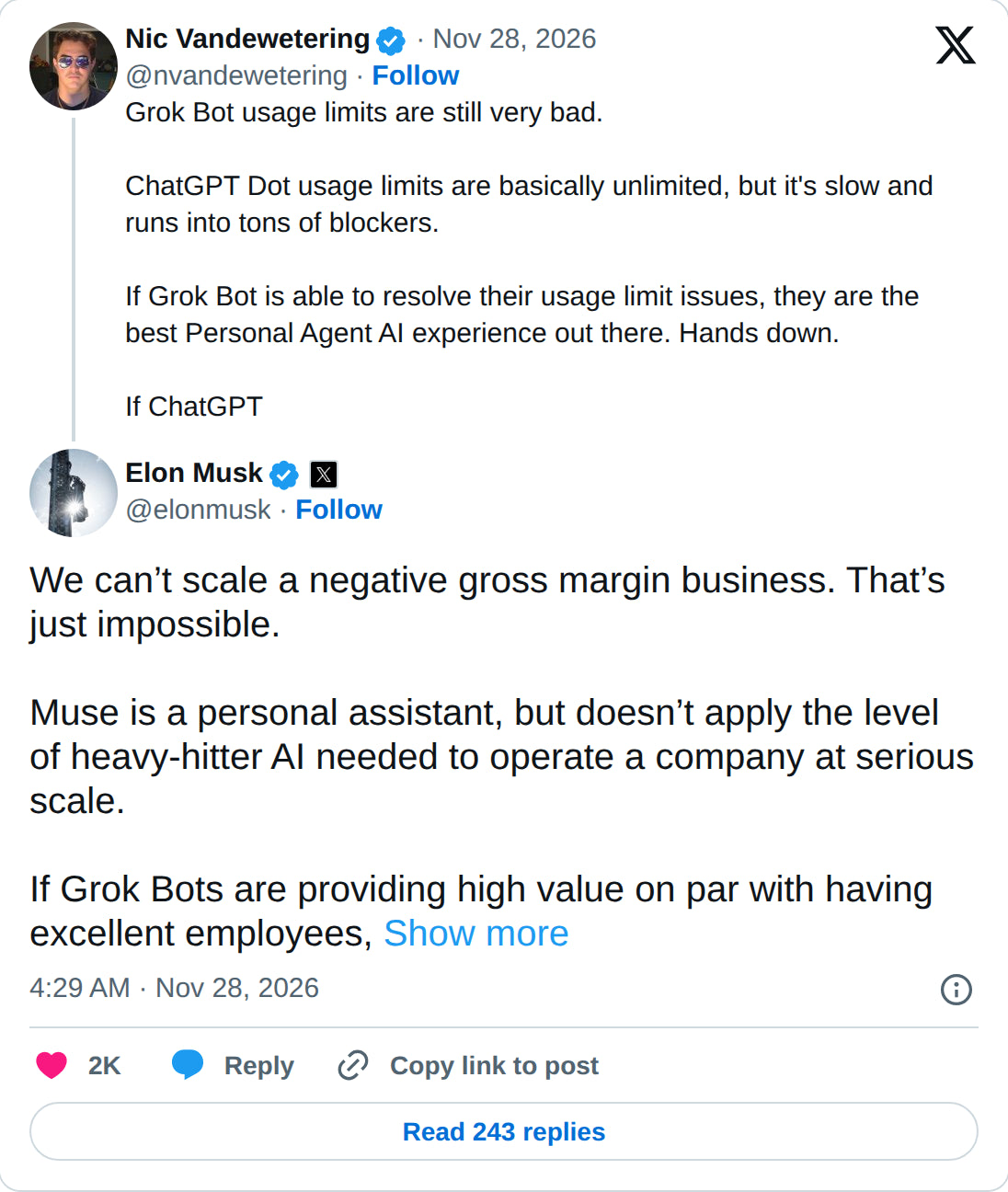
Musk was direct about pricing philosophy: if Grok Bots genuinely deliver the equivalent of excellent employees, the monthly cost can be substantial and still represent strong ROI. "If Grok Bots are providing high value on par with having excellent employees, then the monthly cost can be quite high, but still deliver outstanding RoI," he wrote. The framing positions Grok Bots as a business-grade tool, not a consumer novelty — and signals that xAI isn't planning to compete on being the cheapest option in the market. For context on why Grok's usage economics have been a recurring topic, see why Grok users are hitting limits faster.

4. Gross margin is non-negotiable for scale
Behind the product strategy is a hard business constraint. "We can't scale a negative gross margin business. That's just impossible," Musk wrote. It's a pointed acknowledgment that AI infrastructure is expensive, and that xAI's ability to expand Grok Bots' capabilities depends on the product actually making money. This also explains why the premium pricing model isn't just a revenue grab — it's a structural requirement for the product to keep improving. For a broader look at why Grok sits at the center of Musk's long-term bets, see why Grok may be the most important bet across Musk's empire.
5. Friction in upgrade paths is a self-identified mistake — and higher tiers are coming
Perhaps the most candid moment in the thread: Musk acknowledged that making it complicated to upgrade to higher usage tiers is a mistake xAI has made before, and one that needs fixing. "If we do something dumb, like making it complicated to upgrade to higher usage tiers (a mistake we've made before), then we need to fix that," he wrote. That concern appears to be driving concrete action. Musk followed up by asking directly whether xAI had made it easier to upgrade to higher usage tiers.

Sawyer Merritt subsequently reported that SpaceX is planning to introduce higher Grok Bot tiers priced at thousands of dollars per month, aimed at users who need greater usage capacity. Merritt noted that the existing $200/month plan had always felt too low to be the highest tier available.

For a product that depends on users growing into heavier usage — and paying accordingly — a clunky upgrade experience directly undermines the business model. Fixing that friction, and expanding the tier ceiling, appear to be two sides of the same strategic priority.
The bigger picture: building whole companies, week by week
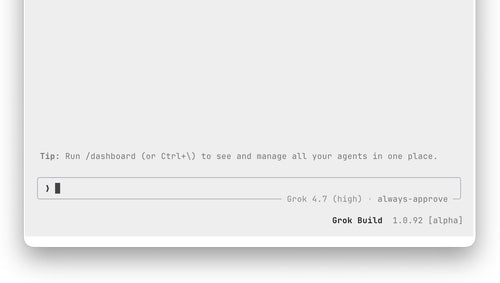
Musk capped the thread with two statements that frame the product's trajectory. First, on pace: "Major improvements land every week for Grok Bot," he confirmed — a cadence that aligns with earlier reporting on Grok's build upgrades and multi-model strategy. Second, on ambition: "The goal with Grok Bots is to enable you to build a whole company!" That framing elevates Grok Bots well beyond a productivity add-on and positions xAI as a platform play for business creation at scale.


Taken together, Musk's posts sketch a coherent picture: Grok Bots are designed for organizations willing to invest in a structured multi-agent setup, not casual users looking for a single AI assistant. The planned introduction of higher-priced tiers — potentially costing thousands per month — reinforces that enterprise positioning and gives heavy users a path to the capacity they need. The distinction between Muse (personal assistant) and Grok Bots (enterprise-grade agents) is becoming sharper. Whether xAI can execute on the pricing and UX side — particularly the upgrade path issue Musk flagged — will determine how quickly that vision of building entire companies on Grok Bots translates into real adoption. You can see how one concrete enterprise use case is already taking shape in Grok Bot as a corporate expense manager.
Update history
- November 27, 2026 — Added: higher Grok Bot tiers costing thousands per month are coming, per Sawyer Merritt, after Musk asked about easier tier upgrades.
- November 27, 2026 — Added Musk's confirmation of weekly major Grok Bot improvements and his stated goal of enabling users to build entire companies on the platform.
Sources & reporting notes
The links below identify the material source records used for this report.
- @elonmusk on X (2026-11-27T20:29:39.000Z) — Direct source
- @elonmusk on X (2026-11-27T20:32:32.000Z) — Direct source
- @SawyerMerritt on X (2026-11-27T20:36:26.000Z) — Direct source
Source links are preserved as published or accessed. See our editorial standards and corrections policy.
The BASENOR Editorial Desk covers Tesla, SpaceX, and related technology, curating reporting from primary sources — official accounts, regulatory filings, and software release data. Every article passes source-record and fact-checking review before publication. About the newsroom.
This report was curated by the BASENOR Editorial Desk from the sources listed above. Read our editorial standards or email editorial@basenor.com to report an error.