A brief clip shared by Whole Mars Catalog this week captured something that would have seemed improbable just three years ago: a non-Tesla vehicle plugging into a charger with a NACS connector as if it were the most natural thing in the world. In many ways, it now is. What Tesla once developed as a proprietary standard has quietly become the default plug for the entire North American EV market — and the numbers behind that shift are significant.

From Proprietary Port to Industry Standard
NACS — now formally designated SAE J3400 — started life as Tesla's in-house connector design. For years it was simply the plug on every Tesla sold in North America, incompatible with the CCS1 infrastructure that the rest of the industry had rallied around. That changed in 2023 when Tesla opened the standard to the industry, and the dominos fell faster than most analysts expected.
By early 2026, virtually every major automaker selling EVs in North America had either integrated native NACS ports into production vehicles or committed to doing so. Ford, General Motors, Rivian, Hyundai, Kia, Honda, Acura, Nissan, Volvo, Polestar, Mercedes-Benz, Lucid, and Genesis are all on the list. GM's transition is illustrative of the pace: starting with the 2026 Cadillac Optiq, every future GM EV ships with a built-in NACS port as standard equipment.
The Numbers Behind the Shift
| Metric | Figure | Context |
|---|---|---|
| Tesla US Supercharger stations | 3,088 | As of mid-May 2026 |
| Tesla US Supercharger ports | 37,428 | 52% of all US DC fast ports |
| Global Tesla Superchargers | 80,000+ | Network milestone crossed |
| Non-Tesla NACS DC fast stalls | 2,500+ | +41% from start of 2026 |
| NACS share of new non-Tesla ports (Q2 2026) | 22.9% | More than doubled year-over-year |
| New ports at 250 kW+ (Q2 2026, all networks) | ~72% | Including Tesla installs |
The third-party charging network buildout is accelerating alongside automaker adoption. According to industry data, ChargePoint, Ionna, and BP Pulse collectively operated over 1,100 non-Tesla NACS DC fast stalls as of April 2026. EVgo has committed to deploying more than 500 NACS connectors across 25 states by the end of this year — a fivefold increase in a single year. The overall US public DC fast-charging network reached 77,776 ports across 14,514 stations by the end of Q2 2026.
A telling inflection point: in Q1 2026, total NACS deployment across Tesla and non-Tesla networks was nearly equal to CCS1 deployment for the same period. That parity, achieved in just a few years from a standing start, underscores how decisively the industry has moved.
What This Means in Practice
For Tesla owners, the practical upside is straightforward: more vehicles at Supercharger stalls means Tesla has continued investing in site capacity, including longer V4 cable booms and dynamic stall allocation to handle the broader mix of vehicles. The network that was once a closed ecosystem is now a public utility — and Tesla has had to engineer accordingly.
For drivers of other brands, the transition is still uneven. CCS1 infrastructure isn't disappearing overnight, and federal NEVI funding requirements have kept CCS1 in the mix at many publicly funded sites. NACS-to-CCS adapters remain a practical necessity for owners of legacy EVs, and that reality will persist for several years as the installed base turns over.
The broader trajectory, though, is clear. NACS represented just roughly 10% of new non-Tesla ports a year ago. By Q2 2026 that share had more than doubled to 22.9%. If that pace continues, the connector question — once a genuine source of anxiety for EV buyers — becomes a non-issue within a few model cycles. The clip @wholemars posted this week is a small moment, but it illustrates something the industry spent years debating: the standard has been decided.
Related Gear
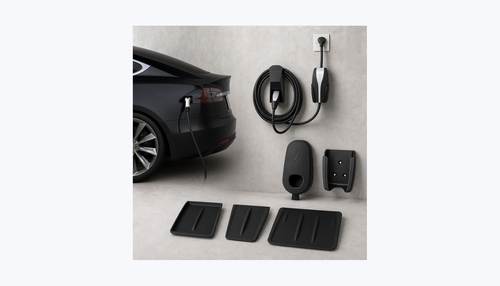
Gear up your Tesla with tested, custom-fit BASENOR accessories — shop Tesla accessories →
Sources & reporting notes
The links below identify the material source records used for this report.
- @wholemars on X (2026-08-08T14:06:59.000Z) — Direct source
Source links are preserved as published or accessed. See our editorial standards and corrections policy.
The BASENOR Editorial Desk covers Tesla, SpaceX, and related technology, curating reporting from primary sources — official accounts, regulatory filings, and software release data. Every article passes source-record and fact-checking review before publication. About the newsroom.
This report was curated by the BASENOR Editorial Desk from the sources listed above. Read our editorial standards or email editorial@basenor.com to report an error.