30-Second Brief
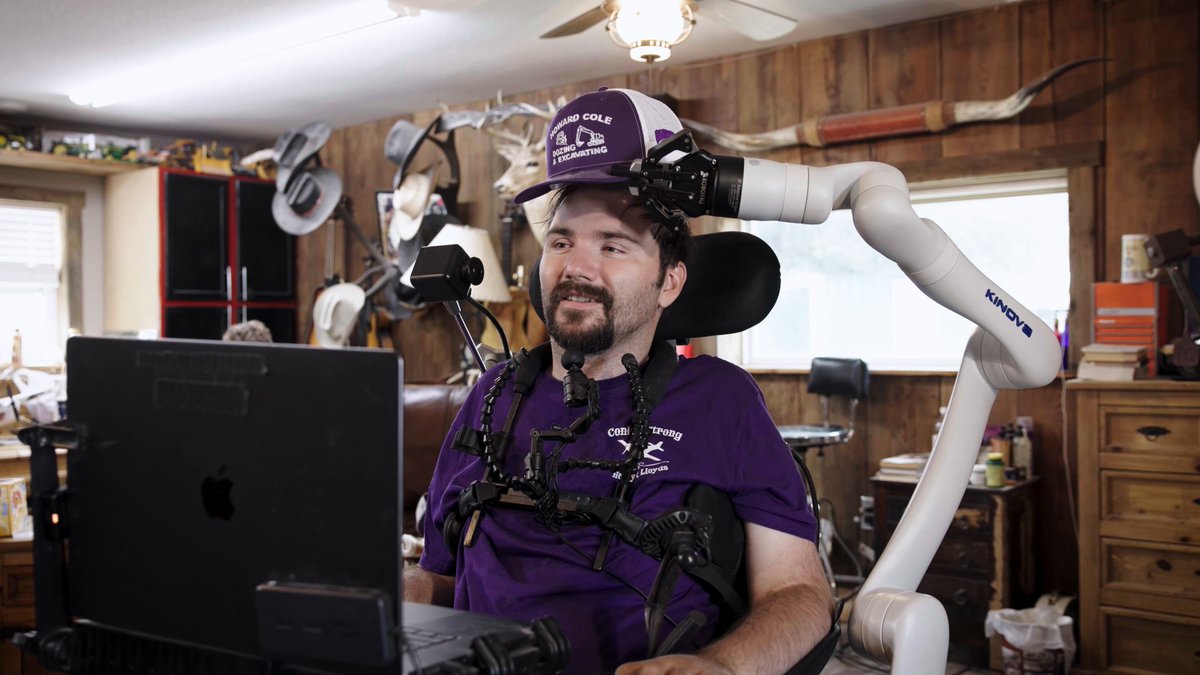
The News: Neuralink has publicly demonstrated its brain-computer interface technology enabling participants who have lost mobility — due to disease or spinal cord injury — to control robotic arms using only their thoughts.
Why It Matters: This is a direct, real-world proof of concept for Neuralink's core mission — and it signals that BCI-assisted mobility restoration is moving from lab experiment to tangible human outcome.
Source: @neuralink on X
Neuralink Shows Paralyzed Patients Controlling Robotic Arms With Their Thoughts
Neuralink just shared one of its most compelling public demonstrations to date: participants who have lost mobility due to disease or spinal cord injury controlling robotic arms using nothing but their thoughts. The video, posted directly by the company, puts a human face on brain-computer interface (BCI) technology that has largely been discussed in the abstract — until now.

What Neuralink Actually Showed
The demonstration centers on Neuralink's implanted BCI chip, which reads neural signals from the brain and translates them into commands for external devices. In this case, the external device is a robotic arm — and the participants operating it have lost the ability to move their own limbs.
The significance here is not just technical. It's the directness of the feedback loop: a person thinks about moving, and a robotic arm moves. No joystick, no voice command, no physical gesture. The brain signal alone is the input.
Neuralink has been working toward this milestone since its founding, but public demonstrations with actual human participants represent a meaningful step beyond early animal trials and theoretical frameworks. The company is now showing outcomes — not just potential.
📊 Key Context
| Aspect | Detail |
|---|---|
| Technology | Implanted brain-computer interface (BCI) chip |
| Input Method | Neural thought signals — no physical movement required |
| Output Device | External robotic arm |
| Target Conditions | Mobility loss from disease or spinal cord injury |
| Stage | Human participant trials (active demonstration) |
🔭 The BASENOR Take
Timeline: Active human trials underway — April 2026
Impact Level: 🔴 High — First-person demonstrations with real patients mark a qualitative shift in BCI credibility
Confidence: High — Directly from Neuralink's official account with video evidence
Neuralink's decision to publish this demonstration publicly is itself a signal. Companies in early-stage medical trials typically guard participant data carefully. Going public with video suggests the company is confident enough in its results to invite scrutiny — and is actively working to build the kind of public trust that will be essential for broader regulatory approval and adoption.
For the broader AI and robotics ecosystem — which includes Tesla's own Optimus humanoid robot program — this matters. The core challenge in robotics is not building the mechanical arm. It's the interface: how does a human communicate intent to a machine with precision and speed? Neuralink is attacking that problem at the most fundamental level possible, bypassing the body entirely and reading intent directly from the brain.
If BCI technology matures to the point where it can reliably interpret complex motor intent, the downstream applications extend well beyond medical rehabilitation. Robotic systems — including humanoid robots — could theoretically be operated with a level of nuance and responsiveness that current controller interfaces cannot match. That's a long road from here, but Neuralink's human trials are the first credible steps down it.
📰 Deep Dive
The robotic arm demonstration is a proof of concept for something the medical community has been working toward for decades: a reliable, high-bandwidth bridge between human neural intent and external mechanical action. What makes Neuralink's approach distinct is the implant's position directly in the motor cortex — the region of the brain responsible for planning and executing movement — giving it access to the most direct possible signal for what the participant intends to do.
For participants living with spinal cord injuries or degenerative diseases that have severed the connection between brain and body, this technology represents something more than a technical milestone. It's a potential pathway back to functional independence — the ability to reach for a glass of water, operate a computer, or interact with the physical world in ways that have been inaccessible since their injury or diagnosis.
The intersection with Elon Musk's broader technology portfolio is worth noting. Tesla's Optimus robot is being developed with the explicit goal of performing physical tasks autonomously — but the long-term vision for human-robot collaboration will likely require increasingly sophisticated interfaces. Neuralink's work on translating neural signals into precise mechanical commands is foundational research that could, over time, inform how humans and robotic systems interact at scale. For now, the focus is squarely on restoring what was lost — and that alone is a remarkable enough goal.

Sarah focuses on Tesla Energy, SpaceX missions, and the broader Musk AI portfolio. Former data analyst in clean energy. Based in San Francisco.
Sources verified at publish time. Spotted an inaccuracy? Email editorial@basenor.com.