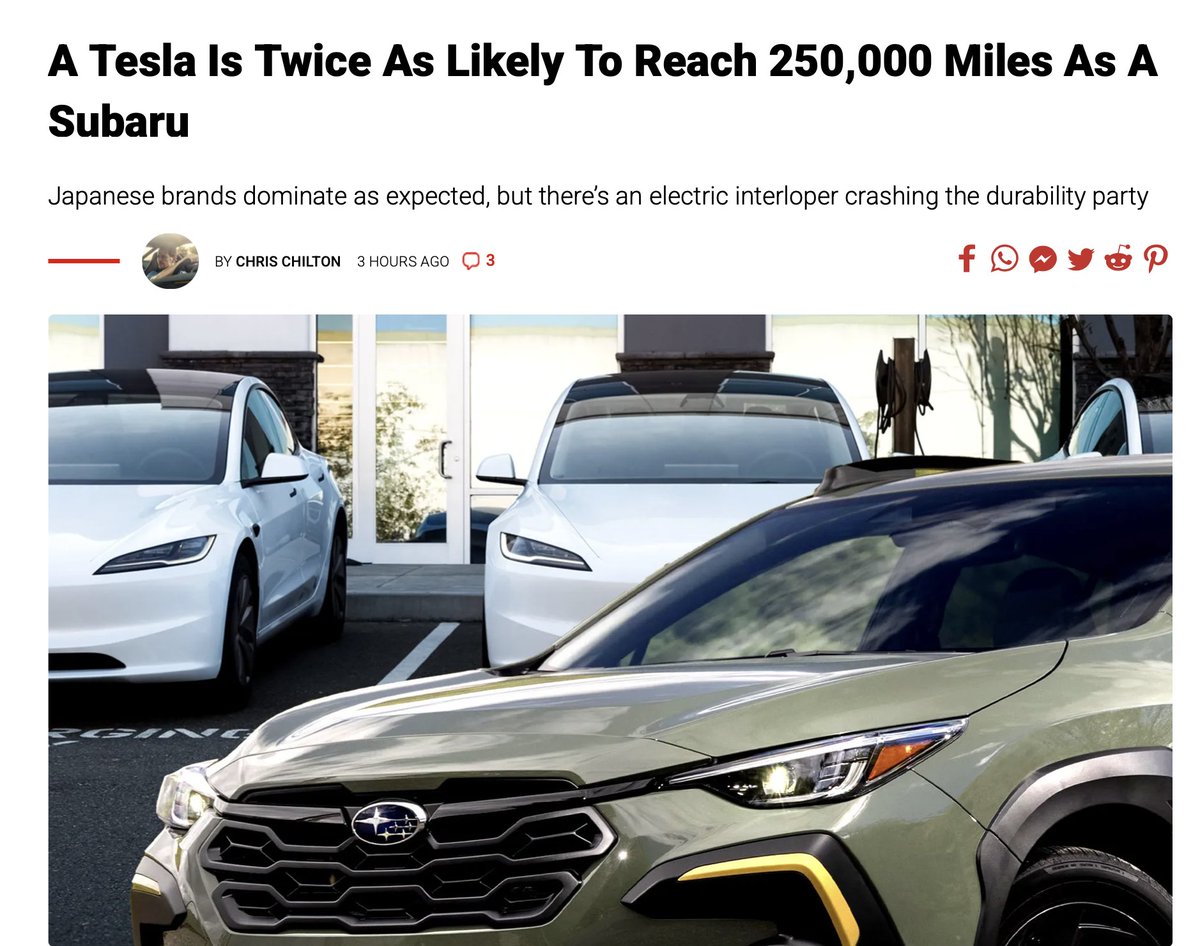
A major new longevity study has handed Tesla owners some compelling bragging rights. According to iSeeCars, which analyzed more than 174 million vehicles, a Tesla is twice as likely to reach 250,000 miles as a Subaru — and it outranks Ford, Kia, Chevy, BMW, Volkswagen, Mazda, Mercedes, and Volvo in the process. For anyone who's ever been told that EVs are an unknown quantity for long-term reliability, this data is a meaningful counter-argument.

What the Numbers Actually Say
The headline figure is striking, but the full context is worth unpacking. iSeeCars found that Tesla vehicles have a 4.6% chance of reaching 250,000 miles — compared to Subaru's 2.3%. That 2x multiple is real, not rounding.
The industry average sits at 4.8%, which means Tesla is essentially at the industry median for ultra-high-mileage survival — but that average is heavily pulled up by Toyota (17.8%) and Lexus (12.8%), two brands with decades of proven internal combustion reliability. Honda and Acura also rank above the average. Strip those legacy leaders out, and Tesla's position among the rest of the field looks considerably stronger.
| Brand | Chance of Reaching 250K Miles |
|---|---|
| Toyota | 17.8% |
| Lexus | 12.8% |
| Industry Average | 4.8% |
| Tesla | 4.6% |
| Subaru | 2.3% |
| BMW | Below Tesla |
| Mercedes | Below Tesla |
Source: iSeeCars study, June 2026. BMW/Mercedes exact figures not disclosed in source data.
Why EVs Age Differently
Tesla North America amplified the study with a pointed observation that cuts to the mechanical heart of the matter:

"No engine, no oil changes, no timing chains, no fuel injectors, and far fewer moving parts overall." That's the official Tesla framing — and it's not just marketing. A conventional internal combustion engine contains hundreds of precision components that wear against each other under extreme heat and pressure. An EV drivetrain eliminates most of that friction-based attrition entirely.
The components that do wear on a Tesla — brakes, tires, suspension bushings — are the same consumables on any vehicle. The difference is that the powertrain itself, historically the most expensive failure point in any car, is dramatically simplified. Regenerative braking also means brake pads last considerably longer than on a gasoline car, since the motor handles most deceleration.
The Caveats Worth Knowing
The study's framing deserves some scrutiny. Tesla's fleet is relatively young compared to Toyota's, which means fewer vehicles have had the opportunity to accumulate 250,000 miles in the first place. The 4.6% figure reflects cars that have already made it — but the sample size of high-mileage Teslas is smaller than the sample for brands with decades of high-volume sales. As the fleet ages, that number will either hold or shift.
Battery degradation is also a separate question from mechanical longevity. A Tesla can absolutely reach 250,000 miles, but the battery capacity at that point — and the cost of replacement — is a variable the iSeeCars methodology doesn't directly address. Owners of high-mileage Teslas have generally reported modest degradation (10-15% capacity loss over 200,000+ miles), but that's a real ownership consideration that a miles-survived metric doesn't capture.
None of that undermines the core finding. Beating BMW, Mercedes, Ford, and Kia in a 174-million-vehicle study is a legitimate result — and for buyers who've hesitated on EV longevity grounds, it's the kind of third-party validation that matters. The question now is whether Toyota's 17.8% benchmark is a ceiling Tesla can eventually challenge, or a legacy advantage that takes another decade to close.
Related Gear
Gear up your Tesla with tested, custom-fit BASENOR accessories — shop Tesla accessories →
Sources & reporting notes
The links below identify the material source records used for this report.
- @SawyerMerritt on X (2026-06-08T00:06:09.000Z) — Direct source
- @SawyerMerritt on X (2026-06-08T00:06:09.000Z) — Direct source
- @tesla_na on X (2026-06-08T00:58:13.000Z) — Direct source
Source links are preserved as published or accessed. See our editorial standards and corrections policy.
The BASENOR Editorial Desk covers Tesla, SpaceX, and related technology, curating reporting from primary sources — official accounts, regulatory filings, and software release data. Every article passes source-record and fact-checking review before publication. About the newsroom.
This report was curated by the BASENOR Editorial Desk from the sources listed above. Read our editorial standards or email editorial@basenor.com to report an error.