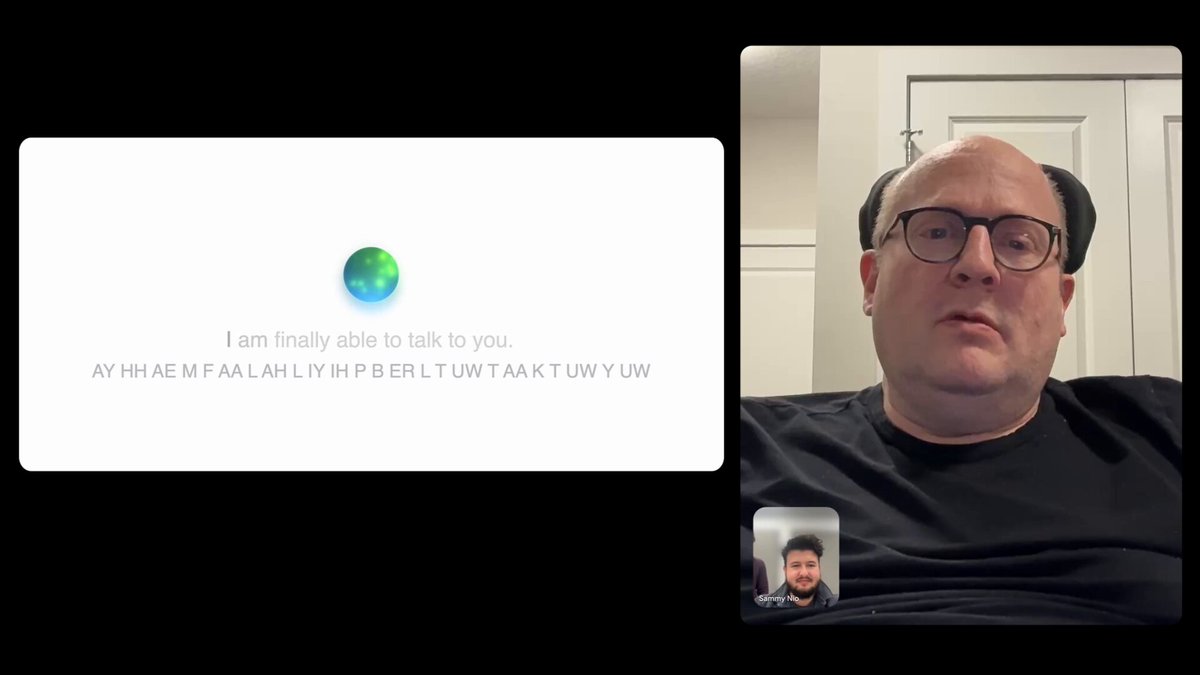
The News: Neuralink spotlighted Kenneth Shock, an ALS patient who received an N1 chip implant in January 2026, and is now translating thoughts into speech via the company's VOICE clinical trial.
Why It Matters: This is the clearest public demonstration yet that Neuralink's brain-computer interface can restore communication in patients with degenerative motor diseases — a milestone with implications far beyond ALS.
Source: @neuralink on X
Neuralink's ALS Patient Kenneth Can Think to Speak Again — Here's What's Actually Happening
ALS doesn't just take mobility. It takes voice, expression, the ability to say your own name. Neuralink's latest update on Kenneth Shock — an ALS patient who received the company's N1 brain chip implant in January 2026 — shows the technology is now doing something that would have seemed like science fiction five years ago: reading neural signals and converting them into spoken words in real time.

📊 Key Figures
| Metric | Value | Context |
|---|---|---|
| Implant Date | January 2026 | ~3 months of operation |
| Electrodes Recorded | 1,024 | N1 chip capacity |
| Trial Enrollment | 21 participants | Quadriplegia & ALS patients |
| Kenneth's Patient Number | 2nd | Second VOICE trial implant for speech |
| Open Positions at Neuralink | 68 | Clinical, Engineering, R&D, Software |
| FDA Status | Investigational | Breakthrough Device Designation granted |
How the N1 Chip Actually Works
The N1 chip sits in the motor cortex — the region of the brain responsible for planning movement, including speech. When Kenneth thinks about forming a word, neurons fire in characteristic patterns. The chip's 1,024 electrodes capture those signals, which are then decoded into phonemes (the building blocks of speech), assembled into words, and output through a computer voice.
Here's what makes Kenneth's case particularly striking: Neuralink trained the output voice on recordings of Kenneth speaking before his ALS diagnosis in 2020. His wife calls it "Original Ken." The system doesn't just produce generic synthesized speech — it reconstructs his own voice as it sounded when he was healthy. That's not just a technical achievement; it's a deeply human one.
Kenneth returned home the day after surgery. The procedure was described as straightforward, with Neuralink engineers providing follow-up training remotely. He has since used the technology not only to speak but to control a computer, edit videos, and interact with digital tools — all through thought alone.
The VOICE Trial: Where It Stands
Kenneth is the second participant in Neuralink's VOICE trial, which focuses specifically on restoring speech in patients with severe communication impairment. The broader PRIME Study — Neuralink's first-in-human trial approved by the FDA in May 2023 — now has 21 enrolled participants, referred to internally as "Neuralnauts," covering both quadriplegia from cervical spinal cord injury and ALS.
On March 31, 2026, Elon Musk publicly confirmed the VOICE trial's success and shared video evidence on X. Today's post from Neuralink puts a face and a story to that announcement — and signals the company is moving into a more active public communication phase, likely ahead of a push for full FDA Premarket Approval (PMA), which Neuralink has targeted for late 2025 or 2026.

The Recruitment Push: What Neuralink Is Looking For
Alongside the Kenneth update, Neuralink issued a direct call to action for both clinical trial participants and potential employees. The company is actively recruiting for its PRIME Study and has recently expanded its Patient Registry to include Canadian residents for preliminary eligibility assessment ahead of future Canadian trials.
On the hiring side, Neuralink currently has 68 open positions across Clinical, Surgery & Robotics Engineering, Software, and Research & Development — based primarily in Austin, Texas and Fremont, California. The timing aligns with Elon Musk's January 2026 announcement that Neuralink plans to begin high-volume production of its BCI devices in 2026, alongside a transition to an almost entirely automated surgical procedure.
⚠️ Important Disclaimer: Neuralink devices are investigational and are not commercially available or FDA approved. There are no guaranteed benefits from participating in a Neuralink clinical trial. This language appeared directly in Neuralink's own post today.
🔭 The BASENOR Take
| Timeline | FDA Breakthrough Device Designation granted; PMA targeted for late 2025–2026; high-volume production planned for 2026 |
| Impact Level | 🔴 High — first credible public demonstration of thought-to-speech restoration in a degenerative disease patient |
| Confidence | High — confirmed by Neuralink directly, corroborated by Musk's March 31 post and verified clinical trial records |
📰 Deep Dive
The Kenneth story matters beyond the headline. ALS is a relentlessly progressive disease — patients typically lose motor function over months to years, with communication often the last ability to go before it too is taken. The fact that Neuralink can intercept neural signals at the source, before they ever reach the muscles that can no longer respond, is the core insight that makes this approach different from eye-tracking or muscle-based assistive technology. It works even when the body has largely stopped cooperating.
What's also notable is the speed of the pipeline from implant to functional use. Kenneth received his chip in January 2026 and was using it to speak, edit video, and control a computer within weeks. That's a dramatically compressed learning curve compared to early BCI research, and it suggests Neuralink's training protocols — and the chip's signal fidelity at 1,024 electrodes — are maturing quickly.
The public communications strategy here is deliberate. Neuralink is building a human narrative around its technology at exactly the moment it's preparing for a regulatory push toward full commercial approval. Kenneth's story — and the "Original Ken" voice restoration detail — is the kind of evidence that resonates with FDA reviewers, potential trial participants, and the public simultaneously. It's not just a feel-good update; it's a proof-of-concept demonstration designed to accelerate every part of the company's roadmap.
For Tesla owners following Elon Musk's broader technology ecosystem, Neuralink's progress is worth tracking. The same engineering culture — rapid iteration, aggressive timelines, willingness to attempt what incumbents consider impossible — is visible here. Whether the FDA PMA timeline holds in 2026 remains to be seen, but the clinical evidence is no longer theoretical. Kenneth is speaking in his own voice again. That's the benchmark that matters.