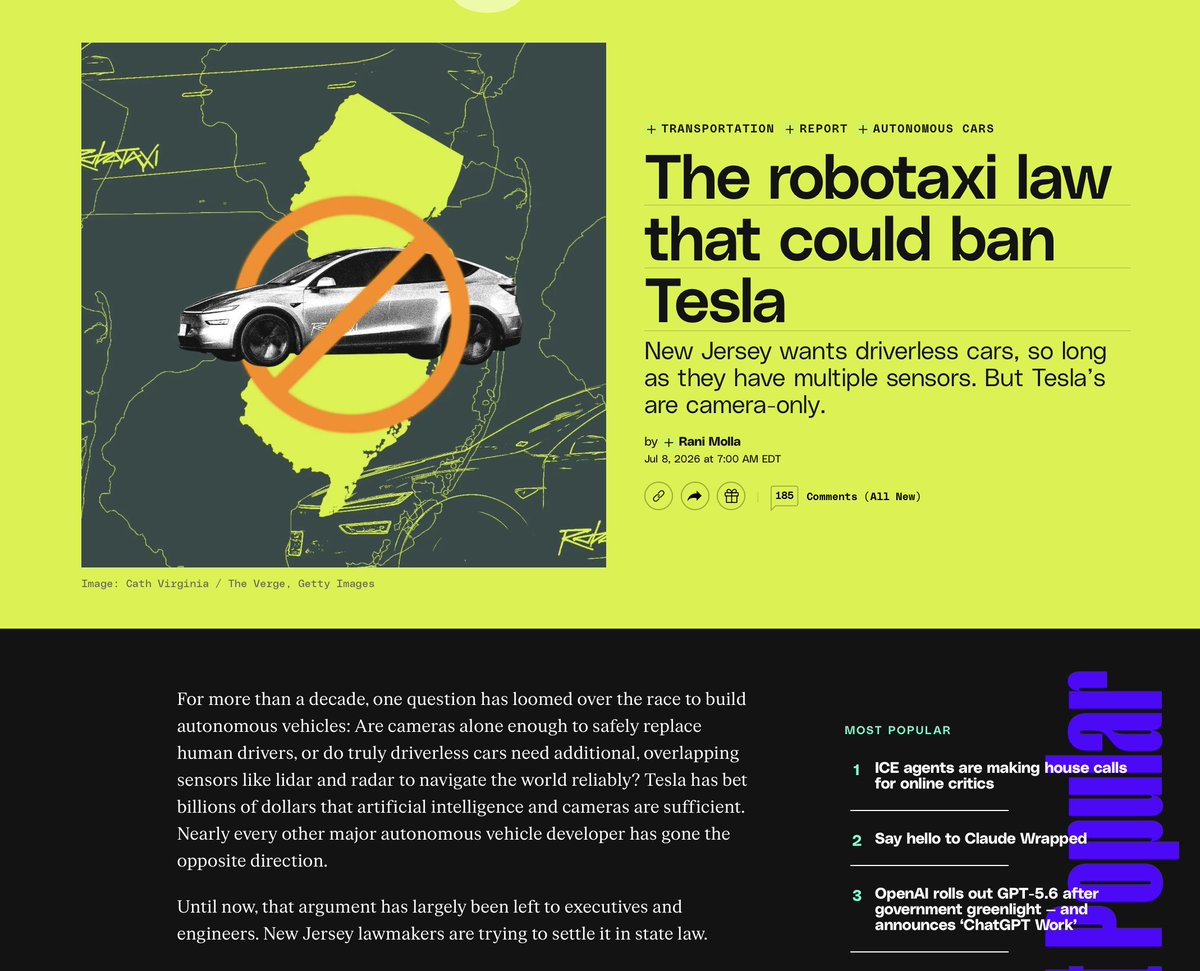
A bill advancing through the New Jersey legislature could shut Tesla's robotaxi ambitions out of one of the most densely populated states in the country. Senate Bill S1677 — and its companion Assembly Bill A3968 — would require fully driverless commercial vehicles to carry cameras plus two additional distinct sensing technologies, almost certainly LiDAR and radar. Tesla's vision-only approach, which underpins both Full Self-Driving and the upcoming Cybercab, uses neither. If the bill becomes law, Tesla would be effectively barred from operating a commercial autonomous fleet in New Jersey without a fundamental hardware redesign.

What the Bill Actually Requires
S1677 establishes a three-year pilot program for fully autonomous commercial vehicles operating in New Jersey. The sensor mandate is the most consequential provision for Tesla, but it is far from the only hurdle the legislation creates. According to legislative filings, operators would need to satisfy all of the following before putting a single driverless vehicle on a New Jersey road commercially:
- Hardware: Cameras plus at least two additional sensing technologies (e.g., radar and LiDAR)
- Supervised testing: Minimum 50,000 miles with a human safety driver inside New Jersey before any driverless commercial deployment
- Crash reporting: All collisions reported to the state within 48 hours, along with relevant vehicle data
- Insurance: At least $5 million in liability coverage per vehicle
- State authorization: Official approval required before launching any commercial driverless network
- Restricted zones: No autonomous operation in school zones, active construction zones, or areas with elevated pedestrian collision rates
- Traditional controls: The bill favors retention of a steering wheel and pedals — a requirement that would directly conflict with the Cybercab's hardware design
The bill has already cleared the Senate Transportation Committee and been referred to the Senate Budget and Appropriations Committee, meaning it is moving through the legislative process rather than stalling at introduction.
The Sponsor's Position
Senator Andrew Zwicker, the Democratic sponsor of S1677, has been direct about his framing. "This is not anti-Tesla. I'm pro-New Jersey safety," he said, as reported by Sawyer Merritt. Zwicker has also clarified that the bill targets fully driverless commercial fleets — it would not affect consumer-facing features like Autopilot or Full Self-Driving that still require a licensed human driver behind the wheel. For the roughly 100,000-plus Tesla owners in New Jersey, day-to-day supervised FSD use would be unaffected.
That distinction matters politically. Zwicker is threading a needle: positioning the legislation as a safety framework rather than a technology ban, while simultaneously writing hardware requirements that only one major AV company cannot currently meet.
Tesla's Response and the Broader Stakes
Tesla has already moved to counter the bill directly. According to reports, the company has lobbied against S1677 and has informed New Jersey owners that the legislation would ban its autonomous vehicle technology in the state — a notable step that signals how seriously Tesla views the threat.
The stakes extend well beyond New Jersey's borders. Neighboring New York is reportedly considering a nearly identical hardware mandate. If both states adopt sensor requirements that camera-only systems cannot satisfy, Tesla would face a de facto exclusion zone covering the entire New York metropolitan area — one of the highest-density, highest-revenue markets for any ride-hail or robotaxi service in the world. That regional dynamic could matter more than the New Jersey bill in isolation.
Tesla's bet on pure vision is a core architectural decision, not a cost-cutting shortcut. The company has argued for years that the human visual system navigates the world using cameras alone, and that adding LiDAR or radar introduces sensor fusion complexity without a proportional safety gain. That argument has carried weight at the federal level, where NHTSA has not mandated specific sensor hardware for autonomous vehicles. State-level mandates, however, operate on a different timeline and with different political pressures — and New Jersey appears willing to move ahead regardless of what Washington does or does not require.
What It Means for the Cybercab Rollout
Tesla has been building toward a commercial robotaxi launch, with the Cybercab — a purpose-built two-seat vehicle without a steering wheel or pedals — central to that plan. The steering-wheel provision in S1677 alone would disqualify the Cybercab's current hardware configuration from New Jersey roads, independent of the sensor debate. Together, the two requirements create a compounding problem: Tesla would need to add sensors it has publicly rejected and physical controls it deliberately removed.
The bill has not yet passed, and Tesla has time to lobby, litigate, or negotiate amendments before it reaches the governor's desk. But the trajectory is worth watching closely. If S1677 becomes law in its current form, it will be the most concrete legislative barrier Tesla's robotaxi program has faced in any major U.S. market — and a potential template for other states weighing similar frameworks.
🚕 Following the Robotaxi rollout? See every operating city, launch date and announced market in our Tesla Robotaxi Tracker.
Related Gear
Gear up your Tesla with tested, custom-fit BASENOR accessories — shop Tesla accessories →
Sources & reporting notes
The links below identify the material source records used for this report.
- @SawyerMerritt on X (2026-07-10T03:23:32.000Z) — Direct source
Source links are preserved as published or accessed. See our editorial standards and corrections policy.
The BASENOR Editorial Desk covers Tesla, SpaceX, and related technology, curating reporting from primary sources — official accounts, regulatory filings, and software release data. Every article passes source-record and fact-checking review before publication. About the newsroom.
This report was curated by the BASENOR Editorial Desk from the sources listed above. Read our editorial standards or email editorial@basenor.com to report an error.