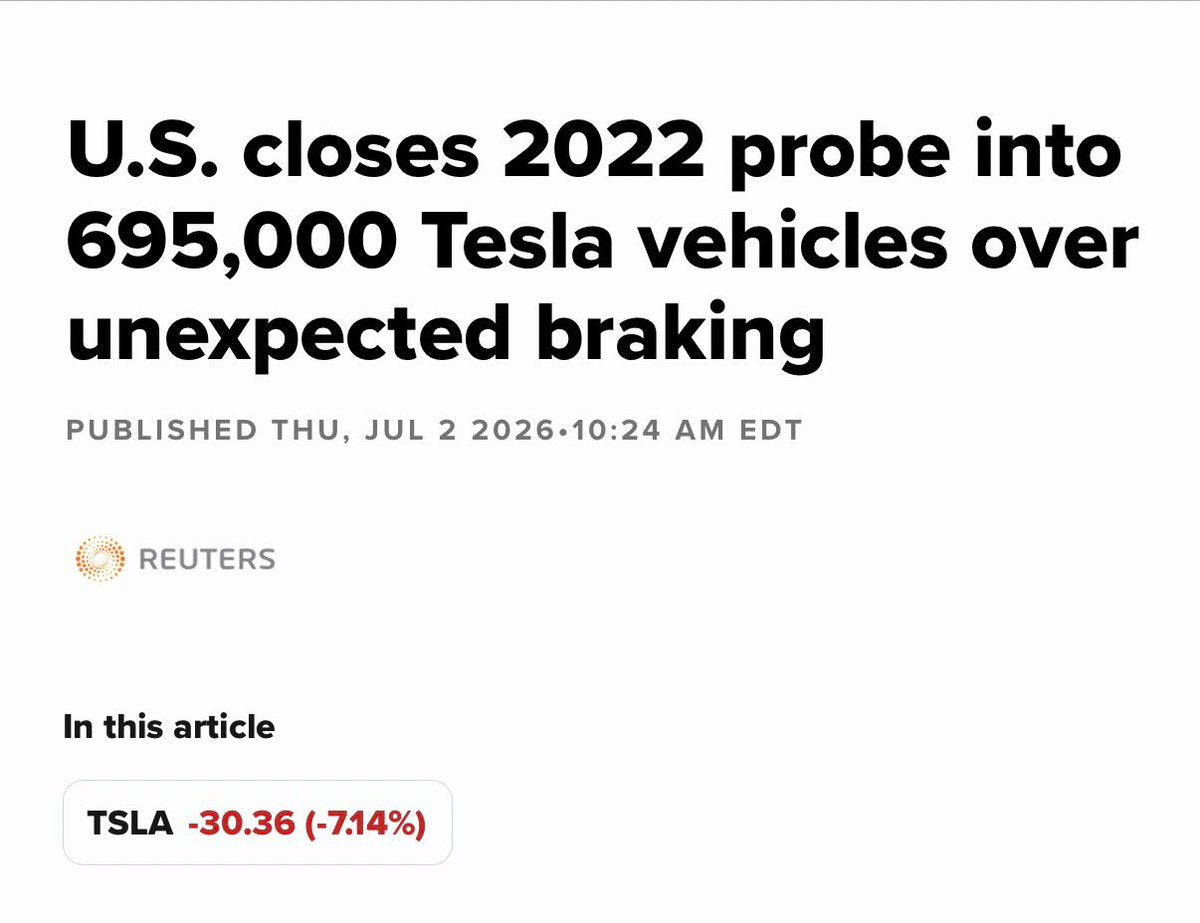
The National Highway Traffic Safety Administration officially closed its 2022 preliminary evaluation into unexpected braking in Tesla vehicles on July 2, 2026 — a four-year investigation that covered approximately 695,000 Model 3 and Model Y vehicles from the 2021 and 2022 model years. The closure marks a significant regulatory milestone for Tesla, with the agency concluding there was no pattern of collision risk tied to the events that originally triggered the probe.

How the Investigation Unfolded
The probe began in February 2022 after complaints of sudden, unexplained deceleration — colloquially dubbed "phantom braking" — surged from 99 at the end of 2021 to 314. The incidents were tied to Tesla's Autopilot, Full Self-Driving, and Traffic-Aware Cruise Control systems, and the NHTSA's review ultimately pointed to a likely contributing factor: Tesla's 2021 transition from a radar-plus-vision sensing system to a vision-only architecture. Without radar as a redundant input, the system occasionally misread traffic conditions and applied the brakes unnecessarily.
Tesla responded quickly at the time, issuing software updates in early 2022 to address the unexpected deceleration behavior. The data suggests those updates worked. According to the NHTSA's findings, incident reports dropped sharply — from the peak of 314 complaints in early 2022 to just 45 in 2024, 19 in 2025, and only 3 in the first half of 2026.
Why NHTSA Closed It
The agency cited two primary reasons for closing the evaluation. First, it found "no pattern of lane departure or collision risk tied to the events." Second, it determined there was a "low demonstrated hazard to drivers" given the steep decline in reported incidents. Importantly, the NHTSA confirmed that no collisions, fatalities, or injuries were identified in connection with the unexpected braking events throughout the entire investigation period.
The closure is a preliminary evaluation closure, not a full exoneration. The NHTSA was careful to note that shutting the probe does not mean a safety-related defect has been definitively ruled out, and the agency retains the authority to reopen an investigation if new circumstances arise.
What This Means for Model 3 and Model Y Owners
For the roughly 695,000 2021–2022 Model 3 and Model Y owners who fell within the investigation's scope, the practical takeaway is straightforward: if you updated your vehicle's software in 2022 or later, you've almost certainly already benefited from the fix Tesla deployed. The complaint data makes clear that the issue largely resolved itself through those over-the-air updates — a pattern that has become Tesla's standard playbook for addressing fleet-wide software-driven anomalies.
Owners still experiencing unexpected deceleration events on older software versions should ensure their vehicle is running the latest available firmware. Those on current builds are unlikely to encounter the behavior that originally drew NHTSA's attention.
The closure also carries a broader implication for the ongoing debate around vision-only autonomy systems. The phantom braking spike in 2021–2022 was widely cited as evidence that removing radar introduced new failure modes. The NHTSA's own review acknowledged that the radar-to-vision transition "likely contributed" to the incidents — a rare instance of a federal agency formally connecting a hardware architecture decision to a safety complaint pattern, even as it ultimately declined to escalate the investigation.
Related Gear
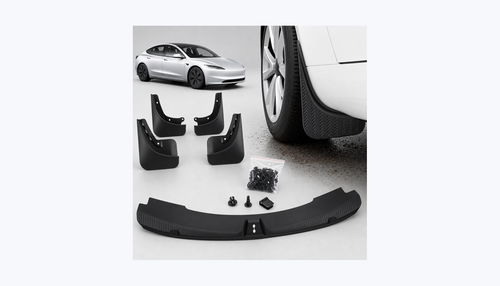
Gear up your Model 3 with tested, custom-fit BASENOR accessories — shop Model 3 accessories →
Sources & reporting notes
The links below identify the material source records used for this report.
- @wholemars on X (2026-07-02T15:21:44.000Z) — Direct source
Source links are preserved as published or accessed. See our editorial standards and corrections policy.
The BASENOR Editorial Desk covers Tesla, SpaceX, and related technology, curating reporting from primary sources — official accounts, regulatory filings, and software release data. Every article passes source-record and fact-checking review before publication. About the newsroom.
This report was curated by the BASENOR Editorial Desk from the sources listed above. Read our editorial standards or email editorial@basenor.com to report an error.