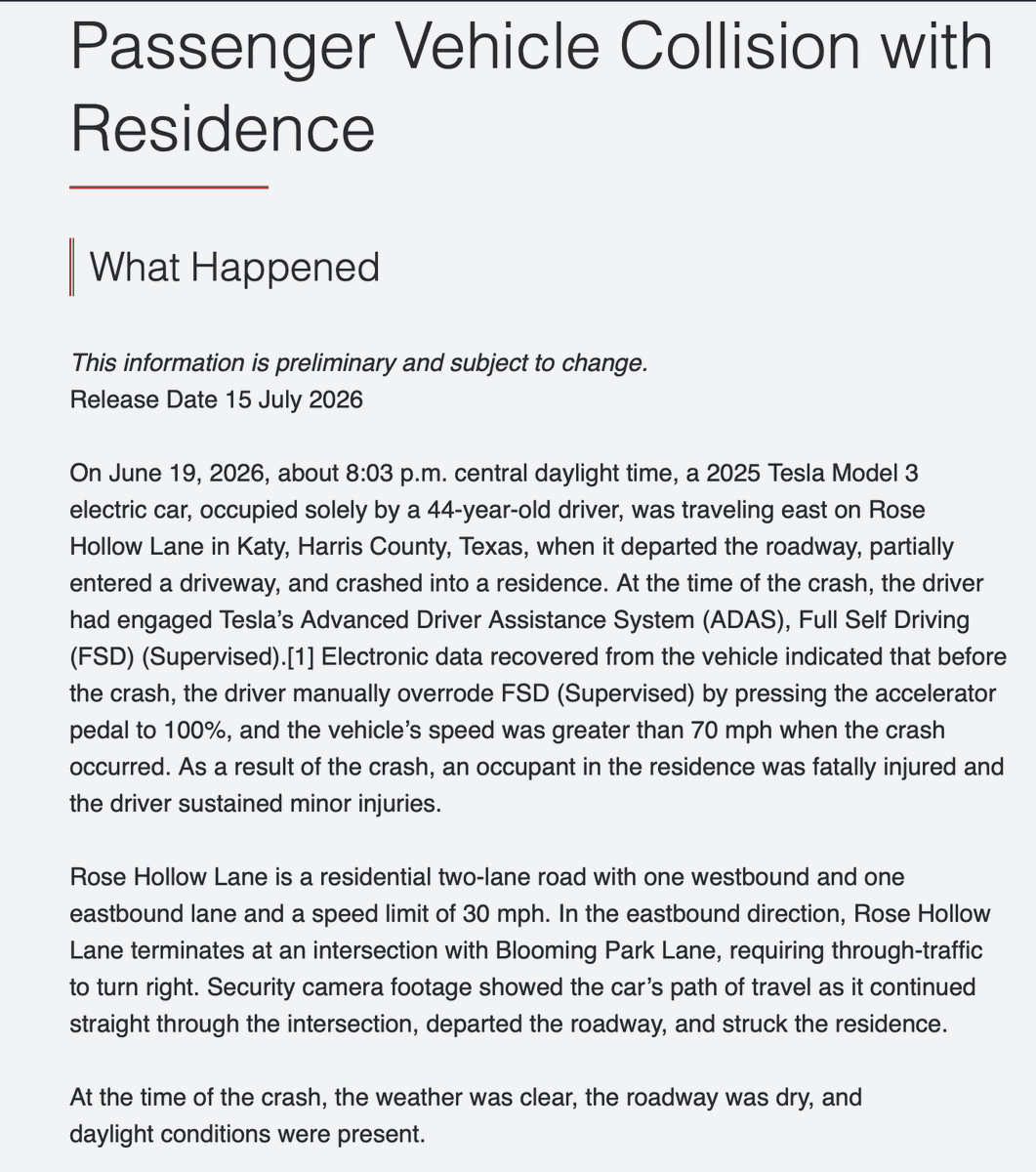
The National Transportation Safety Board has released its preliminary report on the fatal June 2026 Tesla Model 3 crash in Katy, Texas — and the findings directly support Tesla's account of events. According to the report, driver Michael Butler pressed the accelerator pedal to 100%, overriding the active Full Self-Driving (Supervised) system, sending the vehicle through a residential neighborhood at more than double the posted speed limit before it struck a home and killed 76-year-old Martha Avila.

What the NTSB Report Actually Says
The preliminary findings are specific. Butler, 44, depressed the accelerator to its maximum capacity — 100% — while FSD (Supervised) was engaged. That input overrode the system entirely. Tesla's Head of AI, Ashok Elluswamy, confirmed that vehicle data showed the car reached 73 mph in a 30 mph residential zone.
The report also notes that investigators found evidence of prior internet searches by Butler regarding what he described as the "perceived lack of aggression" in Tesla's FSD software. Butler has claimed he lost consciousness before the crash. He is currently facing manslaughter charges, and the victim's family has filed a negligence lawsuit naming both Butler and Tesla as defendants. Both the NTSB and NHTSA are actively investigating.
This is a preliminary report — a final determination on probable cause will come later in the investigation process.
How FSD Override Actually Works — and Why It Matters
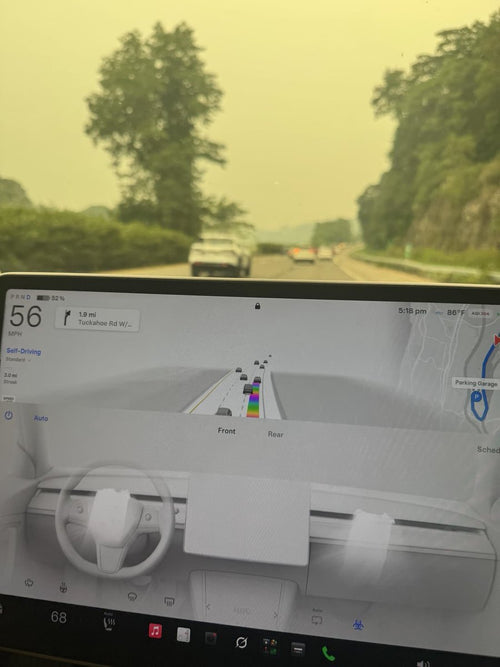
FSD (Supervised) is designed to be overridden by the driver at any time. That's not a flaw — it's a deliberate, regulatory-required design choice that keeps the human in the loop. When a driver presses the accelerator pedal firmly, the system interprets that as an intentional command and yields control. A 100% accelerator press is an unambiguous signal.
This is the same principle behind why Tesla's system is called "Supervised" — it requires an attentive driver who can and will intervene. The system cannot prevent a driver from deliberately or accidentally flooring the accelerator, nor is it currently designed to do so.
What FSD Owners Should Know Right Now
This case is a stark reminder of how the current generation of FSD actually works. If you use FSD (Supervised), here are the behaviors and responsibilities that apply to you today:
1. You can override FSD instantly — and the car will follow your input.
Any firm accelerator press, steering input, or brake application overrides the system. The car does what you tell it to. This is intentional and documented.
2. FSD does not prevent dangerous driver inputs.
FSD (Supervised) is not a safety cage. It cannot countermand a driver who floors the accelerator. If you press the pedal to 100%, the car accelerates — regardless of what FSD was planning to do.
3. Attentiveness is not optional.
Tesla's own terms for FSD (Supervised) require the driver to remain alert, keep hands available, and be ready to take over at all times. The "Supervised" designation is not marketing language — it is a functional description of the system's limitations.
4. Check your driver monitoring settings.
Navigate to Controls > Autopilot and confirm that driver monitoring prompts are enabled. If you've dismissed these reminders in the past, re-familiarize yourself with how frequently the system checks for driver engagement on your current software version.
5. Understand what "Autosteer paused" and override prompts mean.
When FSD hands control back to you — or when you take it — the system logs that transition. Vehicle data is recoverable and has proven decisive in crash investigations, including this one.
The Broader Legal Picture
The NTSB's preliminary findings don't end the legal proceedings — they inform them. The victim's family's lawsuit names Tesla as a co-defendant, which means Tesla's design choices, warning systems, and data logging practices will all face scrutiny regardless of what the driver data shows. Preliminary reports establish facts; final reports assign probable cause. That final report is still months away.
For Tesla owners, the more immediate takeaway is this: the data recorder in your car captures accelerator position, speed, FSD engagement status, and driver inputs with high fidelity. In any serious incident, that data will be the first thing investigators pull — and in this case, it told a clear story within weeks of the crash.
The NTSB's preliminary report can be accessed via the link shared by @SawyerMerritt. A final report with probable cause determination is expected later in the investigation.
Related Gear
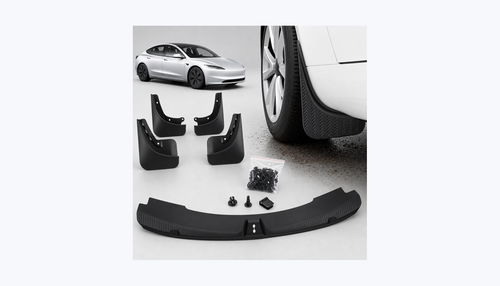
Gear up your Model 3 with tested, custom-fit BASENOR accessories — shop Model 3 accessories →
Sources & reporting notes
The links below identify the material source records used for this report.
- @SawyerMerritt on X (2026-07-15T22:40:49.000Z) — Direct source
- @SawyerMerritt on X (2026-07-15T22:40:48.000Z) — Direct source
Source links are preserved as published or accessed. See our editorial standards and corrections policy.
The BASENOR Editorial Desk covers Tesla, SpaceX, and related technology, curating reporting from primary sources — official accounts, regulatory filings, and software release data. Every article passes source-record and fact-checking review before publication. About the newsroom.
This report was curated by the BASENOR Editorial Desk from the sources listed above. Read our editorial standards or email editorial@basenor.com to report an error.