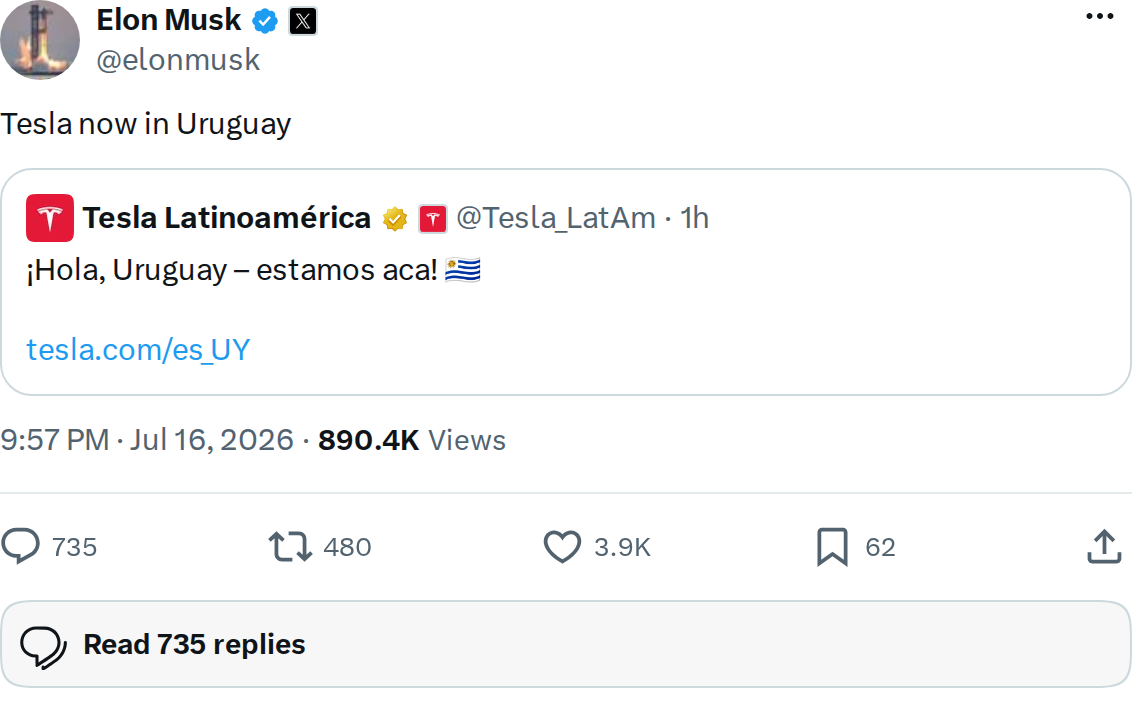
Tesla has officially entered Uruguay, confirming the country as its third direct-sales market in South America. Elon Musk made the announcement on X Wednesday evening, and while the post was brief, the background story is anything but — Uruguay represents one of the most EV-ready environments Tesla has entered in the region.

How We Got Here
The groundwork was laid quietly over the past several weeks. Tesla's Latin America X account teased the Uruguay arrival around June 29–30, with a formal company statement following around July 8–9, according to reporting from teslanorth.com and evwire.com. A registration window — open from July 1 through December 31, 2026 — was set up for interested Uruguayans to receive updates and "experience Tesla in Uruguay." Wednesday's Musk post appears to mark the transition from soft launch to official confirmation.
On the operational side, Tesla appointed Joaquín Lizarralde as country manager for both Argentina and Uruguay on June 22, 2026 — a unified Southern Cone structure that signals Tesla is treating this sub-region as a single commercial unit rather than isolated country bets. Tesla's official website now lists Uruguay for Stores, Service Centers, Superchargers, and Delivery Centers, with headquarters placed in the Montevideo Department.
Why Uruguay Makes Sense
Uruguay is a small market by population, but it punches well above its weight on the metrics that matter for EV adoption. Battery-electric vehicles have already crossed 20% market share domestically — a figure most developed markets are still chasing. Ninety-eight percent of Uruguay's electricity grid runs on renewable sources, which means Tesla owners there will be charging on some of the cleanest power anywhere in the world. Add a stable regulatory environment and relatively high per-capita income for the region, and the case writes itself.
Grey-market Tesla imports have existed in Uruguay for years, but without factory warranties, official service, or proper charging infrastructure. The official launch changes all of that — buyers now get direct sales, factory-backed warranties, and a Supercharger network that Tesla controls end-to-end.
Models and the Tax Question
Uruguayan regulators have homologated three versions each of the Model 3 and Model Y, with units set to be imported from Gigafactory Shanghai. Exact pricing has not yet been officially announced, though Tesla is expected to release details in the coming weeks.
One variable worth watching: Uruguay's government recently passed a resolution imposing the IMESI (Specific Internal Tax) on electric vehicles, effective January 1, 2027, with rates that vary based on import cost and apply to vehicles priced above $30,000. The Automobile Trade Association of Uruguay (ACAU) has raised objections to the measure. How Tesla prices its lineup relative to that threshold — and whether it adjusts before the tax kicks in — will be a key story to follow as the market matures.
The South American Picture
Uruguay follows Chile and Colombia, where Tesla began direct operations in November 2025. The pattern suggests a methodical, country-by-country approach to the continent rather than a simultaneous regional rollout. Argentina, sharing a country manager with Uruguay, is the obvious next question — though no official launch date has been announced there.
For now, Uruguay gets the distinction of being the most renewables-powered Tesla market on the planet. Whether Tesla can convert that favorable backdrop into meaningful volume before the 2027 IMESI tax complicates the pricing picture will define the early chapter of its presence there.
Related Gear
Gear up your Tesla with tested, custom-fit BASENOR accessories — shop Tesla accessories →
Sources & reporting notes
The links below identify the material source records used for this report.
- @elonmusk on X (2026-07-16T21:57:08.000Z) — Direct source
Source links are preserved as published or accessed. See our editorial standards and corrections policy.
The BASENOR Editorial Desk covers Tesla, SpaceX, and related technology, curating reporting from primary sources — official accounts, regulatory filings, and software release data. Every article passes source-record and fact-checking review before publication. About the newsroom.
This report was curated by the BASENOR Editorial Desk from the sources listed above. Read our editorial standards or email editorial@basenor.com to report an error.