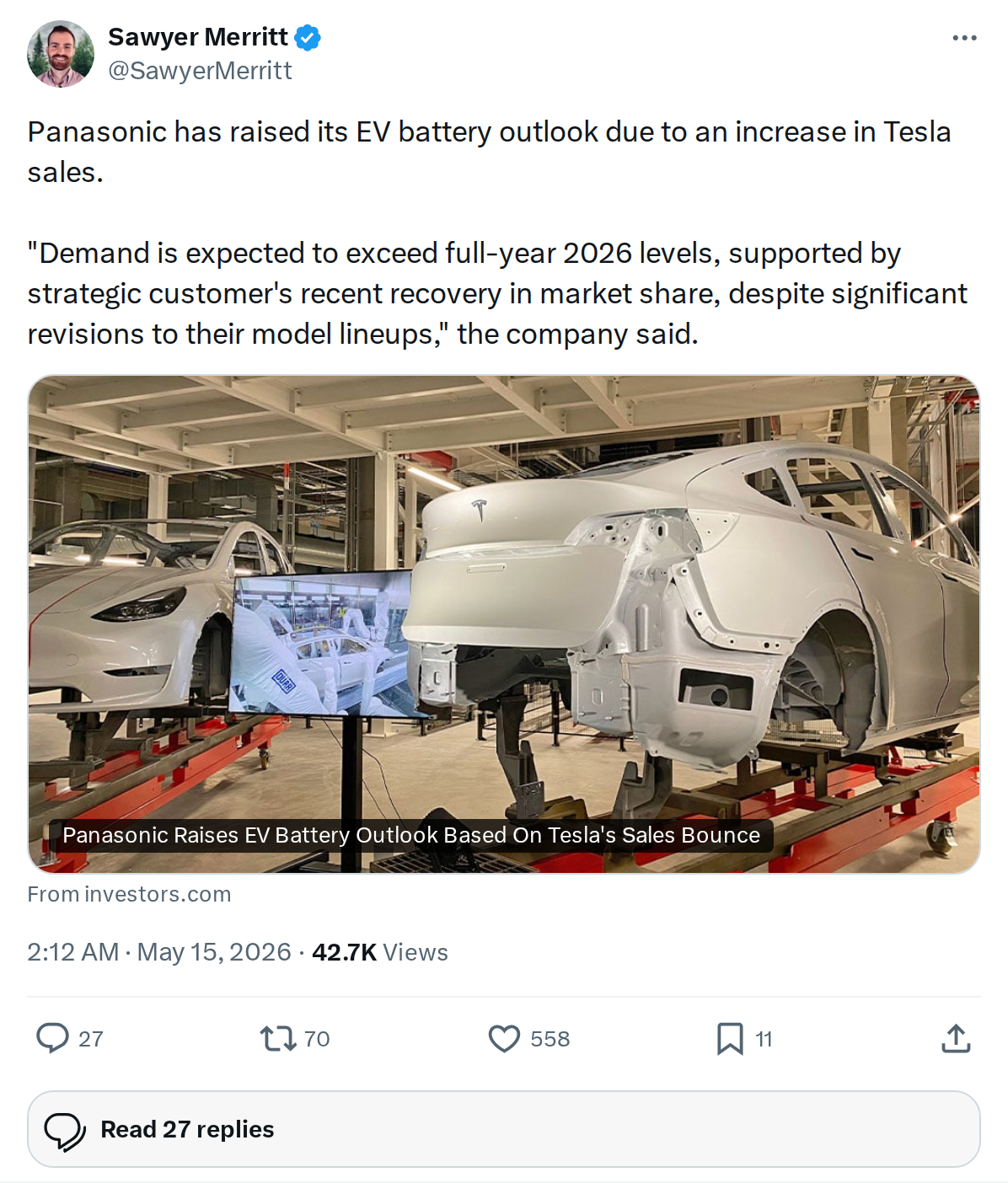
Panasonic has upgraded its electric vehicle battery demand forecast, pointing directly to a sales rebound at its primary customer — Tesla. The Japanese battery giant now expects demand to exceed full-year 2026 levels, a meaningful upward revision that signals Tesla is regaining commercial ground despite having made significant changes to its vehicle lineup in recent months.

What the Numbers Actually Say
Panasonic's revised forecast projects a 19% increase in US battery demand, reaching 46 gigawatt-hours (GWh) for the financial year ending March 2027. That growth is coming almost entirely from Tesla's recovery — not from a broader EV market surge. The overall US EV market is expected to remain flat for the year, which makes Panasonic's bullishness on Tesla-specific demand all the more notable.
The profit picture is equally striking. Panasonic's battery division is now expected to generate an operating profit of approximately ¥173 billion (roughly $1 billion USD) for fiscal year 2027 — more than double the ¥69.8 billion recorded in the prior year. That kind of year-over-year swing doesn't happen without a substantial pickup in order volume from a customer of Tesla's scale.
| Metric | Value | Context |
|---|---|---|
| US Battery Demand (FY2027 forecast) | 46 GWh | +19% year-over-year |
| Battery Division Operating Profit (FY2027) | ¥173B (~$1B) | vs. ¥69.8B prior year |
| Q1 Energy Unit Operating Result | -¥3.8B (-$24.2M) | Tariffs + Kansas startup costs |
| Panasonic Annual Net Profit (FY2026) | ¥189.5B | Down ~50% year-over-year |
| Long-term Adjusted Operating Profit Target | ¥750B+ ($4.76B) | By FY2029 |
The Complications Underneath the Optimism
The rosy demand forecast comes with real headwinds that Panasonic is still navigating. In the January–March quarter, the energy division posted an operating loss of ¥3.8 billion ($24.2 million), pressured by US tariffs, startup costs at its new Kansas manufacturing plant, and reduced output at a Japanese facility. The full-year profit recovery is therefore back-half weighted — dependent on Tesla's sales momentum holding through the remainder of 2026 and into early 2027.
Then there's the 4680 battery cell situation. Panasonic has disclosed further delays in mass production of the next-generation cylindrical cell, which was originally slated to begin scaling by March 2024. Full-scale automotive production at the Kansas plant — previously targeted for 2025 — has also been pushed back. For Tesla owners watching the Cybertruck and next-generation vehicle roadmap, those delays remain a factor worth tracking.
Panasonic's Broader Pivot
It's worth understanding Panasonic's forecast in the context of a company undergoing significant strategic change. The company is cutting 12,000 jobs and committing ¥500 billion in investment over three years — with a growing portion directed at AI data center hardware rather than automotive batteries. Panasonic has already begun shipping battery cells for data center applications in Japan and has decided to add a production line for that purpose at its Kansas plant.
Of Panasonic's ¥750 billion long-term operating profit target by FY2029, ¥130 billion is linked to AI infrastructure growth. That's a meaningful hedge: the company is betting on Tesla's EV recovery in the near term while simultaneously diversifying away from automotive dependency over the longer arc.
What This Means for Tesla Owners
For Tesla's existing and prospective customers, a supplier raising demand forecasts is a quiet but credible signal. Panasonic doesn't revise its outlook upward speculatively — it does so when order visibility improves. The fact that this revision is happening while the broader US EV market is expected to stay flat suggests Tesla is taking share from competitors, not simply riding a rising tide.
The model lineup revisions Panasonic references — the refreshed Model Y Juniper and other updates — appear to be driving real purchase decisions. Whether that momentum extends through the second half of 2026 is the open question, and Panasonic's own profitability now depends on the answer being yes.

Sarah focuses on Tesla Energy, SpaceX missions, and the broader Musk AI portfolio. Former data analyst in clean energy. Based in San Francisco.
Sources verified at publish time. Spotted an inaccuracy? Email editorial@basenor.com.