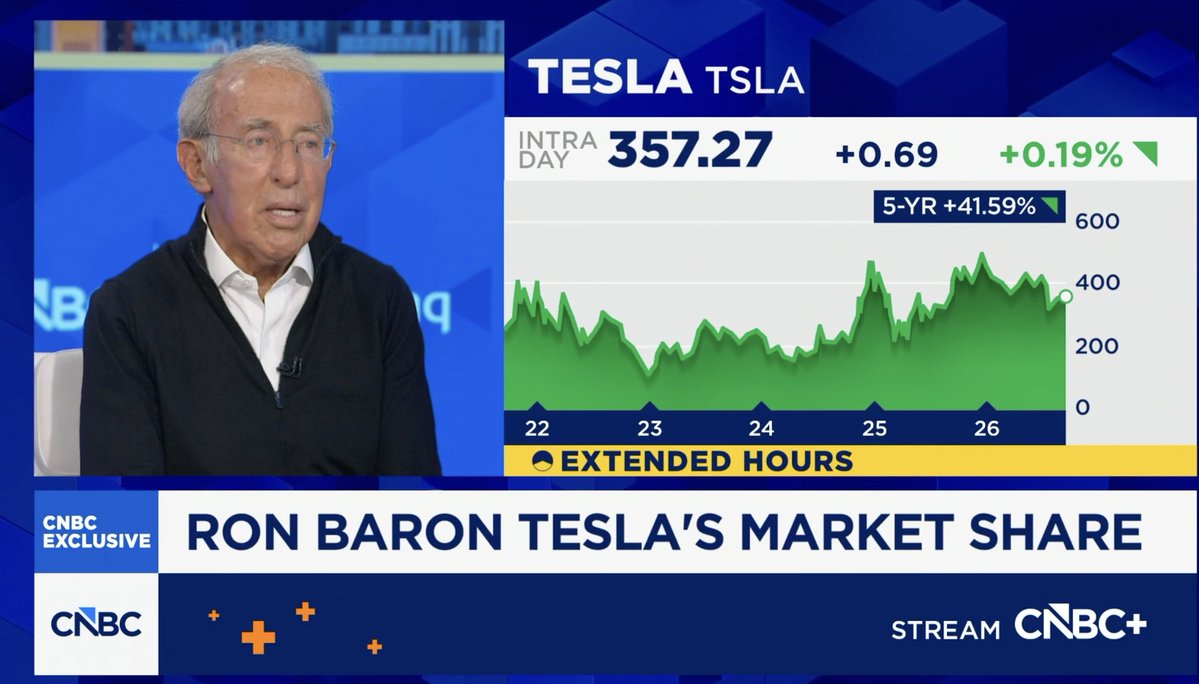
Billionaire investor Ron Baron made a fresh case for Tesla's Full Self-Driving technology on September 16, 2026, telling viewers in a new interview that adoption is accelerating, the safety record is improving, and the stock is worth buying right now. For Tesla owners watching FSD evolve from a niche add-on into a mainstream feature, his numbers are worth paying attention to.

Baron's FSD Interview, Broken Down
1. More than half of new buyers are choosing FSD
Baron cited a striking figure: 55% of new Tesla buyers are now opting into FSD at the point of purchase. That's a meaningful shift from the early days when FSD was a niche upgrade adopted mainly by enthusiasts. If accurate, it suggests Tesla has successfully repositioned FSD from an optional extra into something closer to a standard expectation for a large portion of its customer base — a dynamic that changes the economics of the entire software segment.
2. Baron calls FSD "safer" — and frames it as a selling point
Baron didn't hedge on safety. He stated flatly that FSD "is safer," using it as a core argument for why adoption will continue to grow. Tesla has long pointed to its fleet-wide miles-driven data as evidence of improving safety outcomes, and Baron appears to be leaning on that narrative directly. For prospective buyers still on the fence about autonomous features, endorsements from credible outside voices carry weight that internal marketing rarely achieves.
3. "It's going to be everywhere" — Baron sees FSD as a mass-market product
The phrase "it's going to be everywhere" signals that Baron views FSD not as a premium tier but as an eventual default. That framing matters for how owners think about the technology's trajectory. Features that reach ubiquity tend to get refined faster, supported more aggressively, and integrated more deeply into the vehicle experience. If Baron's read is right, the FSD you drive today is an early version of something far more capable and common.
4. "Bigger and bigger" — the compounding adoption argument
Baron's language — "catching on" and "bigger and bigger" — describes a compounding dynamic rather than a linear one. Each new FSD-equipped vehicle adds miles to Tesla's training dataset, which in turn improves the system, which makes it more attractive to the next buyer. Baron appears to be betting on that feedback loop accelerating. For current FSD subscribers, this is the core reason why the product tends to improve noticeably between major version releases — see our FSD coverage for the full version history.
5. Baron's stock call is built on the FSD thesis
"The time to buy the stock is now" — Baron tied his investment recommendation directly to FSD momentum, not to vehicle deliveries or energy storage. That's a notable framing. It positions FSD's software revenue and robotaxi potential as the primary value driver going forward, rather than hardware margins. Whether or not you follow his investment advice, the underlying logic tells you something about where the smart money thinks Tesla's growth story is headed.
Baron has been one of Tesla's most consistent long-term institutional backers, so his comments carry the weight of someone with deep visibility into the company's direction. A 55% FSD attach rate — if it holds — would represent a fundamental change in how Tesla monetizes its fleet, and the downstream effects for software updates, feature rollouts, and the broader autonomous driving roadmap could be substantial.
Related Gear
Gear up your Tesla with tested, custom-fit BASENOR accessories — shop Tesla accessories →
Sources & reporting notes
The links below identify the material source records used for this report.
- @SawyerMerritt on X (2026-09-16T15:36:27.000Z) — Direct source
- @SawyerMerritt on X (2026-09-16T15:47:55.000Z) — Direct source
Source links are preserved as published or accessed. See our editorial standards and corrections policy.
The BASENOR Editorial Desk covers Tesla, SpaceX, and related technology, curating reporting from primary sources — official accounts, regulatory filings, and software release data. Every article passes source-record and fact-checking review before publication. About the newsroom.
This report was curated by the BASENOR Editorial Desk from the sources listed above. Read our editorial standards or email editorial@basenor.com to report an error.