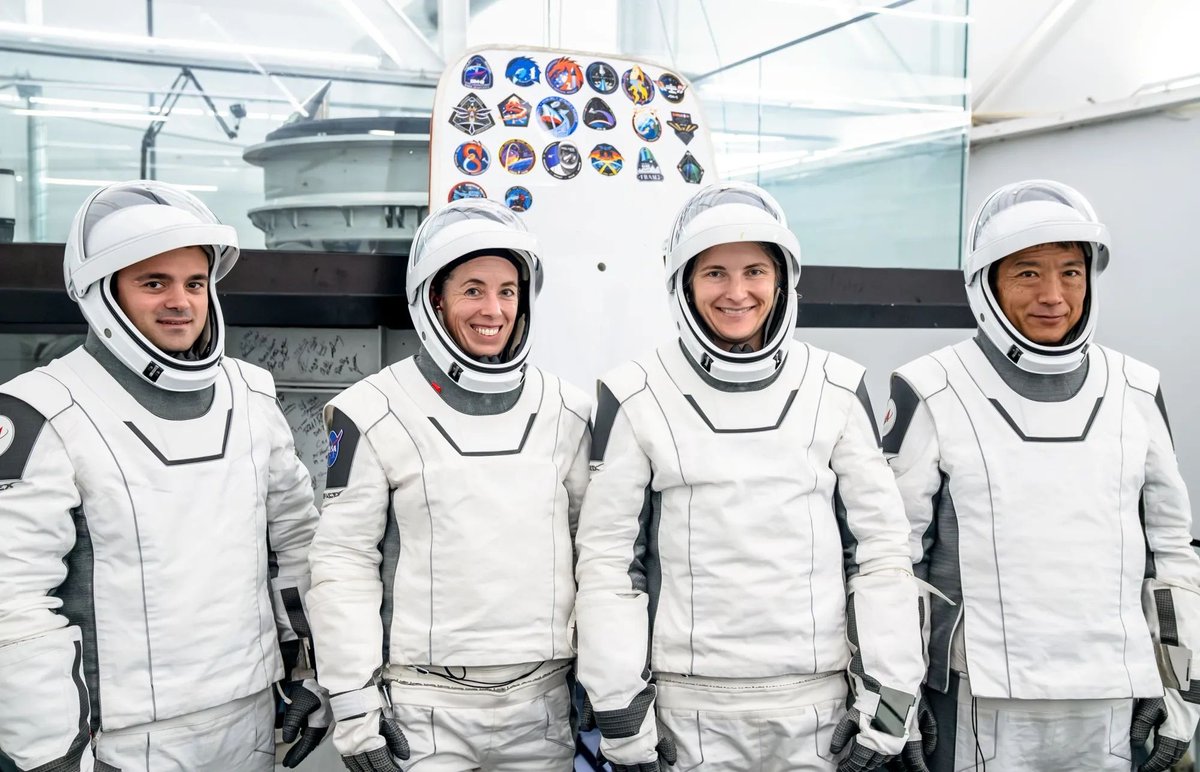
SpaceX has officially confirmed it is training NASA's Crew-14 astronauts ahead of a Falcon 9 launch aboard Dragon targeted for Spring 2027. The announcement, posted to X on September 24, puts the 14th commercial crew rotation mission to the International Space Station firmly on the calendar — and comes just days after a significant expansion of SpaceX's contract with NASA.

The Crew
Crew-14 will carry four people to the ISS, representing three space agencies. According to NASA, the lineup is:
| Name | Agency | Role |
|---|---|---|
| Kayla Barron | NASA | Spacecraft Commander |
| Chris Birch | NASA | Pilot |
| Makoto Suwa | JAXA | Mission Specialist |
| Arutyun Kiviryan | Roscosmos | Mission Specialist |
The international composition — NASA, JAXA, and Roscosmos under a single Dragon capsule — reflects the ISS partnership structure that has defined Commercial Crew missions since Crew-1 in 2020.
The Contract Behind the Mission
Crew-14 doesn't exist in isolation. On September 18, 2026 — just six days before SpaceX's training announcement — NASA modified its Commercial Crew Transportation Capability (CCtCap) contract with SpaceX, adding three additional crewed Dragon flights: Crew-15, Crew-16, and Crew-17. The modification was valued at $946 million, according to NASA, bringing the total CCtCap contract value to approximately $5.92 billion through 2030.
That scope covers considerably more than just putting people in a seat. SpaceX's responsibilities under CCtCap include ground processing, launch operations, in-orbit operations, crew return, capsule recovery, cargo transport, and maintaining a lifeboat capability while Dragon is docked at the station. It is, in effect, a full end-to-end human spaceflight service contract.
Where Crew-14 Fits in the Cadence
Commercial Crew rotation missions have settled into a reliable rhythm. A Dragon capsule launches, docks at the ISS, and the crew spends roughly six months aboard before returning to Earth — overlapping with the outgoing crew for a brief handover period. Crew-14's Spring 2027 target maintains that cadence, following whatever crew is currently on station.
The fact that SpaceX is already in active training with the Crew-14 astronauts — roughly six months out from the target launch window — is consistent with NASA's standard preparation timeline. Training covers Dragon systems, emergency procedures, ISS operations, and mission-specific science objectives.
For context on SpaceX's broader human spaceflight program, see our SpaceX coverage.
Falcon 9's Role
The mission will fly on Falcon 9, not Falcon Heavy or Starship. That's the expected choice for ISS crew rotation — Falcon 9 has an unbroken record on Commercial Crew missions, and its reliability at this point is well established. The Dragon capsule used for Crew-14 will almost certainly be a previously flown vehicle; SpaceX has routinely reused Dragon spacecraft across crew missions, with each capsule rated for multiple flights.
With Crew-15, 16, and 17 now contracted and Crew-14 entering active training, SpaceX's pipeline to the ISS is booked well into the latter half of the decade. The $5.92 billion total contract value underscores how central Dragon has become to NASA's human spaceflight strategy — at least until the agency's commercial successor programs mature.
Sources & reporting notes
The links below identify the material source records used for this report.
- @SpaceX on X (2026-09-24T22:46:40.000Z) — Direct source
Source links are preserved as published or accessed. See our editorial standards and corrections policy.
The BASENOR Editorial Desk covers Tesla, SpaceX, and related technology, curating reporting from primary sources — official accounts, regulatory filings, and software release data. Every article passes source-record and fact-checking review before publication. About the newsroom.
This report was curated by the BASENOR Editorial Desk from the sources listed above. Read our editorial standards or email editorial@basenor.com to report an error.