SpaceX Drone Ships Deploy for Triple Falcon 9 Launch Weekend
⚡ 30-Second Brief
The News: SpaceX's autonomous drone ships 'Just Read The Instructions' and 'A Shortfall of Gravitas' departed Port Canaveral within minutes of each other to support upcoming Falcon 9 booster recovery missions in the Atlantic.
Why It Matters: The dual deployment signals a compressed launch schedule with at least three Falcon 9 missions planned between February 15-18, demonstrating SpaceX's operational tempo as it scales Starlink deployment.
Source: @NASASpaceflight — Feb 15, 2026

📊 Key Figures
| Metric | Value | Context |
|---|---|---|
| Drone Ships Deployed | 2 | JRTI and ASOG from Atlantic fleet |
| Falcon 9 Missions (Feb 15-18) | 3 | Two from Cape Canaveral, one from Vandenberg |
| Booster B1077 Flight Number | 26th | Starlink 10-36 mission, Feb 17 |
| Booster B1090 Flight Number | 10th | Starlink mission, Feb 17 |
| Booster B1063 Flight Number | 31st | Starlink 17-25 from Vandenberg, Feb 18 |
🔭 The BASENOR Take
Timeline: Immediate deployment — ships departed hours before the first scheduled mission window
Impact Level: 🟢 Industry Signal — High operational cadence demonstrates recovery infrastructure scaling
Confidence: 95% — Launch schedules are fluid, but dual drone ship deployment confirms multi-mission intent
The synchronized departure of SpaceX's two Atlantic-based drone ships represents more than routine launch support operations. It's a visible indicator of the company's infrastructure maturation as it manages an increasingly compressed launch manifest.
According to verified launch schedules, Just Read The Instructions is positioned to catch Falcon 9 booster B1077 on its 26th flight during the Starlink 10-36 mission launching February 17 from SLC-40 at Cape Canaveral Space Force Station. Meanwhile, A Shortfall of Gravitas will support booster B1090's 10th flight, also launching a Starlink payload from the same pad on February 17.
The tight scheduling — potentially two launches from the same pad within hours — showcases SpaceX's evolved ground operations capability. This operational tempo was unthinkable just five years ago when turnaround times measured in weeks, not hours.
What makes this weekend particularly notable is the cross-country coordination: while the Atlantic fleet handles dual missions from Florida, the Pacific-based Of Course I Still Love You is stationed off California to receive booster B1063 on its 31st flight for Starlink 17-25 launching February 18 from Vandenberg Space Force Base. Three Falcon 9 launches across two coasts in four days represents the kind of sustained cadence SpaceX has been building toward since introducing booster reusability.
What This Means for Reusability Economics
The booster flight counts tell the real story. B1077 reaching its 26th flight and B1063 hitting 31 flights aren't just milestones — they're proof points for the economic model that makes rapid launch cadence financially viable. Each reuse dramatically lowers the marginal cost per launch, enabling SpaceX to maintain aggressive Starlink deployment schedules while still serving commercial and government customers.
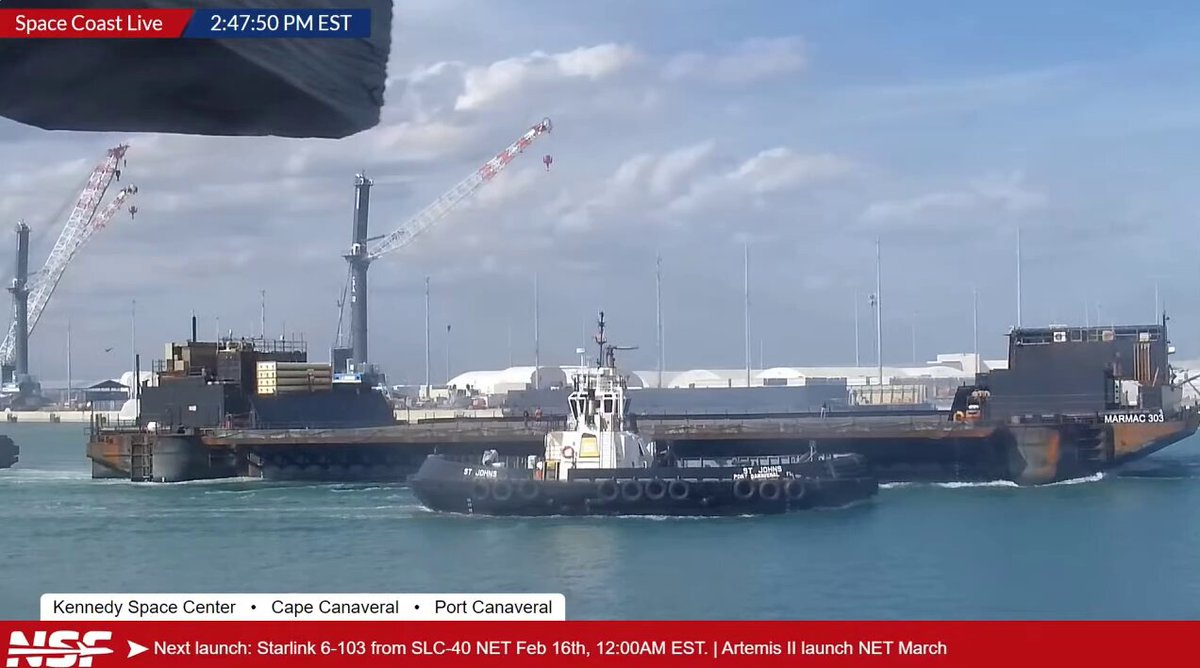
The drone ships themselves have evolved into finely-tuned recovery platforms. Each vessel — named after sentient starships from Iain M. Banks' Culture series — operates with minimal crew during recovery operations, relying on autonomous positioning systems to maintain station in the Atlantic's recovery zones. The tug escort visible in the departure footage handles initial navigation out of Port Canaveral before the drone ships proceed autonomously to their downrange stations.
For Tesla owners following SpaceX's progress, the parallel is clear: both companies are built on the premise that reusability and vertical integration unlock step-function improvements in unit economics. Just as Tesla's battery production scale drives EV cost curves downward, SpaceX's booster reuse and in-house manufacturing enable launch costs that legacy aerospace providers can't match.
The Starlink Build-Out Context
These missions are all Starlink deployments, which is significant. SpaceX is racing to complete its second-generation constellation while simultaneously serving a growing commercial manifest. The company has launched over 6,000 Starlink satellites to date, and maintaining global coverage while upgrading to Gen2 hardware requires sustained weekly launch cadence.
The February 7 return-to-flight mission — which saw booster B1088 land successfully on OCISLY after a brief operational pause — cleared the path for this weekend's rapid sequence. That mission deployed 25 Starlink satellites and validated vehicle readiness following the pause, which typically indicates SpaceX engineers identified and resolved a technical concern flagged during pre-flight analysis.
Infrastructure as Competitive Moat
The casual observer might see routine launch operations. The informed observer sees infrastructure advantage that competitors struggle to replicate. SpaceX operates three drone ships (JRTI and ASOG in the Atlantic, OCISLY in the Pacific), maintains dedicated booster processing facilities at both coasts, and has streamlined refurbishment workflows to the point where boosters can fly monthly.
The tug 'showing off' by sailing in reverse, as noted by NASASpaceflight, is actually a practical demonstration of the harbor pilot's skill navigating the massive drone ship through Port Canaveral's traffic. These seemingly minor operational details — efficient harbor egress, optimized sailing routes to recovery zones, rapid post-landing booster transport — compound into the time savings that enable 48-hour launch cadences from the same pad.
📰 Deep Dive
The dual drone ship deployment signals SpaceX's operational maturity reaching a new plateau. Where single launches once commanded weeks of preparation and dedicated recovery assets, the company now stages multiple missions in parallel with the kind of operational rhythm typically associated with airline departures rather than rocket launches.
This weekend's mission sequence also highlights how Starlink deployment has become the baseline workload that funds SpaceX's broader ambitions. Every Starlink launch generates revenue through subscriber growth while simultaneously proving out the reusability economics that will eventually support Starship operations. The Falcon 9 program has essentially become a cash-generating machine that finances next-generation development.
For the broader space industry, this cadence sets a benchmark that traditional providers cannot match without fundamentally restructuring their operations. When SpaceX can launch three missions in four days using flight-proven hardware, the competitive gap isn't about technology alone — it's about the entire operational philosophy that enables rapid reuse.
The coming weeks will likely see continued high-tempo operations as SpaceX works through its Starlink backlog while maintaining commercial mission commitments. Each successful recovery adds flight data to boosters approaching records that seemed impossible when the reusability program began. And each synchronized deployment of recovery assets demonstrates infrastructure leverage that represents years of iterative improvement in marine operations, weather forecasting, autonomous ship positioning, and post-landing logistics.
Sources & reporting notes
The links below identify the material source records used for this report.
- @NASASpaceflight on X (2026-02-15T19:53:17.000Z) — Direct source
Source links are preserved as published or accessed. See our editorial standards and corrections policy.
The BASENOR Editorial Desk covers Tesla, SpaceX, and related technology, curating reporting from primary sources — official accounts, regulatory filings, and software release data. Every article passes source-record and fact-checking review before publication. About the newsroom.
This report was curated by the BASENOR Editorial Desk from the sources listed above. Read our editorial standards or email editorial@basenor.com to report an error.