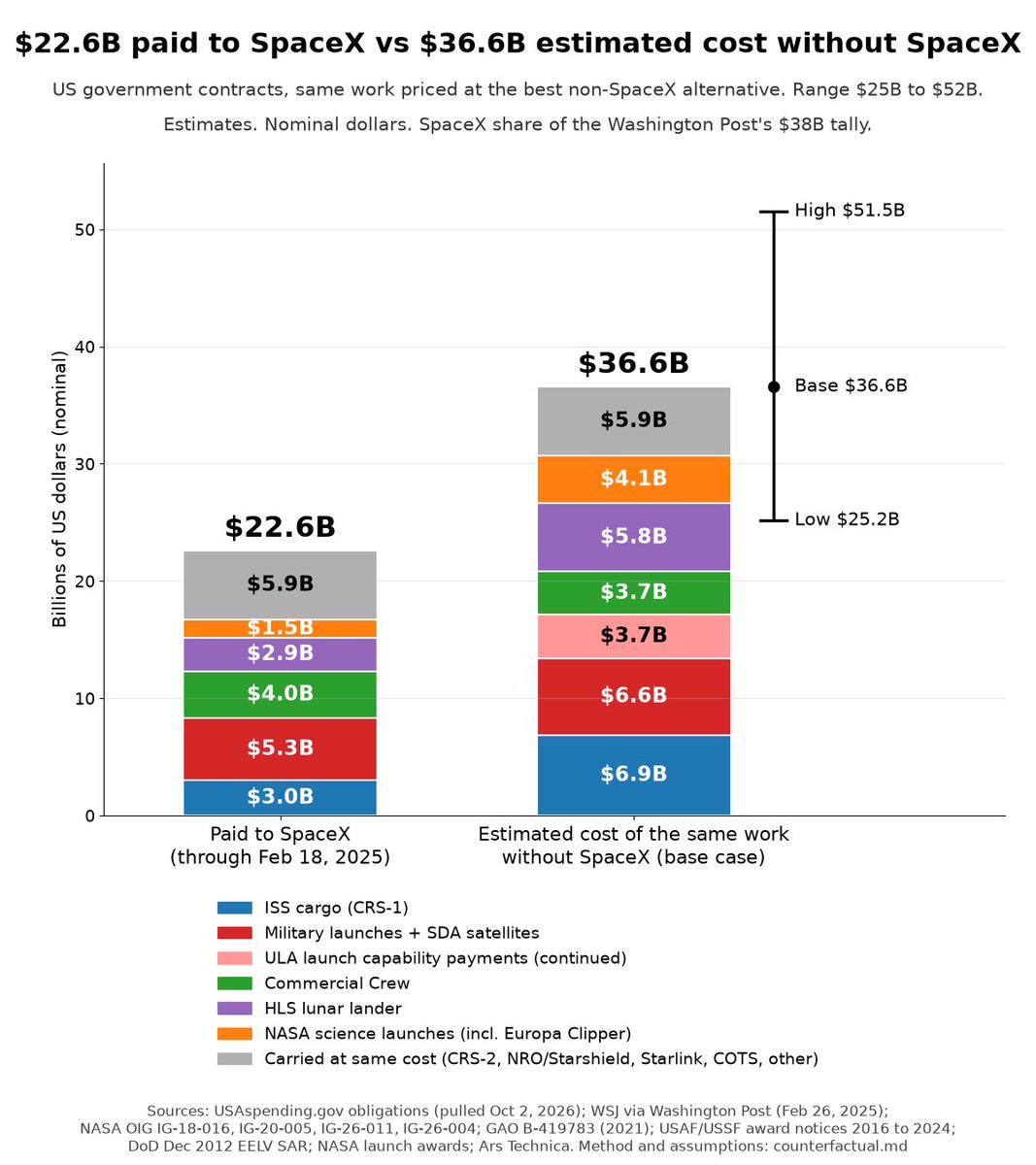
The U.S. government's bill for getting to orbit has dropped dramatically over the past decade — and according to Elon Musk, the savings figure that's already been confirmed publicly is now an undercount. In a post on X on Friday, Musk pointed back to the Pentagon's own accounting and noted the actual taxpayer savings from SpaceX are higher still.

The $40 Billion Baseline
In March 2026, the Pentagon confirmed that SpaceX had saved the U.S. government more than $40 billion through lower launch prices and superior contract execution. That figure was attributed to former Air Force General John Hyten and was later cited publicly by NASA Administrator Bill Nelson — giving it rare bipartisan institutional backing from both the defense and civilian space sides of the federal government.
To put that number in context: $40 billion is roughly the entire annual budget of NASA. The savings stem primarily from SpaceX's reusable rocket architecture, which slashed the per-kilogram cost to orbit compared to legacy launch providers. Where a traditional expendable rocket mission might cost $300–400 million, a Falcon 9 mission can run a fraction of that — and the booster lands itself for reuse.
Why the Number Keeps Growing
Musk's Friday post didn't attach a new specific figure, but the direction is straightforward to explain. SpaceX's launch cadence has continued accelerating through 2026, and each government mission flown at competitive commercial rates rather than cost-plus legacy contracts adds to the cumulative savings tally. The Department of Defense's National Security Space Launch program, NASA's Commercial Crew and Cargo contracts, and an expanding slate of intelligence community payloads all run through SpaceX's manifest.
Starship's development trajectory matters here too. As the fully reusable heavy-lift vehicle matures, the cost curve for large payloads is expected to fall further — meaning the savings gap between SpaceX and what legacy procurement would have cost will widen with each passing year.
The Institutional Confirmation Factor
What makes the $40 billion-plus figure notable isn't just the size — it's the source. These aren't SpaceX's own marketing numbers. The Pentagon's acknowledgment, backed by a four-star general's assessment and echoed by NASA's administrator, represents the U.S. government formally putting a dollar value on what competitive commercial launch has delivered. That kind of institutional validation is rare, and it carries weight in ongoing budget and procurement debates on Capitol Hill.
For the broader space industry, the implication is significant: the cost-plus contracting model that dominated government space procurement for decades has been structurally disrupted, and the savings are now large enough that they're being cited in official government communications as a measurable outcome.
Musk's note that the real figure is now even higher than the confirmed $40 billion suggests the accounting hasn't fully caught up with the pace of launches. As SpaceX continues to for our SpaceX coverage for updates as the Starship program matures and the full scope of those savings comes into sharper focus.
Sources & reporting notes
The links below identify the material source records used for this report.
- @elonmusk on X (2026-10-02T19:14:29.000Z) — Direct source
Source links are preserved as published or accessed. See our editorial standards and corrections policy.
The BASENOR Editorial Desk covers Tesla, SpaceX, and related technology, curating reporting from primary sources — official accounts, regulatory filings, and software release data. Every article passes source-record and fact-checking review before publication. About the newsroom.
This report was curated by the BASENOR Editorial Desk from the sources listed above. Read our editorial standards or email editorial@basenor.com to report an error.