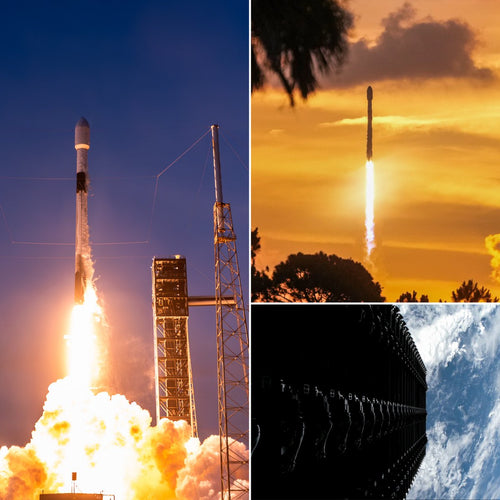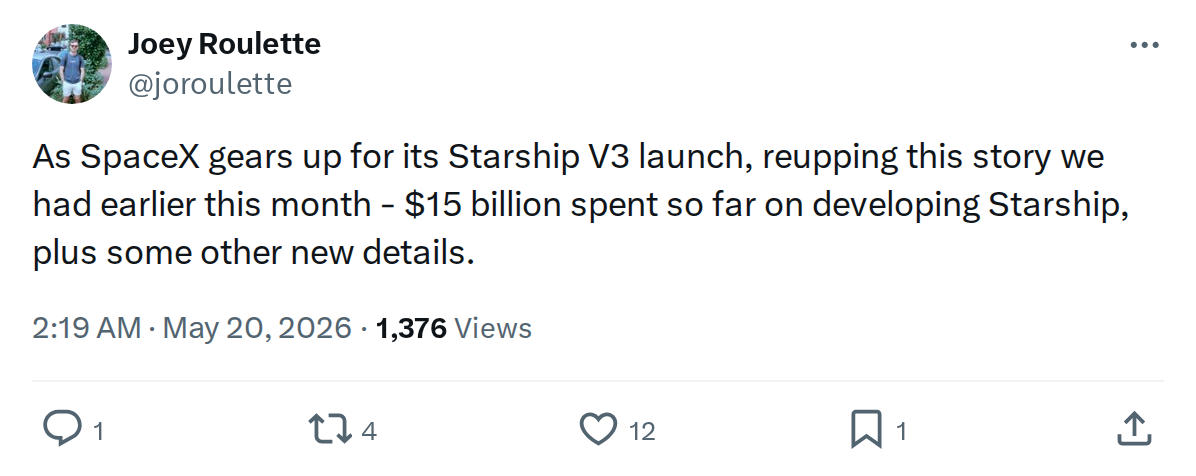
SpaceX has spent more than $15 billion developing its Starship rocket, according to the company's confidential IPO registration reviewed by Reuters — a figure that dwarfs the roughly $400 million it cost to develop the Falcon 9. The disclosure, resurfaced this week by Reuters reporter Joey Roulette as SpaceX prepares for its Starship V3 launch, puts the sheer ambition of the program into sharp financial relief.

What $15 Billion Actually Builds
To put the number in context: SpaceX spent roughly 37 times more developing Starship than it did on Falcon 9, the workhorse rocket that transformed commercial launch economics. The goal, according to Reuters, is "airline-like" reliability — a cadence of launches so routine and cost-efficient that space access becomes genuinely commoditized.
That ambition is baked into Starship V3's design. Unlike its predecessors, V3 is described as a clean-sheet redesign with dozens of key upgrades targeting orbital flight, extended in-space operations, and eventually crewed lunar landings for NASA's Artemis program. The estimated build cost for an expendable V3 vehicle sits around $90 million, with a projected launch cost of approximately $300 per kilogram to orbit — a figure that would fundamentally undercut every other heavy-lift option on the market if achieved at scale.

Where the Program Stands Now
V3's hardware is already past a critical milestone. On April 14, Booster 19 — the Super Heavy booster slated to fly the first V3 prototype — completed a full static fire test, igniting all 33 Raptor 3 engines simultaneously and generating approximately 9,240 tonnes of thrust. That's the kind of ground test that clears the path to an actual launch attempt.
V3 also unlocks payload categories that Falcon 9 simply cannot handle. SpaceX's next-generation Starlink V3 satellites are too large for Falcon 9's fairing, making Starship the only viable internal delivery vehicle for the next phase of the Starlink constellation. A recently disclosed launch contract — revealed in Voyager Technologies' annual Form 10-K filed in March 2026 — valued a single future orbital Starship launch at $90 million, offering a rare public data point on what the market is willing to pay.
The Remaining Challenges
The $15 billion figure is a development cost, not a finish line. SpaceX still needs to prove out two particularly complex systems at scale: the heat shield tiles that protect the vehicle during atmospheric re-entry, and in-orbit propellant transfer technology required for deep-space missions. Both have been tested in limited form but neither has been demonstrated under full operational conditions. Solving them is what separates a working prototype from the airline-like reliability SpaceX is promising customers and NASA alike.
For context on SpaceX's broader trajectory, check out our SpaceX coverage.
Whether $15 billion proves to be the full tab — or just the opening chapter — depends almost entirely on how quickly V3 can move from static fire to sustained orbital operations. The launch window is approaching, and the financial stakes have never been clearer.

Sarah focuses on Tesla Energy, SpaceX missions, and the broader Musk AI portfolio. Former data analyst in clean energy. Based in San Francisco.
Sources verified at publish time. Spotted an inaccuracy? Email editorial@basenor.com.