📌 UPDATE — May 21, 2026
SpaceX has selected Robinhood as one of a handful of brokerages to allocate IPO shares directly to retail investors — a major development for everyday investors looking to get in early. Notably, there is no minimum account size required to participate through Robinhood, lowering the barrier to entry significantly. Additional brokerages have also been selected, broadening retail access beyond a single platform. This signals SpaceX's intent to make the IPO widely accessible to the public, not just institutional players.


Source: @SawyerMerritt via X
📌 UPDATE — May 21, 2026
Retail investors looking to get in on the SpaceX IPO now have a clearer path forward. Charles Schwab has confirmed to reporter Sawyer Merritt that it is one of a select few brokerages chosen by SpaceX to allocate IPO shares directly to retail investors. To be eligible, Schwab account holders must proactively opt into IPO participation through the Schwab website before shares are made available. Other brokerages are also reportedly part of this allocation group, though specific names have not yet been confirmed. If you hold accounts at multiple brokerages, it's worth checking whether your platform is also participating and ensuring your IPO preferences are enabled ahead of the expected June listing.

📌 UPDATE — May 20, 2026
SpaceX has officially filed its IPO prospectus, revealing a trove of financial details that far exceeded analyst expectations. The biggest headline: Anthropic is paying SpaceX $15 billion per year (~$41M/day) for AI compute capacity — more than double the highest pre-filing estimates. Elon Musk confirmed SpaceX is in talks with additional companies for similar compute-as-a-service deals, with orbital data centers cited as a long-term growth avenue.
The filing also disclosed that Tesla holds 18,990,195 Class A common shares of SpaceX as of May 1, 2026, and that SpaceXAI has established a dedicated corporate headquarters in Palo Alto to house its AI research and engineering teams. On the Starlink front, the filing revealed 344 United Airlines aircraft are equipped with Starlink, having served 7 million passengers across 167,000 connected flights, and that 8,000 Starlink kits have been distributed to farmers.
Instead of a traditional 6-month lock-up, SpaceX is using a staggered insider share unlock structure tied to earnings milestones and stock price performance. Retail investors will be able to participate in the IPO directly through Charles Schwab, Fidelity, Robinhood, SoFi, and E*Trade.


📌 UPDATE — May 20, 2026
SpaceX's IPO filing has revealed the full scope of Elon Musk's voting control over the company. Through a dual-class share structure, Musk holds a combined voting power of 85.1%, owning 93.6% of all Class B stock. Specifically, he holds 849.5 million Class A shares (12.3% of that class) and 5.57 billion Class B shares — the latter carrying outsized voting weight that cements his dominance over all major corporate decisions. Public investors purchasing shares in the IPO will have minimal influence over SpaceX's strategic direction.
📣 @SawyerMerritt via X · May 20, 2026
📌 UPDATE — May 20, 2026
SpaceX's IPO filing has revealed the company's staggering market ambitions: it claims to have identified "the largest actionable total addressable market in human history," pegging its quantifiable TAM at $28.5 trillion. That figure breaks down across multiple segments, including $370 billion in space-enabled solutions and $1.6 trillion in connectivity. Beyond near-term markets, the filing also calls out asteroid mining and space tourism as future growth opportunities SpaceX intends to pursue — underscoring just how far beyond rockets and satellites the company is positioning itself for investors.


Source: @SawyerMerritt via SpaceX IPO filing disclosures
📌 UPDATE — May 20, 2026
SpaceX's IPO filing has revealed major financial details for the first time. Its Connectivity segment (primarily Starlink) generated $3.25 billion in Q1 2026 revenue and $11.38 billion for the full year, with Q1 operating income of $1.18B and Segment Adjusted EBITDA of $2.08B. The filing also discloses that SpaceX holds 18,712 Bitcoin — currently valued at over $1.45 billion — on its balance sheet.
On the AI and social side, the filing counts 6.3 million active paid subscribers across X Premium/Premium+ (4.4M) and SuperGrok tiers (1.9M), with 117 million monthly active Grok users and over 1.3 billion supported accounts active across its integrated AI platforms in the last twelve months.
Source: @SawyerMerritt via X, May 20, 2026
📌 UPDATE — May 20, 2026
SpaceX has officially filed its IPO prospectus — a 308-page document now publicly available — confirming the Nasdaq listing under the ticker symbol SPCX. The filing reveals a dual-class share structure: Class A shares carry 1 vote each, while Class B shares carry 10 votes each, ensuring Elon Musk retains dominant voting control over the company post-IPO. This moves the SpaceX listing from rumor and target to official regulatory reality.

via @SawyerMerritt · May 20, 2026

via @wholemars · May 20, 2026
📌 UPDATE — May 20, 2026
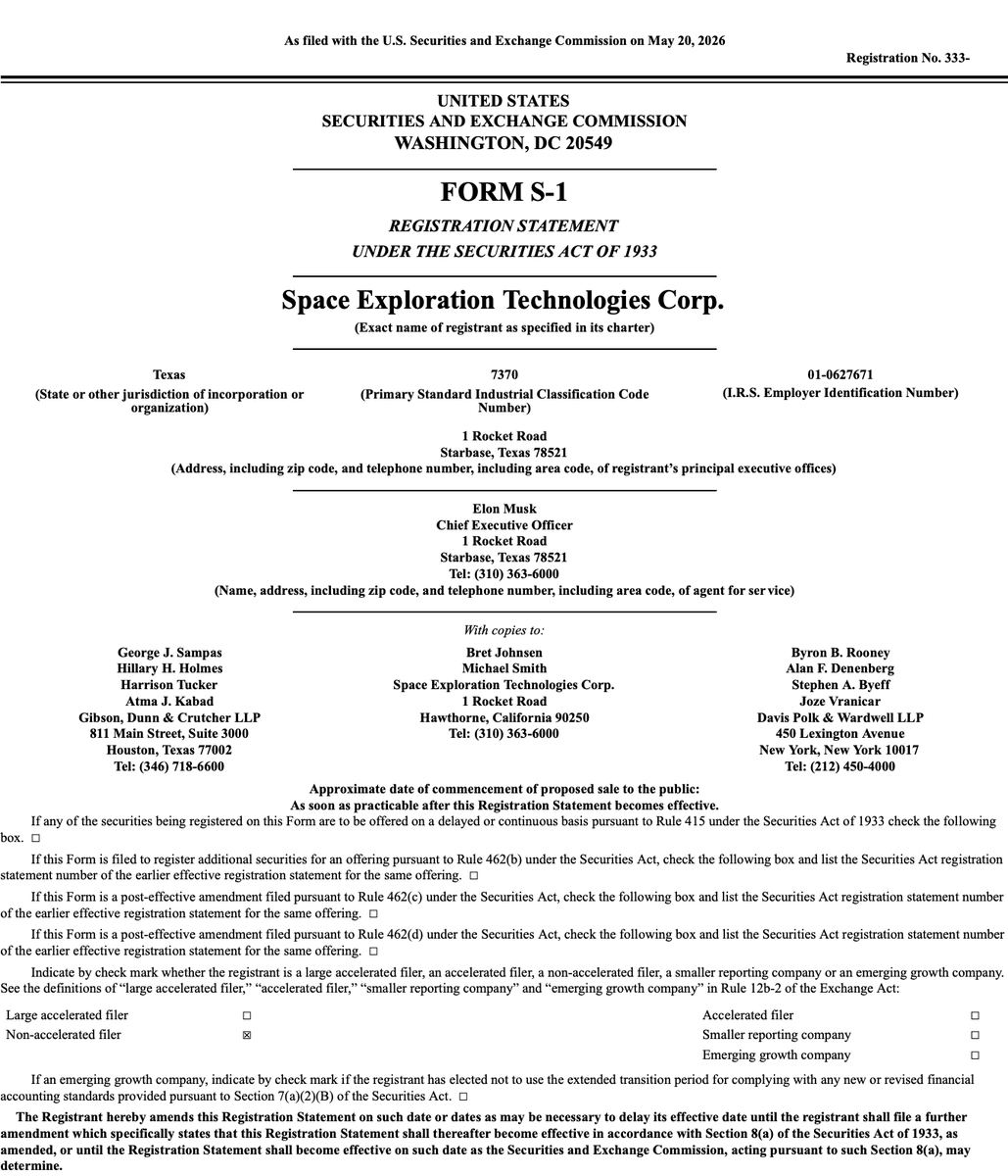
SpaceX has officially filed its S-1 IPO prospectus with the SEC, marking a major milestone on the path to a public listing. The document is now publicly available and contains detailed financial and operational disclosures about the company. This filing is a required step before shares can be offered to the public, and its release signals the IPO process is actively moving forward ahead of the previously reported June 2026 target timeline.

📌 UPDATE — May 19, 2026
SpaceX has reportedly selected Goldman Sachs as the lead underwriter for its anticipated IPO, marking a major step forward in the company's path to going public. The choice of Goldman Sachs — one of Wall Street's most prestigious investment banks — signals that SpaceX is serious about executing a high-profile listing. This development adds a key piece to the IPO puzzle as the June 2026 target window approaches. No official confirmation has been issued by SpaceX or Goldman Sachs at this time.

SpaceX is moving fast toward a public market debut, and Elon Musk has weighed in directly on the upcoming IPO. According to reports shared by Tesla and SpaceX watcher Sawyer Merritt, Musk has addressed what shareholders and prospective investors can expect — including a notable personal commitment regarding his own stake in the company.

What We Know About the SpaceX IPO
Based on verified reporting, SpaceX is targeting a Nasdaq listing under the ticker symbol SPCX, with trading expected to begin as early as June 12, 2026. The timeline has actually accelerated from an initial late-June target, driven by a faster-than-expected SEC review process. A public prospectus filing is anticipated as early as the week of May 20, with the investor roadshow kicking off June 4 and the offering price expected to be set around June 11.
The scale of this offering is historic. SpaceX is targeting a valuation in the range of $1.75 trillion to $2 trillion, with the company aiming to raise approximately $75 billion through the offering — figures that would potentially make this the largest IPO in history. Underwriters include Morgan Stanley, Bank of America, Citigroup, JPMorgan, and Goldman Sachs.
Musk's Personal Stance: No Share Sales
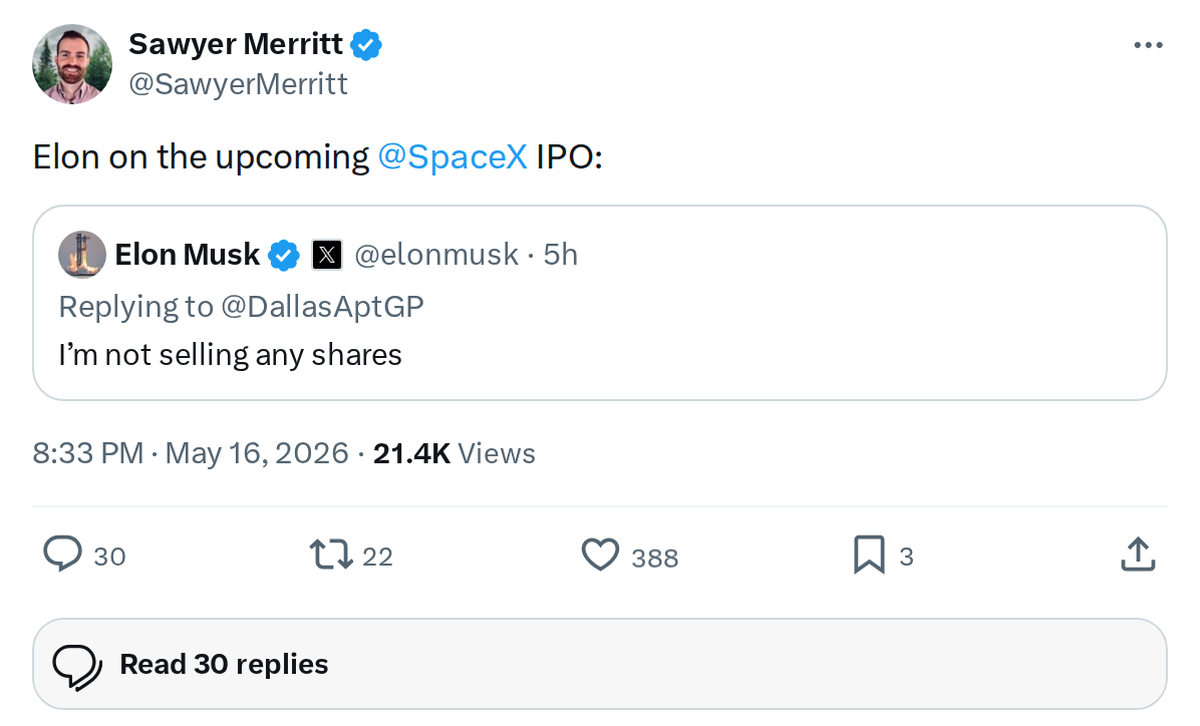
One of the more closely watched details: Elon Musk has stated he will not sell any of his personal SpaceX shares in connection with the IPO. That's a meaningful signal for prospective investors — it means the IPO proceeds are going to the company, not to the founder cashing out.
Musk will, however, retain significant control over the company post-IPO. According to the confidential filing, he controls Class B shares carrying 10 votes each. Under this dual-class structure, Musk can only be removed from his CEO or chairman roles by a vote of Class B holders — which he controls. Prospective investors are explicitly informed in the filing that this structure limits their ability to influence corporate matters.
Stock Split and xAI Merger Context
Ahead of the public listing, SpaceX shareholders have approved a 5-for-1 stock split. The adjustment reduces the fair market value per share from approximately $526.59 to $105.32, with the split scheduled to be processed during the week of May 18 and completed by May 22. The lower per-share price is designed to broaden retail investor accessibility once trading begins.
There's also a significant structural change worth noting: SpaceX merged with Musk's AI company xAI in February 2026, and as of May 2026, xAI is fully absorbed into SpaceX and rebranding as SpaceXAI. Investors buying into the SpaceX IPO will effectively be buying into a combined space, rocket, and artificial intelligence business — a scope that goes well beyond what the SpaceX brand name alone suggests.
SpaceX is also targeting early inclusion in the Nasdaq-100 Index, leveraging a new fast-entry rule that took effect May 1, 2026. If achieved, that would trigger automatic buying from index-tracking funds, adding significant demand pressure in the weeks after the listing.
For Tesla owners and investors who follow Musk's broader portfolio, the SpaceX IPO represents the most significant liquidity event in his empire since Tesla itself went public in 2010. Whether the $2 trillion valuation holds through the roadshow — and how Musk's dual-class governance structure lands with institutional investors — will be the story to watch over the next four weeks. You can follow our SpaceX coverage for updates as the listing date approaches.
Related Gear
Gear up your Tesla with tested, custom-fit BASENOR accessories — shop Tesla accessories →
Sources & reporting notes
The links below identify the material source records used for this report.
- @SawyerMerritt on X (2026-05-16T12:33:13.000Z) — Direct source
- @wholemars on X (2026-05-19T22:35:43.000Z) — Direct source
- @SawyerMerritt on X (2026-05-20T20:47:22.000Z) — Direct source
- @jeff_foust on X (2026-05-20T20:46:19.000Z) — Direct source
- @SawyerMerritt on X (2026-05-20T21:23:48.000Z) — Direct source
- @wholemars on X (2026-05-20T21:01:03.000Z) — Direct source
- @SawyerMerritt on X (2026-05-20T21:27:14.000Z) — Direct source
- @SawyerMerritt on X (2026-05-20T21:43:54.000Z) — Direct source
- @SawyerMerritt on X (2026-05-20T21:39:25.000Z) — Direct source
- @SawyerMerritt on X (2026-05-20T21:47:01.000Z) — Direct source
- @SawyerMerritt on X (2026-05-20T21:29:49.000Z) — Direct source
- @SawyerMerritt on X (2026-05-20T21:42:13.000Z) — Direct source
- @SawyerMerritt on X (2026-05-20T21:50:59.000Z) — Direct source
- @elonmusk on X (2026-05-20T22:35:20.000Z) — Direct source
- @SawyerMerritt on X (2026-05-20T22:55:09.000Z) — Direct source
- @SawyerMerritt on X (2026-05-20T22:46:09.000Z) — Direct source
- @SawyerMerritt on X (2026-05-20T22:24:15.000Z) — Direct source
- @SawyerMerritt on X (2026-05-20T22:15:08.000Z) — Direct source
- @SawyerMerritt on X (2026-05-20T22:12:46.000Z) — Direct source
- @SawyerMerritt on X (2026-05-20T22:07:38.000Z) — Direct source
- @SawyerMerritt on X (2026-05-20T22:02:11.000Z) — Direct source
- @SawyerMerritt on X (2026-05-21T17:36:09.000Z) — Direct source
- @SawyerMerritt on X (2026-05-21T18:33:43.000Z) — Direct source
- @SawyerMerritt on X (2026-05-21T18:55:12.000Z) — Direct source
Source links are preserved as published or accessed. See our editorial standards and corrections policy.
The BASENOR Editorial Desk covers Tesla, SpaceX, and related technology, curating reporting from primary sources — official accounts, regulatory filings, and software release data. Every article passes source-record and fact-checking review before publication. About the newsroom.
This report was curated by the BASENOR Editorial Desk from the sources listed above. Read our editorial standards or email editorial@basenor.com to report an error.