📌 UPDATE — July 16, 2026
Elon Musk has officially confirmed that the Starship Flight 13 launch window opens at 5:45 PM CT (Texas time) today, July 16. As of approximately 4:46 PM CT, NASASpaceflight reported T-60 minutes to the opening of the launch window, indicating the countdown is actively underway. The launch target date of July 14 slipped to July 16, and the pad and vehicle appear ready for the attempt.


📌 UPDATE — July 16, 2026
Starship Flight 13 has reached a major milestone: Ship 40 has been successfully stacked atop Booster 20 at Orbital Launch Pad 2, completing full stack operations in the early hours of July 16 UTC. Mechazilla executed the lift swiftly, with NASASpaceflight noting the arms "wasted no time" hoisting Ship 40 into position. The fully assembled Starship stack is now standing at the pad ahead of the targeted test flight, with SpaceX personnel on-site visibly celebrating the milestone.

📌 UPDATE — July 16, 2026
Ship 40 has arrived at the Starbase launch site and is ready to be stacked atop Booster 20 ahead of Starship Flight 13. Aerial photographer RGV Aerial Photography captured Ship 40 making its way to the pad late on July 15, and spaceflight photographer Joe Tegtmeyer confirmed the ship has "joined the party" with full stacking expected imminently. With both hardware elements now at Orbital Launch Pad 2, a launch attempt as early as July 16 appears to be on track.


📌 UPDATE — July 10, 2026 🔍
Booster 20 completed a static fire test from Pad 2 this morning, and the results were striking. Acoustic measurements taken from 6 miles away by LabPadre showed 182% greater peak pressure and 150% greater RMS pressure compared to previous tests, with dominant energy shifting to a lower frequency — making it one of the strongest events ever recorded at the site. The unusual pressure signature has raised questions about whether less water was used in the deluge system than normal, which could explain the dramatically amplified acoustic output.
@LabPadre · Jul 10, 2026
"Was less water used in the deluge system? From 6 miles away B20's static fire produced 182% greater peak pressure, 150% greater RMS pressure, and shifted the dominant energy into a lower-frequency. It was one of the strongest events we've measured, both in amplitude and in its…"
View on X

▶ Click to watch B20 static fire footage via @LabPadre
📌 UPDATE — July 10, 2026
Starship Flight 13 is now fast approaching, with SpaceX actively preparing launch notices for mid-July attempts as Starbase works through the final test schedule. In a sign of the program's rapid cadence, Ship 41 — designated for the subsequent Flight 14 mission — is already undergoing testing at Starbase concurrently with Flight 13 preparations. This parallel processing suggests SpaceX is pushing to significantly compress the turnaround time between successive Starship flights.

@NASASpaceflight · Jul 10, 2026
"The launch of Starship Flight 13 is fast approaching as Starbase moves through the test schedule and prepares launch notices for mid-July attempts. Notably, Ship 41, intended for Flight 14, is also undergoing testing."
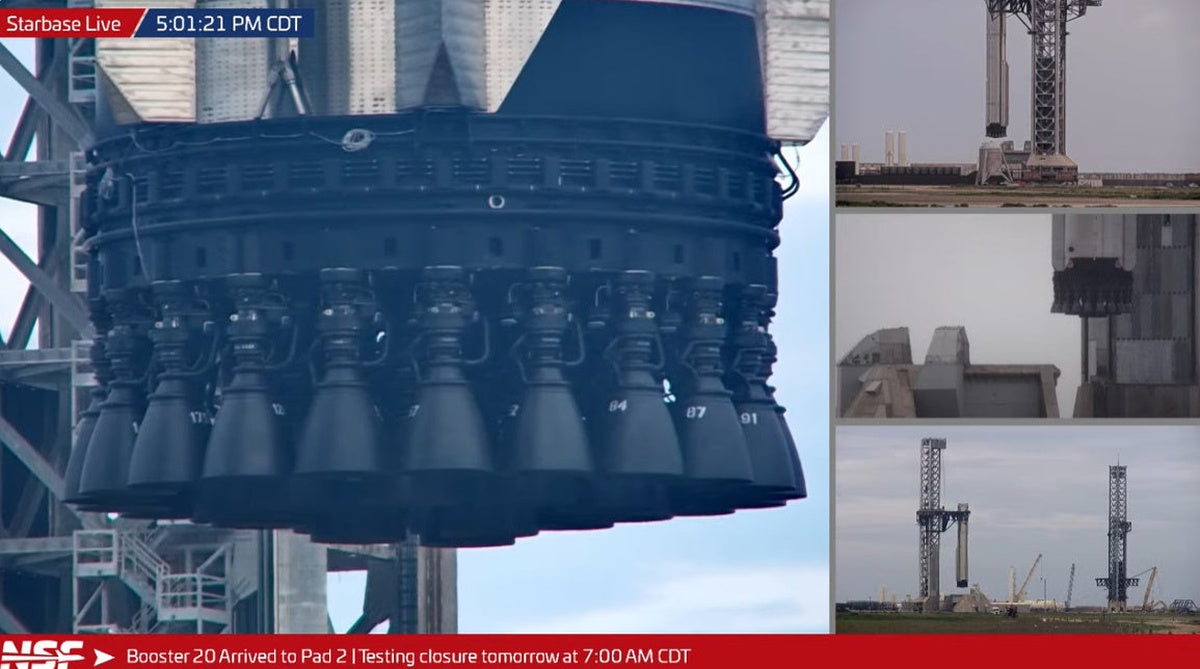
SpaceX has moved the Super Heavy booster for Starship Flight 13 to Orbital Launch Pad 2 at Starbase, Texas, officially kicking off the pre-flight test campaign for what will be the 13th integrated test flight of the world's most powerful rocket. The milestone, confirmed by SpaceX on July 9, puts the program on track for a targeted launch date of July 14, 2026 — though a booster static fire test still stands between now and liftoff.

Where Things Stand
The move to the pad follows a methodical test campaign that began in early June. Booster 20 — the Super Heavy for this flight — rolled out of Megabay 1 on June 5 and completed its cryogenic proof test two days later on June 7, according to Space.com. Meanwhile, the upper stage, Ship 40, completed a 60-second static fire of all six Raptor engines on July 1, clearing a major hurdle on the vehicle side.
NASASpaceflight captured the booster lift operation at Pad 2 earlier on July 9, roughly an hour before SpaceX's official confirmation.

With Booster 20 now vertical on the pad, the next critical milestone is a static fire of its 33 Raptor engines — the test that will generate close to 20 million pounds of thrust and give SpaceX engineers the data needed to clear the vehicle for flight. That test has not yet been scheduled publicly, but its completion is the primary gate between the current pad operations and a launch attempt.
Flight 13 in Context
Flight 13 will be the second flight of Starship Version 3 (V3), the more capable iteration of the upper stage that stands 408 feet (124.4 meters) tall — about 5 feet taller than V2. The mission profile is expected to closely mirror Flight 12, including a Raptor engine relight in space and a planned soft ocean splashdown of the upper stage. No booster catch attempt has been confirmed for this flight, though SpaceX's cadence has been building toward increasingly ambitious recovery operations.
The FAA has issued advisories reflecting a NET (No Earlier Than) launch date of July 14, 2026, at 10:45 PM UTC (5:45 PM CDT). NOTAMs covering Mexican airspace have also been filed starting July 15 at 5:45 PM CDT, suggesting SpaceX has at least a two-day window in mind. Both dates remain contingent on the booster static fire going cleanly and any regulatory sign-offs that follow.
| Vehicle Element | Designation | Status |
|---|---|---|
| Super Heavy Booster | Booster 20 | On pad — static fire pending |
| Starship Upper Stage | Ship 40 (V3) | Static fire complete (July 1) |
| Launch Site | Orbital Launch Pad 2, Starbase TX | Active |
| Target Launch Date | July 14, 2026 (NET) | FAA advisory issued |
Why the Pace Matters
SpaceX has been compressing the turnaround between Starship flights at a pace that would have seemed implausible two years ago. Flight 12 flew earlier this year, and the program is now targeting a roughly monthly cadence. Each successive flight adds to the operational data SpaceX needs to certify Starship for commercial payloads and, eventually, NASA's Artemis lunar landing mission. The booster static fire — and how quickly SpaceX can process the results — will be the real indicator of whether July 14 holds or slips into the following week. Follow our SpaceX coverage for updates as the static fire date is confirmed.
🚀 Following the Starship program? See every test flight, official outcome and the next launch window in our SpaceX Starship Tracker.
Sources & reporting notes
The links below identify the material source records used for this report.
- @NASASpaceflight on X (2026-07-09T22:04:55.000Z) — Direct source
- @SpaceX on X (2026-07-09T22:56:45.000Z) — Direct source
- @NASASpaceflight on X (2026-07-10T00:20:08.000Z) — Direct source
- @LabPadre on X (2026-07-10T16:44:47.000Z) — Direct source
- @LabPadre on X (2026-07-10T16:08:27.000Z) — Direct source
- @JoeTegtmeyer on X (2026-07-16T01:52:55.000Z) — Direct source
- @RGVaerialphotos on X (2026-07-16T01:06:34.000Z) — Direct source
- @NASASpaceflight on X (2026-07-16T03:55:17.000Z) — Direct source
- @NASASpaceflight on X (2026-07-16T03:29:06.000Z) — Direct source
- @RGVaerialphotos on X (2026-07-16T03:25:21.000Z) — Direct source
- @NASASpaceflight on X (2026-07-16T03:18:53.000Z) — Direct source
Source links are preserved as published or accessed. See our editorial standards and corrections policy.
The BASENOR Editorial Desk covers Tesla, SpaceX, and related technology, curating reporting from primary sources — official accounts, regulatory filings, and software release data. Every article passes source-record and fact-checking review before publication. About the newsroom.
This report was curated by the BASENOR Editorial Desk from the sources listed above. Read our editorial standards or email editorial@basenor.com to report an error.