📌 UPDATE — July 16, 2026
Ars Technica's Eric Berger has published a cost analysis of SpaceX's 1-million Starmind satellite plan, and the numbers are sobering. Berger concludes that the entire business case hinges on Starship achieving exceptional performance — without it, the economics simply don't work at the scale SpaceX is proposing. The analysis underscores just how central Starship's launch cadence and cost-per-kg figures are to making orbital data centers financially viable. SpaceX has not publicly responded to the cost breakdown.

— Eric Berger (@SciGuySpace), July 16, 2026
📌 UPDATE — July 16, 2026
Elon Musk has confirmed a significant power upgrade for SpaceX's AI1 satellite. Peak power has been raised by 67% to ~250kW (battery-assisted), up from the previously reported 150kW, while average power climbs 33% to ~160kW (from 120kW). Musk noted that GPU average power consumption during continuous inference over 24 hours runs at roughly two-thirds of peak — the design rationale behind the split specs. The boosted power budget means AI1 will now be capable of hosting an Nvidia Rubin NVL72 rack, packing 72 Rubin GPUs, substantially expanding its in-orbit AI processing muscle beyond what was originally announced.

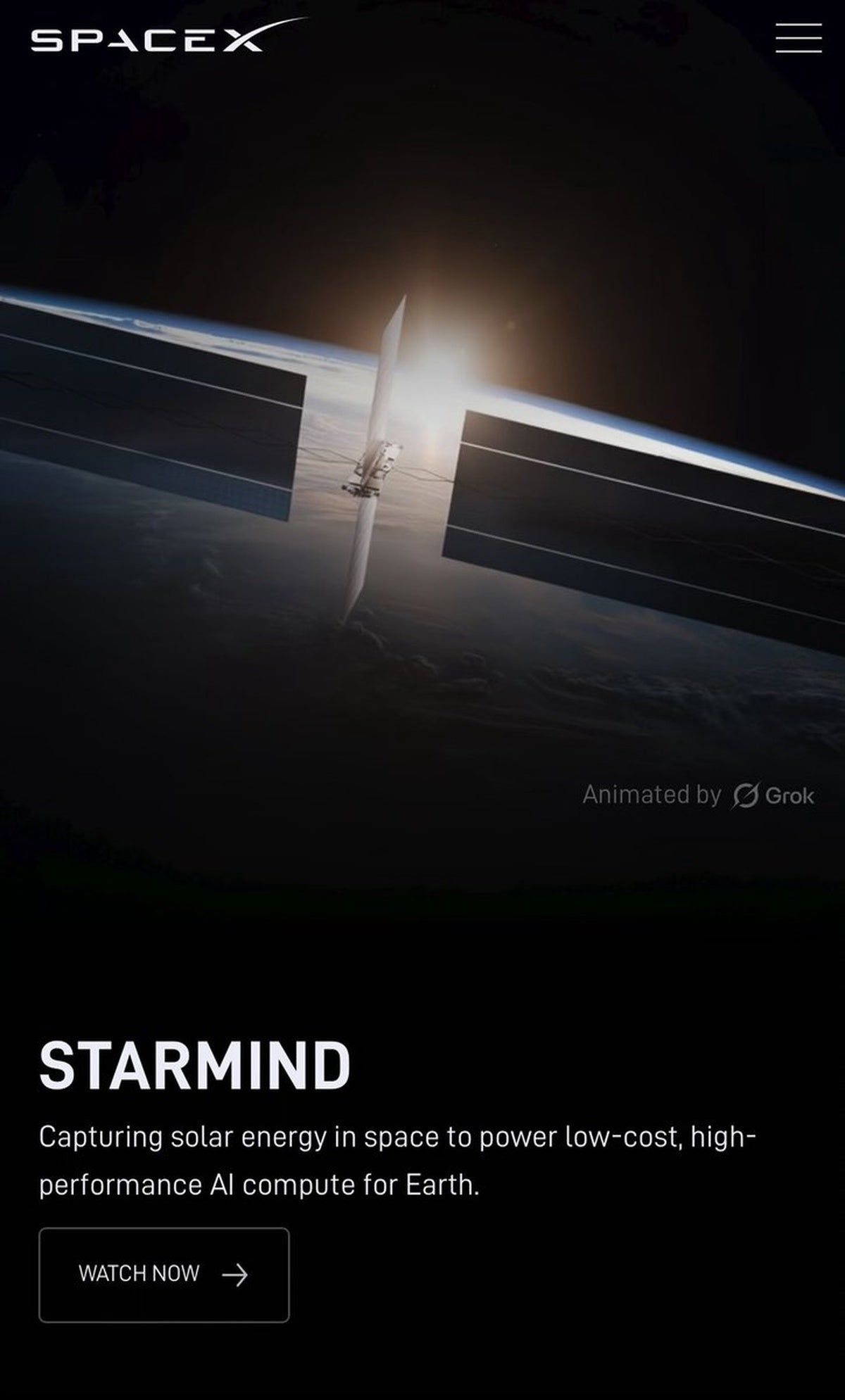
SpaceX has launched a dedicated website for Starmind, its ambitious AI satellite constellation, revealing the first detailed specifications for the AI1 satellite. The project — which already has an FCC filing for up to 1 million satellites — aims to move AI compute infrastructure off the ground entirely, using orbital solar power and the vacuum of space to do what terrestrial data centers increasingly cannot. Here's what we know.

What exactly is Starmind?
Starmind is SpaceX's constellation of AI-focused satellites — not communication satellites like Starlink, but orbiting compute nodes designed to run AI workloads at scale. The core idea is to relocate the energy-hungry, land-intensive infrastructure of AI data centers into low Earth orbit, where solar power is abundant and the vacuum naturally assists with thermal management. SpaceX filed with the FCC in January 2026 to launch and operate up to 1 million of these satellites.
What are the specs of the AI1 satellite?
The AI1 is the first-generation satellite in the constellation. According to the newly launched Starmind website, its headline figures are:

| Specification | Value |
|---|---|
| Peak Compute Payload | 150 kW |
| Average Compute Payload | 120 kW |
| Vehicle Efficiency | 70 kW per ton |
| Wingspan (deployed) | 70 meters |
| Height (deployed) | 20 meters |
| Thermal System | 110 m² deployable liquid radiator |
| Orbit Altitude | ~600 km |
Why is it "vendor agnostic" and why does that matter?
The AI1's compute payload is designed to be modular and interchangeable — meaning SpaceX isn't locking the system to any single chipmaker's hardware. Customers or SpaceX itself could swap in compute modules from different providers as AI chip technology evolves. This is a significant architectural decision: it avoids the constellation becoming obsolete if a better chip generation arrives, and it opens the door to commercial customers who may have existing relationships with specific AI hardware vendors.
How does it relate to existing Starlink technology?
The AI1 isn't built from scratch. According to background research, it reuses core Starlink V3 bus technologies — including solar cells and inter-satellite laser links. That's a meaningful cost and development advantage: SpaceX already has high-volume manufacturing processes for those components. The laser links are particularly relevant, as they'd allow AI1 satellites to communicate with each other and relay data globally without relying on ground stations for every hop.
When will these actually launch?
SpaceX is targeting prototype AI1 launches in early 2027, with commercial deployment and volume production following in late 2027. Starship is the intended launch vehicle, with each mission expected to carry 30 to 50 AI1 satellites. That cadence, combined with Starship's payload capacity, is what makes the 1-million-satellite ambition at least theoretically achievable on a multi-year horizon — though regulatory approval from the FCC remains a prerequisite for the full constellation.
Where will the satellites be manufactured?
SpaceX plans to build a dedicated "Gigasat" factory in Bastrop, Texas. According to background research, the facility would span over 1,000 acres with potential for up to 11 million square feet of manufacturing space — vertically integrating the supply chain from solar ingots and wafers all the way to fully assembled satellites. The scale is reminiscent of Tesla's Gigafactory model applied to orbital hardware.
What's the bigger picture here?
The premise behind Starmind is that terrestrial AI infrastructure is running into hard limits — power grid constraints, land availability, cooling costs. By deploying compute in orbit at 600 km altitude, SpaceX is betting that abundant solar energy and passive vacuum cooling can sidestep those bottlenecks entirely. Whether the economics work at scale remains to be proven, but the FCC filing, the detailed specs, and now a public-facing website signal this has moved well beyond a concept stage. The next concrete milestone to watch is the early 2027 prototype launch window. For more on SpaceX's broader ambitions, see our SpaceX coverage.
Sources & reporting notes
The links below identify the material source records used for this report.
- @SawyerMerritt on X (2026-07-09T21:11:42.000Z) — Direct source
- @SawyerMerritt on X (2026-07-09T21:07:58.000Z) — Direct source
- @SawyerMerritt on X (2026-07-16T05:47:18.000Z) — Direct source
- @elonmusk on X (2026-07-16T05:28:54.000Z) — Direct source
Source links are preserved as published or accessed. See our editorial standards and corrections policy.
The BASENOR Editorial Desk covers Tesla, SpaceX, and related technology, curating reporting from primary sources — official accounts, regulatory filings, and software release data. Every article passes source-record and fact-checking review before publication. About the newsroom.
This report was curated by the BASENOR Editorial Desk from the sources listed above. Read our editorial standards or email editorial@basenor.com to report an error.