📌 UPDATE — October 20, 2026
SpaceX's Q3 2026 earnings beat Wall Street estimates by a wide margin, with revenue of $14.58B coming in well above Bloomberg's $12.7B consensus, and EPS of $0.35 nearly doubling the $0.15 estimate. The company's first-ever $4.4B net income has now been confirmed across multiple sources. In addition, CEO Elon Musk made a striking forward-looking statement on the earnings call, projecting SpaceX's Annual Recurring Revenue (ARR) could reach $500 billion to $1 trillion in 2027 — a figure that would place SpaceX among the largest revenue-generating companies on Earth within a single year.
"SpaceX ARR could be somewhere between $500 billion - $1 trillion next year" — @elonmusk, SpaceX CEO

SpaceX just posted the most consequential earnings report in its history. Q3 2026 revenue hit $14.58 billion, up 161% year-over-year and well above the $12.7 billion consensus estimate. More striking: the company swung from a $1.05 billion loss a year ago to a $4.40 billion GAAP net income, its first quarterly profit as a public company. But the real story isn't the top line — it's that the Service & Infrastructure segment, built around what SpaceX now calls Super Intelligence, has quietly become the largest revenue driver inside the company, eclipsing Starlink.

The Headline Numbers
Every major line on the P&L moved in the right direction, most of them violently so. Adjusted EBITDA of $8.81 billion represents 306% year-over-year growth — faster than revenue growth, which signals real operating leverage rather than growth-at-any-cost spending. The GAAP profit flip is the milestone investors have been waiting on since the IPO, and it arrived two quarters earlier than most sell-side models projected.
| Metric | Q3 2026 | YoY Change |
|---|---|---|
| Revenue | $14.58B | +161% |
| Adjusted EBITDA | $8.81B | +306% |
| Net Income (GAAP) | $4.40B | vs. ($1.05B) loss |
| Capital Expenditures | $19.59B | +185% |
| SI Segment Revenue | $7.56B | +830% |
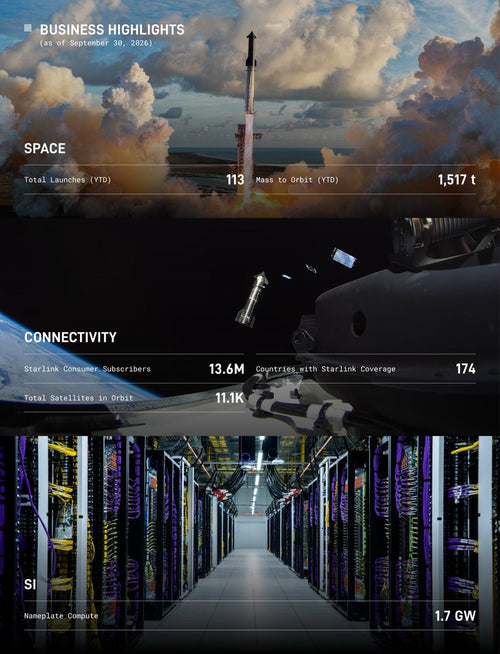
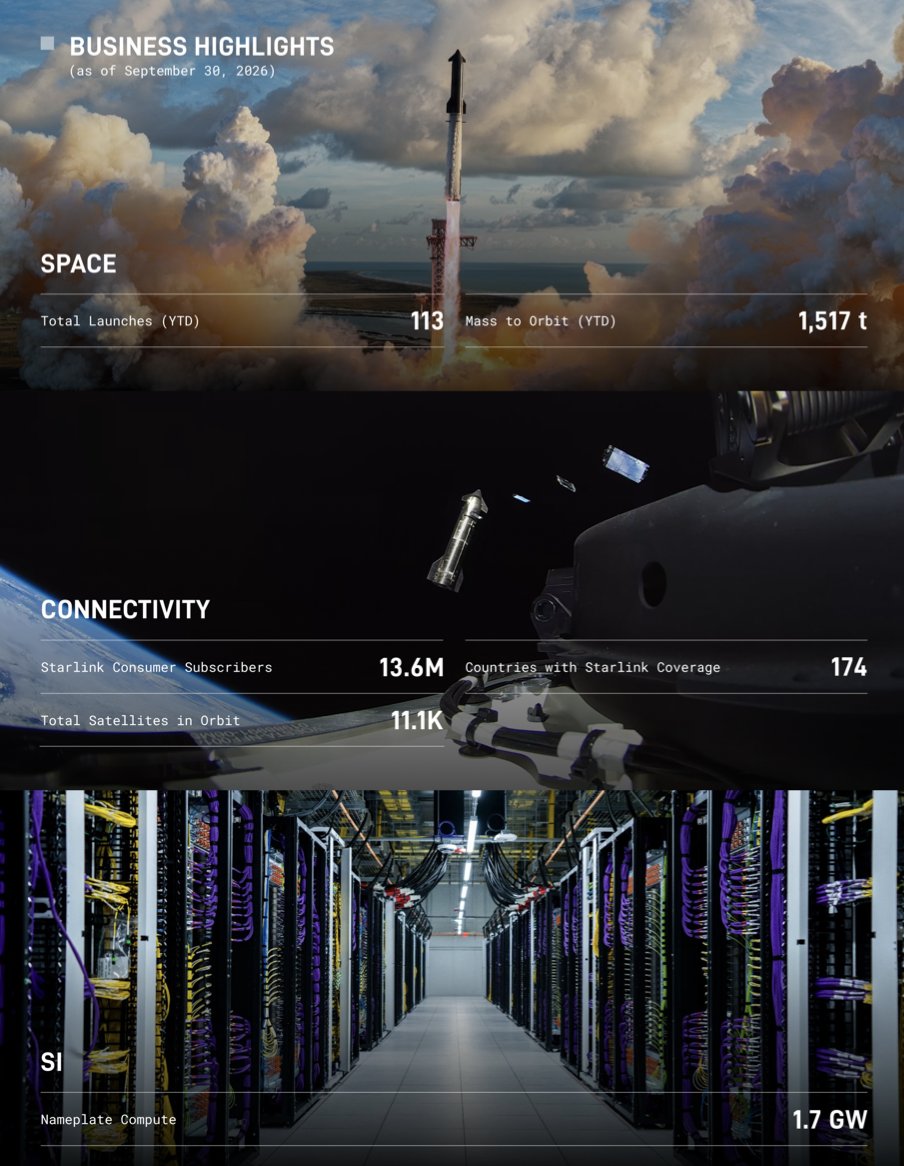
| Starlink Subscribers | 13.6M | +89% |
The Segment Shuffle: SI Is Now the Main Business
For most of SpaceX's post-IPO era, Starlink carried the revenue story. That's no longer true. The Service & Infrastructure segment — formerly reported as the AI segment and now rebranded around "Super Intelligence" — generated $7.56 billion in Q3, up 830% year-over-year and 195% quarter-over-quarter. According to the earnings materials relayed by Sawyer Merritt, SI is now the single largest revenue line inside SpaceX.

According to reporting from Seeking Alpha and Benzinga summaries of the filing, three factors drove the SI jump: new cloud services agreements with enterprise customers, the August 14 acquisition of Cursor (which contributed $608 million in revenue from closing through September 30 at an implied equity value of $60 billion), and expanded enterprise and consumer adoption of Grok. The Connectivity segment — SpaceX's name for Starlink and related services — still grew 69% year-over-year to $5.2 billion, but it's no longer the biggest piece of the pie.
Starlink itself continues to compound. Consumer subscribers reached 13.6 million by quarter-end, up 89% year-over-year. That's a healthy run rate, but it's being overshadowed inside the business by compute-and-services revenue that didn't exist in meaningful size a year ago.
The $19.6 Billion Capex Line
If you only read the profit headline, you'd miss the more aggressive story underneath. SpaceX spent $19.6 billion on capital expenditures in a single quarter, nearly triple the $6.9 billion it spent in Q3 2025. Of that, $16.4 billion — roughly 84% of total capex — went to SI infrastructure, almost entirely compute buildout.

SpaceX reported 1.7 GW of nameplate compute capacity installed as of September 30, 2026. For context, that places SpaceX's compute footprint in the same conversation as the largest hyperscaler buildouts disclosed this year. The capex-to-revenue ratio is extreme — spending roughly $1.34 for every $1 of revenue — but it's being funded entirely out of operating cash flow plus the company's cash reserves, not new debt or dilution.
This is the strategic bet, laid bare in the numbers: SpaceX is treating compute infrastructure the same way it treated Falcon 9 reusability and the Starlink constellation — build the capacity first, let the services revenue catch up to it. That worked twice. Whether it works a third time depends on whether SI's quarter-over-quarter growth can sustain anything close to 195% as the base gets larger.
What's Still Ahead
The quarter also included SpaceX's first revenue-generating Starship mission, Flight 14, which successfully deployed 26 Starlink V3 satellites. That's a small line item in a $14.58 billion quarter, but it's the opening of a revenue stream — commercial Starship launch cadence — that hasn't contributed in any material way yet.

As Merritt noted in his thread, Starship hasn't started launching regularly yet, V3 Starlink satellites are only beginning deployment, and Grok's enterprise rollout is in early innings. In other words: the quarter that just produced a $4.4 billion profit still doesn't reflect most of what SpaceX is actually building.
What to Watch Next Quarter
- SI gross margin disclosure. SpaceX hasn't broken out segment-level margins. If SI is EBITDA-positive at $7.56B in revenue, the stock gets rerated. If it's running at hyperscaler-style negative margins, the capex story gets harder to defend.
- Starship cadence. Flight 14 was the first paying mission. Analysts will want a 2027 launch rate target before year-end guidance.
- Cursor integration milestones. At a $60 billion implied equity value, Cursor is the largest acquisition in SpaceX's history. Any disclosure about developer seat growth or revenue run-rate will move the SI narrative.
- Starlink V3 ramp. V3 satellites unlock higher per-user bandwidth and new enterprise tiers. Subscriber growth is one thing; ARPU is where Connectivity revenue needs to accelerate.
Editor's View
The headline most outlets will run is "first profit." The real headline is that SpaceX is no longer a space-and-connectivity company with an AI side project. In Q3, SI contributed more revenue than Starlink, more revenue than launch services, and absorbed 84% of capex. The capital allocation decision has already been made at the board level — this is now a compute-infrastructure business that happens to own the world's leading launch provider and satellite network. Whether that's the right bet is a question for 2027. The Q3 print says SpaceX is going to find out either way.
🚀 Following the Starship program? See every test flight, official outcome and the next launch window in our SpaceX Starship Tracker.
Related Gear
Gear up your Tesla with tested, custom-fit BASENOR accessories — shop Tesla accessories →
Sources & reporting notes
The links below identify the material source records used for this report.
- @SawyerMerritt on X (2026-10-20T20:07:14.000Z) — Direct source
- @SawyerMerritt on X (2026-10-20T20:10:12.000Z) — Direct source
- @SawyerMerritt on X (2026-10-20T20:13:57.000Z) — Direct source
- @SawyerMerritt on X (2026-10-20T20:26:11.000Z) — Direct source
Source links are preserved as published or accessed. See our editorial standards and corrections policy.
The BASENOR Editorial Desk covers Tesla, SpaceX, and related technology, curating reporting from primary sources — official accounts, regulatory filings, and software release data. Every article passes source-record and fact-checking review before publication. About the newsroom.
This report was curated by the BASENOR Editorial Desk from the sources listed above. Read our editorial standards or email editorial@basenor.com to report an error.