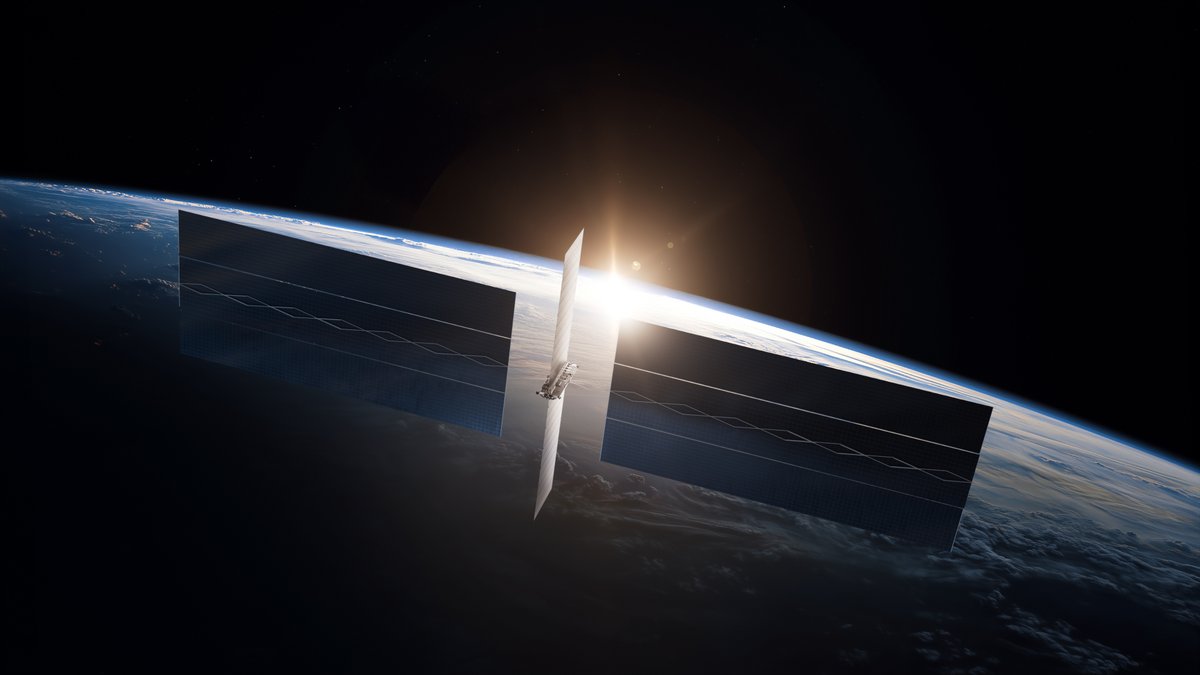
SpaceX has officially confirmed a partnership with Nvidia to design the compute payload for its Starmind AI1 satellite — the orbital AI infrastructure Elon Musk has been quietly teasing since June. Each Starmind satellite will carry Nvidia Rubin GPUs and Vera CPUs, giving the constellation what SpaceX describes as "datacenter class space compute." The announcement, made via SpaceX's official X account on August 4, formalizes a supplier relationship that has been building for months and answers the biggest open question about the AI1 program: whose silicon is going up.

Why This Announcement Matters
Until today, SpaceX had described AI1's compute payload as vendor-agnostic — the June 8 unveiling video explicitly noted the platform could accommodate Nvidia GB300, Rubin, or TPU-class silicon. Naming Nvidia as the design partner for the payload itself signals that Rubin has won the primary slot, at least for the first-generation constellation. It also aligns SpaceX with the same silicon roadmap powering every hyperscaler datacenter buildout on the ground, from Microsoft to Meta.
The timing is notable. Nvidia delivered its first Vera CPU systems to partners — SpaceX among them — on May 19, 2026, according to earlier reporting. Elon Musk then confirmed a major power upgrade to the AI1 platform on July 16, raising peak power roughly 67% to around 250 kW (battery-assisted) so the satellite could host a full Nvidia Rubin NVL72 rack — 72 Rubin GPUs per bird. Today's announcement closes the loop: the hardware is spec'd, the supplier is confirmed, and the program is moving from concept video to production planning.
The Numbers Behind Starmind AI1
| Metric | Specification |
|---|---|
| Compute silicon | Nvidia Rubin GPUs + Vera CPUs (Rubin NVL72 rack, 72 GPUs) |
| Average power | ~160 kW (updated July 2026) |
| Peak power | ~250 kW battery-assisted |
| Deployed dimensions | 20 m tall × 70 m wingspan |
| Cooling | 110 m² deployable liquid radiators |
| Launch vehicle | Starship — 30 to 50 satellites per mission |
| Prototype launches | Targeting early 2027 |
| Commercial deployment | Late 2027 (high-volume production) |
Figures above are drawn from SpaceX's June 8 AI1 unveiling and Musk's July 16 power-budget update, according to previous reporting summarized in our background research.
How We Got Here
SpaceX filed with the Federal Communications Commission in January 2026 for authority to operate a constellation of up to one million satellites — a filing that raised eyebrows at the time but now reads as a direct precursor to the Starmind AI compute build-out. The AI1 satellite itself debuted in a June 8 presentation, with the initial design pitched as roughly equivalent to one Nvidia GB300 server rack in orbit. Six weeks later, Musk confirmed the platform had been upgraded to accommodate a full Rubin NVL72 rack.
In parallel, SpaceX is constructing what it calls the "Gigasat Factory" in Bastrop, Texas — the manufacturing base intended to produce these satellites at scale. Production is anticipated to begin as early as late 2027, according to background reporting from tomshardware.com and optimusk.blog.
The Constellation Goal Is Enormous
SpaceX's public compute-capacity targets are aggressive to the point of being difficult to model: 1 gigawatt of AI compute in orbit by the end of 2027, scaling to 100 GW by the end of 2029, and reaching 1 terawatt (1,000 GW) by the end of 2030. At the AI1's 150 kW peak output, hitting 1 terawatt would require roughly 6.67 million satellites — well beyond the one-million-satellite FCC filing.
Those targets should be read as directional. Even reaching the 1 GW figure by end of 2027 would require several thousand AI1 satellites launched inside roughly 18 months of the first prototype flight — an aggressive cadence even by Starship standards. But the direction of travel is clear: SpaceX is positioning orbital compute as a serious business line alongside Starlink connectivity, and the Nvidia partnership is the anchor supplier deal that makes it credible.
What This Means for the Broader Market
For Nvidia, the deal extends Rubin's footprint into an environment — space — where compute has historically been radiation-hardened, low-power, and years behind ground-based silicon. Deploying current-generation datacenter GPUs in orbit is a step change, and one Nvidia can now cite as it markets Rubin to sovereign AI and hyperscaler customers.
For SpaceX, orbital AI compute becomes another vertical that ties Starship's payload economics to a recurring revenue stream — much as Starlink did for Falcon 9. Background reporting notes that the AI infrastructure story is being framed as a significant factor in SpaceX's expected IPO, with pricing reportedly targeted around $135 per share and a valuation approaching $1.8 trillion. Investors evaluating that number now have a concrete silicon partner attached to the AI thesis, not just a concept video.
What to Watch Next
Three specific signals will tell us whether the timeline holds:
- First AI1 prototype launch (targeted early 2027): The gap between announcement and first flight is the single biggest execution risk. A Starship-integrated prototype flight would be the definitive proof point.
- Bastrop "Gigasat Factory" progress: Manufacturing readiness by late 2027 is what enables the high-volume phase. Watch for permitting filings, hiring announcements, and any imagery of tooling installation.
- Follow-up disclosure on radiation hardening and thermal margin: Rubin was designed for climate-controlled datacenters. How SpaceX and Nvidia have adapted the silicon and package for the orbital environment is still an open engineering question the companies have not addressed in detail.
SpaceX's announcement today converts Starmind AI1 from a June concept video into a program with a named silicon partner, a defined power envelope, and a stated launch window. The next 12 months — leading up to that early-2027 prototype target — will show whether the hardware can move as fast as the ambition.
🚀 Following the Starship program? See every test flight, official outcome and the next launch window in our SpaceX Starship Tracker.
Sources & reporting notes
The links below identify the material source records used for this report.
- @SpaceX on X (2026-08-04T19:31:13.000Z) — Direct source
- @SawyerMerritt on X (2026-08-04T19:33:43.000Z) — Direct source
- @wholemars on X (2026-08-04T19:46:04.000Z) — Direct source
Source links are preserved as published or accessed. See our editorial standards and corrections policy.
The BASENOR Editorial Desk covers Tesla, SpaceX, and related technology, curating reporting from primary sources — official accounts, regulatory filings, and software release data. Every article passes source-record and fact-checking review before publication. About the newsroom.
This report was curated by the BASENOR Editorial Desk from the sources listed above. Read our editorial standards or email editorial@basenor.com to report an error.