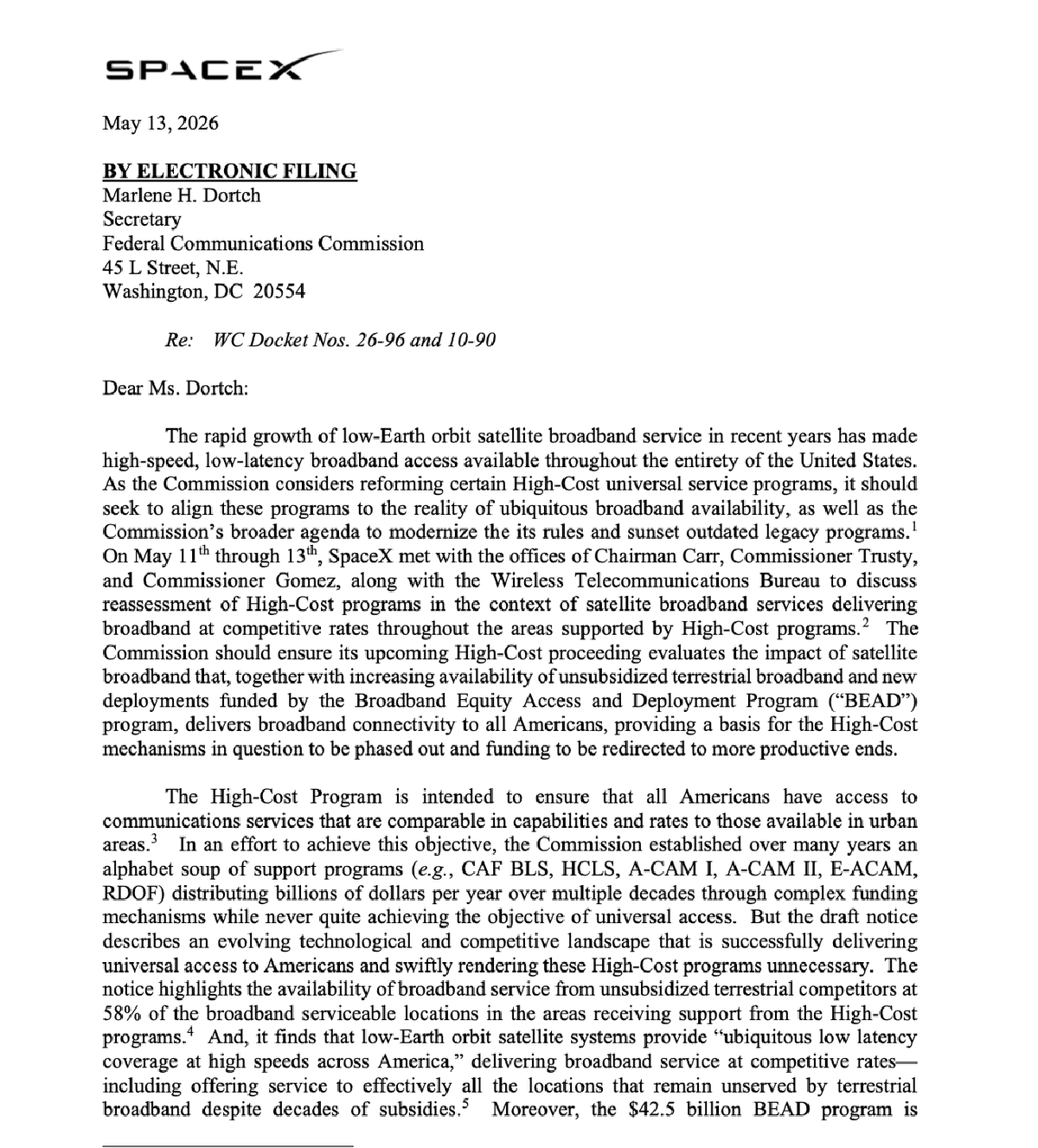
SpaceX has formally asked the Federal Communications Commission to shut down the $4.5 billion annual program that has long subsidized rural voice and broadband services — arguing that Starlink has already done what the fund was designed to accomplish. The letter, submitted to the FCC on May 13, 2026, puts the agency in an awkward position: it's currently in the middle of modernizing the very program SpaceX wants eliminated.

The Fund SpaceX Wants Gone
The FCC's High-Cost program is part of the Universal Service Fund — a decades-old mechanism designed to ensure Americans in remote areas have access to telephone and broadband service. According to background reporting, the program currently funnels nearly $1 billion in subsidies to 249 local carriers, who were only required to offer minimum speeds of 25 Mbps download and 3 Mbps upload. By today's standards, that's a floor, not a ceiling.
SpaceX's argument, in essence: the problem the fund was built to solve no longer exists — at least not in the way it did when the program was designed. Starlink, the company contends, now provides high-speed satellite broadband at competitive prices to virtually any rural address in the United States, making legacy carrier subsidies redundant.
The timing is pointed. The FCC was scheduled to vote this week on initiating a process to update the High-Cost program's rules — changes that would affect approximately $1.6 billion of the $4.5 billion annual budget. SpaceX's letter landed just before that vote, framing the modernization effort as insufficient and calling for a more fundamental rethink.
Starlink's Case by the Numbers
SpaceX isn't making this argument in a vacuum. The performance data behind Starlink has shifted considerably over the past year, and the numbers make a credible case:
| Metric | Starlink (Dec 2025) | FCC Benchmark |
|---|---|---|
| Download Speed | >200 Mbps (global avg) | 100 Mbps |
| Upload Speed | >30 Mbps | 20 Mbps |
| Latency | ~23 ms median | <100 ms |
| US Download (Q4 2025) | 132 Mbps median | 100 Mbps |
Sources: Starlink performance data, FCC broadband benchmarks
The subscriber trajectory is equally significant. As of January 2026, Starlink serves over 9 million customers globally across all seven continents — adding more than 4.6 million new active customers during 2025 alone. In the US specifically, the share of Starlink users meeting the FCC's minimum broadband benchmark jumped from 17% at the start of 2025 to nearly 45% by Q4. That's a dramatic improvement in a single year, and it's the kind of data that makes the legacy subsidy framework look increasingly anachronistic.
On pricing, Starlink currently offers a "Residential 100Mbps" plan at $50 per month for eligible US customers, with hardware costs around $600. That's not cheap by urban standards, but it's increasingly competitive for rural areas where the alternative has historically been slow DSL or nothing at all.
The Irony in SpaceX's Position
There's a notable backstory here. In December 2023, the FCC denied SpaceX an $886 million Rural Digital Opportunity Fund (RDOF) subsidy, ruling that Starlink had not demonstrated it could reliably deliver the required 100/20 Mbps speeds at that time. Now, roughly two years later, SpaceX is not only meeting that threshold — it's arguing the entire subsidy framework should be dismantled because Starlink has made it obsolete.
The reversal is striking. SpaceX went from subsidy applicant to subsidy opponent in under three years, and the performance data suggests the shift is grounded in genuine capability gains rather than pure opportunism. Whether the FCC sees it that way is another matter.
What the FCC Is Actually Weighing
The commission's immediate agenda isn't full elimination — it's modernization. The vote this week targets roughly $1.6 billion of the $4.5 billion program, focused on updating minimum speed requirements and eligibility rules for legacy carriers. SpaceX's letter pushes the debate further, asking regulators to consider whether the remaining $2.9 billion in legacy support has a future at all given where satellite broadband now stands.
The carriers receiving those subsidies will almost certainly push back hard. Many rural communities still rely on local telephone companies for voice service, and the transition to satellite-only infrastructure raises real questions about reliability, emergency services, and affordability for low-income households. Starlink's $600 hardware cost, in particular, is a meaningful barrier for some of the populations the High-Cost program was designed to serve.
The FCC's response — and how quickly it moves — will signal whether regulators view Starlink as a genuine infrastructure solution or as a complement to, rather than replacement for, the legacy network. SpaceX has made its position clear. The agency's next move is the one to watch.
Sources & reporting notes
The links below identify the material source records used for this report.
- @SawyerMerritt on X (2026-05-16T12:39:01.000Z) — Direct source
Source links are preserved as published or accessed. See our editorial standards and corrections policy.
The BASENOR Editorial Desk covers Tesla, SpaceX, and related technology, curating reporting from primary sources — official accounts, regulatory filings, and software release data. Every article passes source-record and fact-checking review before publication. About the newsroom.
This report was curated by the BASENOR Editorial Desk from the sources listed above. Read our editorial standards or email editorial@basenor.com to report an error.