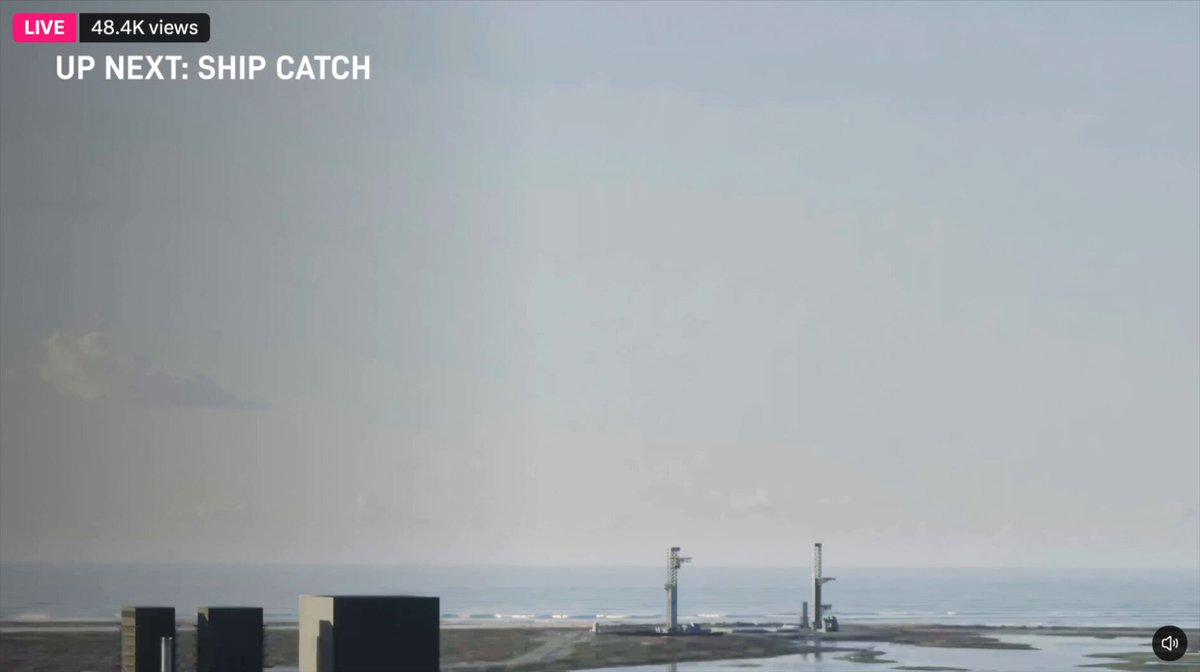
SpaceX is about to attempt something it has never tried before: catching the Starship upper stage with the launch tower's chopstick arms. Elon Musk confirmed on October 20 that the maneuver is on the manifest for Flight 15, scheduled for next month, and the company released a new simulation video showing exactly how the recovery is supposed to unfold. If it works, it will be the first time an orbital-class upper stage has ever been returned to its launch site and caught mid-air.

What Musk Confirmed
According to Sawyer Merritt's post on X, Musk has committed SpaceX to attempting the Starship catch on Flight 15 — the next scheduled flight of the full Starship stack. The simulation video released alongside the announcement depicts both the Super Heavy booster and the Starship upper stage returning to Starbase for tower catches, mirroring the booster-only catch technique SpaceX pioneered on earlier flights but extending it to the orbital upper stage for the first time.
Earlier this month, Musk told audiences the mission was "hopefully four to six weeks away," which lines up with a launch target in the first half of November. According to spacereporting.com and spacelaunchschedule.com, Flight 15 is currently tracking a No Earlier Than date of November 8, 2026, from Starbase, Texas, though SpaceX has not published an official window and the FAA has not yet issued launch approval.
Why Catching the Upper Stage Matters
Catching Super Heavy — the first-stage booster — is already a demonstrated capability. Catching the Starship upper stage is a dramatically harder problem. The upper stage returns from orbital velocity, performs a bellyflop re-entry through peak heating, and has to execute a precise flip-and-burn seconds before the tower makes contact. Any heat-shield damage, engine anomaly, or guidance drift during the hour-long mission can disqualify a catch attempt.
If SpaceX pulls it off, it validates the core economic premise of Starship: a fully and rapidly reusable launch system where both stages return to the same pad and fly again with minimal refurbishment. That is the architecture Musk has repeatedly cited as the prerequisite for a sustained Mars campaign and for Starlink V3 deployment at the cadence SpaceX wants.
The Vehicles Flying
According to thespaceroad.com and keeptrack.space, Flight 15 is expected to use Booster 22 paired with Ship 42 — the fourth pair of Block 3 Starship vehicles. Ship 42 completed a cryogenic test on October 9, 2026, following earlier cryotesting of both vehicles in early September. SpaceX has also run a simulated catch rehearsal with Ship 42 at the tower, according to publicly posted test footage.
Flight 15 Key Facts
| Item | Detail |
|---|---|
| Target launch date | NET November 8, 2026 (unofficial) |
| Launch site | Starbase, Texas |
| Booster | Booster 22 (Block 3) |
| Upper stage | Ship 42 (Block 3) |
| Primary objective | Tower catch of booster and ship |
| FAA status | No launch license published as of Oct 20 |
Coming Off Flight 14
Flight 14 flew on September 28, 2026, and was the first fully successful orbital mission for Starship, deploying 26 Starlink V3 satellites. Neither stage was recovered on that flight — both were committed to planned splashdowns to gather data before the Flight 15 catch attempt. According to post-flight commentary from Musk, Ship 41 experienced a premature shutdown of one Raptor Vacuum engine during ascent, which he characterized as a software glitch isolated to that engine's computer rather than a hardware or design concern. He described the fix as straightforward.
Resolving that software issue cleanly is likely a gating item for Flight 15. Catching the upper stage requires every engine to perform on schedule through the landing burn — there is no margin for a repeat anomaly during the terminal phase.
What to Watch Between Now and Launch
Several concrete milestones will signal whether the November target holds:
- FAA launch license update — SpaceX cannot fly without it, and no public approval has been posted yet.
- Static fire campaigns — Expect a full-duration static fire of Ship 42 and a booster static fire of Booster 22 in the coming weeks.
- Wet dress rehearsal — Typically run within a week of launch.
- Chopstick arm testing — Any additional catch rehearsals at the tower would indicate the recovery hardware is cleared.
Editor's View
The headline is the catch, but the subtler story is cadence. SpaceX is attempting its most ambitious recovery milestone roughly six weeks after a successful operational Starlink deployment on Flight 14. That compressed turnaround — if the November window holds — is a meaningful signal about Block 3 vehicle readiness and the maturity of SpaceX's launch pipeline at Starbase. A successful dual catch would also materially shorten the path to the first Starship reflight, which is the actual threshold event for the program's economics.
Whether Flight 15 slips a few weeks or lands on target, the simulation video Musk shared is effectively SpaceX telling the industry what the next phase of Starship looks like: both stages home, same pad, same day.
🚀 Following the Starship program? See every test flight, official outcome and the next launch window in our SpaceX Starship Tracker.
Sources & reporting notes
The links below identify the material source records used for this report.
- @SawyerMerritt on X (2026-10-20T20:42:24.000Z) — Direct source
Source links are preserved as published or accessed. See our editorial standards and corrections policy.
The BASENOR Editorial Desk covers Tesla, SpaceX, and related technology, curating reporting from primary sources — official accounts, regulatory filings, and software release data. Every article passes source-record and fact-checking review before publication. About the newsroom.
This report was curated by the BASENOR Editorial Desk from the sources listed above. Read our editorial standards or email editorial@basenor.com to report an error.