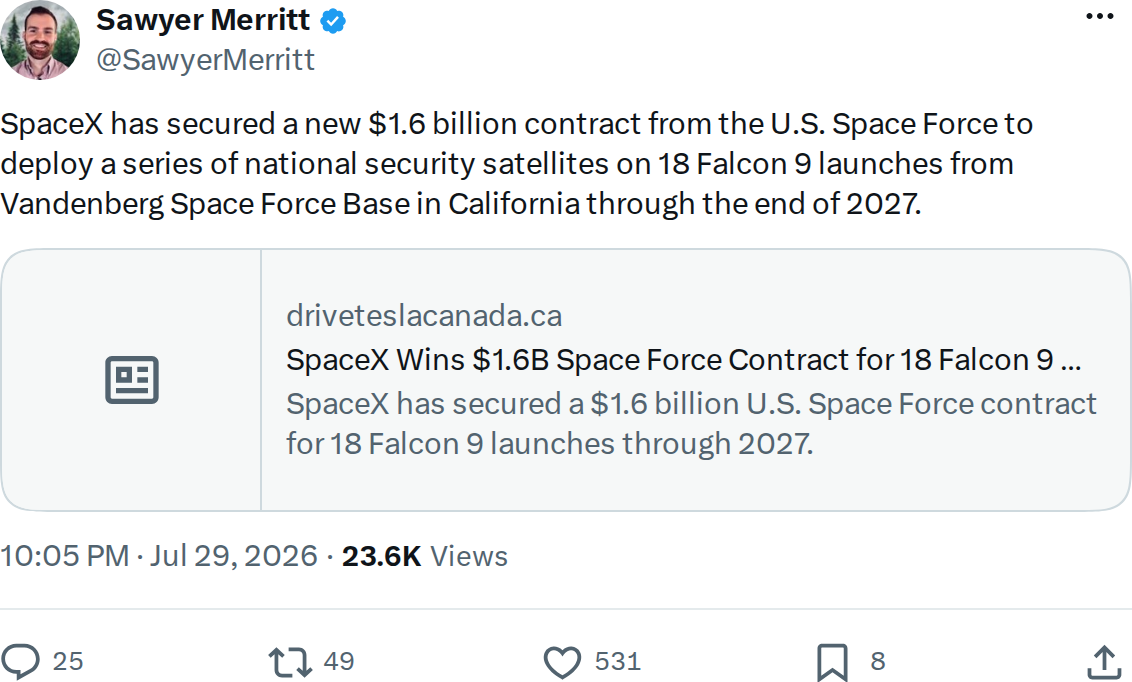
SpaceX has secured a $1.6 billion contract from the U.S. Space Force covering 18 dedicated Falcon 9 launches out of Vandenberg Space Force Base in California, with all missions targeted for completion by the end of 2027. The award, announced July 29, comes through the National Security Space Launch (NSSL) Phase 3 Lane 1 program and locks in a substantial chunk of SpaceX's West Coast manifest for the next two-plus years.
The task orders will deliver satellites supporting the Pentagon's Space Based Sensing and Targeting (SBST) portfolio — a next-generation constellation designed to track airborne threats and provide near-real-time communications to warfighters, according to a U.S. Space Force release.

The Deal, By the Numbers
| Metric | Value |
|---|---|
| Total contract value | $1.6 billion |
| Task orders | 2 |
| Falcon 9 launches | 18 |
| Launch site | Vandenberg SFB, California |
| Program | NSSL Phase 3 Lane 1 |
| Payload | SBST satellites |
| Completion deadline | End of 2027 |
Averaged out, that's roughly $89 million per launch — a figure that reflects the added mission assurance, integration, and security work the Space Force requires on national security payloads, well above SpaceX's commercial Falcon 9 sticker price.
What Is NSSL Phase 3 Lane 1?
The National Security Space Launch program is how the Pentagon buys rides to orbit for its most sensitive payloads. Phase 3, which took effect in 2025, split awards into two lanes. Lane 1 covers missions to more permissive orbits — typically low Earth orbit constellations — and is designed to be more competitive, faster to award, and open to newer entrants. Lane 2 handles the heaviest and most demanding national security missions with stricter certification requirements.
By stacking 18 launches into Lane 1, the Space Force is signaling how quickly it wants to build out proliferated LEO constellations like SBST. Rather than a handful of exquisite, expensive satellites, the department is buying dozens of smaller nodes and needs a launch cadence to match.
Why SBST Matters
The Space Based Sensing and Targeting portfolio is the Pentagon's answer to a threat environment that's shifted from ballistic missiles to hypersonic glide vehicles, cruise missiles, and maneuvering aerial targets that legacy early-warning satellites in geostationary orbit weren't designed to track. According to the U.S. Space Force, SBST is meant to deliver sensing and targeting data on airborne objects and pass it back to shooters in near real time.
That mission profile requires a lot of satellites in low Earth orbit — enough to guarantee constant coverage of any point on the globe — which in turn requires a lot of launches. Vandenberg, which supports polar and sun-synchronous trajectories ideal for global-coverage constellations, is the natural West Coast hub for that work.
Where This Fits in SpaceX's Manifest
SpaceX is already the workhorse for U.S. national security launches, having flown NSSL Phase 2 missions alongside its own Starlink deployments and commercial customers. Layering 18 additional Vandenberg missions on top of an already busy West Coast cadence is significant, but the site has scaled aggressively in recent years to support Starlink polar shells and other government work.
The award also reinforces a broader trend: while Starship dominates headlines, Falcon 9 remains the revenue engine and the vehicle the Pentagon actually trusts today for time-sensitive national security missions. The rocket is human-rated, has flown hundreds of times, and has a reuse cadence that keeps per-mission economics competitive even against emerging rivals.
What to Watch Next
Three signals worth tracking through the rest of 2026 and into 2027:
- First SBST launch date. The Space Force hasn't published the mission-by-mission schedule yet. The first flight out of Vandenberg under this contract will set the tempo for the remaining 17.
- Additional Lane 1 awards. NSSL Phase 3 Lane 1 is designed to keep issuing task orders through the ordering period. Watch whether ULA, Blue Origin, or Rocket Lab pick up subsequent tranches.
- Vandenberg cadence. With Starlink polar launches, other government payloads, and now 18 SBST missions, the West Coast pad complex will need to sustain a launch rhythm it has not previously demonstrated.
For SpaceX, this is another layer of guaranteed revenue and another endorsement from the Pentagon's most demanding customer. For the Space Force, it's a concrete step toward the proliferated architecture that has been on PowerPoint slides for years — now backed by hardware, dates, and 18 Falcon 9 flights on the books.
Sources & reporting notes
The links below identify the material source records used for this report.
- @SawyerMerritt on X (2026-07-29T22:05:04.000Z) — Direct source
Source links are preserved as published or accessed. See our editorial standards and corrections policy.
The BASENOR Editorial Desk covers Tesla, SpaceX, and related technology, curating reporting from primary sources — official accounts, regulatory filings, and software release data. Every article passes source-record and fact-checking review before publication. About the newsroom.
This report was curated by the BASENOR Editorial Desk from the sources listed above. Read our editorial standards or email editorial@basenor.com to report an error.