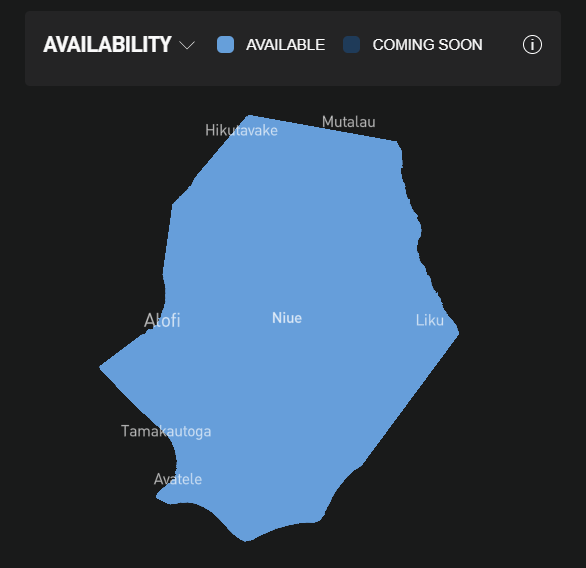
The News: Starlink's official account announced that high-speed, low-latency internet service is now available in Niue — a small Pacific island nation that had previously banned Starlink operations and requested geo-blocking from SpaceX.
Why It Matters: If the regulatory situation has genuinely resolved, this marks a significant shift for one of the last holdout markets in the Pacific — and signals Starlink's continued push to clear regulatory hurdles in contested territories. For Tesla owners who use Starlink for home internet or travel, it's a reminder of how aggressively SpaceX is expanding global coverage.
Source: @Starlink on X

Starlink Goes Live in Niue — But There's Important Context
Starlink's official account posted Friday that its high-speed, low-latency internet service is now available in Niue, the tiny self-governing Pacific island nation of roughly 1,600 people. The announcement is brief — a single tweet with a link to the Starlink availability page — but the backstory is anything but simple.
Niue has been one of the more prominent holdouts in Starlink's global expansion. The Niuean government formally requested that SpaceX geo-block the island in mid-2024, and Starlink's roaming service was deactivated in unlicensed jurisdictions globally — including Niue — effective August 22, 2024. At that point, the government was awaiting guidance from its Regulator, Crown Law Office, and Telecom Niue before making any final decision on permitting Starlink to operate legally.
The concerns were substantive: regulatory compliance, protection of local telecommunications infrastructure (Telecom Niue holds the existing licensed operator position), and national security considerations. Users found operating Starlink units in violation of Niue's Communications Act 1989 faced fines of up to $200 NZD or up to three months imprisonment.
⚠️ Editorial Note: Starlink's tweet announces availability as of March 14, 2026. Verified records through mid-2025 show Niue had an active ban in place. BASENOR is treating the @Starlink announcement as the current ground truth while acknowledging the regulatory history. If Niue has granted a license to SpaceX, that approval has not yet been independently confirmed by a third-party source at time of publication. We will update this article as details emerge.
📊 Key Figures
| Metric | Value | Context |
|---|---|---|
| Niue Population | ~1,600 | One of world's smallest nations |
| Prior Roaming Deactivation | Aug 22, 2024 | Starlink cut unlicensed access globally |
| Estimated Illegal Units (as of mid-2025) | ~50 | Operating despite ban |
| Starlink Global Roam Price | $500/mo + $599 hardware | As of March 2026 |
| Announcement Date | March 14, 2026 | Via @Starlink official account |
Why Niue Was a Flashpoint
Niue's resistance to Starlink wasn't arbitrary. The island's sole licensed telecommunications provider, Telecom Niue, operates under a regulatory framework governed by the Communications Act 1989. Starlink's satellite signal doesn't respect geographic borders the way a terrestrial ISP does — which created an inherent conflict when residents began importing and using Starlink dishes without regulatory approval.
By mid-2024, the Niuean government had grown concerned enough to send a formal letter to SpaceX's legal team requesting geo-blocking. SpaceX complied as part of a broader global deactivation of roaming services in unlicensed markets. The government then initiated a review process — involving the Regulator, Crown Law Office, and Telecom Niue — to determine whether a path to legal operation existed.
That review process, if it has now concluded in Starlink's favor, would represent a meaningful regulatory win. It would suggest SpaceX successfully navigated concerns around incumbent operator protection and national security — the same friction points it faces in dozens of other small-nation markets.
🔭 The BASENOR Take
Timeline: Geo-block request (May 2024) → Roaming deactivation (August 2024) → Regulatory review (late 2024–2025) → Announced availability (March 14, 2026)
Impact Level for Tesla/SpaceX Ecosystem: Low-direct, High-symbolic
Confidence in Regulatory Resolution: Moderate — based solely on the @Starlink official announcement; independent confirmation pending
Niue is not a commercially significant market by any conventional metric. A population of 1,600 people does not move the needle on Starlink's subscriber count or revenue. But that's precisely what makes this interesting.
Starlink's expansion strategy has never been purely commercial — it's geopolitical and infrastructural. Every small-nation approval matters for two reasons: it fills in the global coverage map (critical for maritime, aviation, and roaming users), and it establishes precedent for how SpaceX handles incumbent operator concerns and national regulatory frameworks.
If SpaceX resolved Niue's concerns — likely by engaging directly with Telecom Niue and the government's regulatory body — it demonstrates a maturing approach to market entry. Early Starlink expansion was sometimes characterized by a move-fast posture that created friction with regulators. Niue's arc, from formal ban to announced availability in roughly 18 months, suggests a more deliberate negotiation process.
For Tesla owners who rely on Starlink for home internet or who use it while traveling, the practical takeaway is straightforward: Starlink's coverage footprint continues to expand into previously inaccessible territories, and the company appears to be investing in the regulatory groundwork needed to sustain that expansion long-term. For our full SpaceX coverage, including prior Starlink milestones, see the linked tag page.
📰 Deep Dive
The Niue situation illustrates a tension that Starlink faces in dozens of markets: the physics of low-earth-orbit satellites make geographic containment difficult, which means SpaceX often finds itself in a position where its service is technically accessible before it is legally authorized. That gap between technical availability and regulatory approval creates exactly the kind of friction Niue experienced — unauthorized units proliferating, a government scrambling to respond, and an enforcement mechanism (fines, potential imprisonment) that is difficult to apply at scale.
SpaceX's decision in August 2024 to proactively deactivate roaming in unlicensed jurisdictions was a notable policy shift. Rather than waiting for regulators to act, SpaceX moved first — removing the unauthorized access that was creating political problems and, in doing so, giving itself a cleaner negotiating position. The message to governments like Niue's was essentially: we can control access, we are willing to work within your framework, now let's talk about what a licensed arrangement looks like.
Whether that approach has now produced a formal license in Niue is the key outstanding question. The @Starlink tweet links to the Starlink availability page — standard practice for any new market launch — but does not reference a specific regulatory approval or licensing agreement. Independent confirmation from Niue's government or Telecom Niue would substantially strengthen the picture. BASENOR will update this article when that confirmation is available.
For the broader SpaceX ecosystem, the pattern matters more than the specific market. Each regulatory clearance — however small the territory — adds to a body of precedent and a set of relationships that makes the next approval marginally easier to obtain. Starlink's path to true global coverage runs directly through hundreds of these small-nation negotiations, and Niue, if fully resolved, is one more step along that road.
Sources & reporting notes
The links below identify the material source records used for this report.
- @Starlink on X (2026-03-14T01:14:17.000Z) — Direct source
Source links are preserved as published or accessed. See our editorial standards and corrections policy.
The BASENOR Editorial Desk covers Tesla, SpaceX, and related technology, curating reporting from primary sources — official accounts, regulatory filings, and software release data. Every article passes source-record and fact-checking review before publication. About the newsroom.
This report was curated by the BASENOR Editorial Desk from the sources listed above. Read our editorial standards or email editorial@basenor.com to report an error.