30-Second Brief
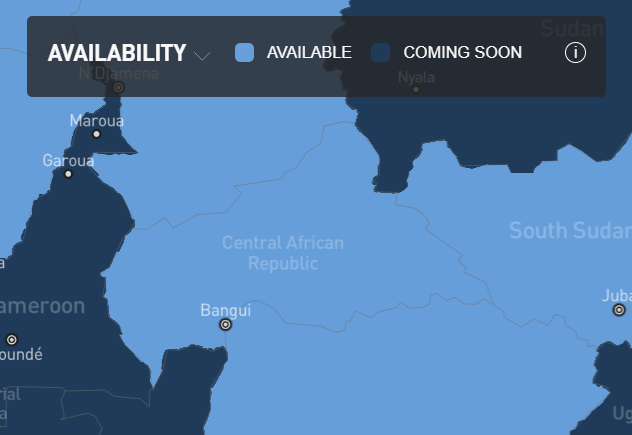
The News: Starlink has officially launched commercial satellite internet service in the Central African Republic (CAR), making high-speed connectivity available for the first time via SpaceX's low-Earth-orbit network.
Why It Matters: With 88% of CAR's population currently offline, this launch represents one of the most impactful connectivity expansions Starlink has made anywhere in Africa — and signals SpaceX's continued push to blanket the continent.
Source: @Starlink on X
Starlink Goes Live in the Central African Republic — 88% of the Population Was Offline Until Now
Starlink has just flipped the switch in the Central African Republic. As of today, SpaceX's satellite internet network is commercially available in one of the world's most underconnected nations — a country where, at the end of 2025, just 12% of the population had any internet access at all. That's roughly 670,000 people online out of a total population of 5.56 million. The other 4.89 million? Completely offline.
This isn't just another dot on Starlink's coverage map. It's a meaningful inflection point for a region that fiber and mobile broadband have largely bypassed.

📊 Key Figures
| Metric | Value | Context |
|---|---|---|
| CAR Internet Users (end-2025) | 670,000 | 12% of population |
| Population Without Internet | 4.89 million | 88% of population |
| Government Agreement Signed | Dec 18, 2025 | ~90 days to launch |
| Satellite Kits to Be Donated | Hundreds | Schools, clinics, gov institutions |
| Starlink Max Download Speed | 400+ Mbps | Global average, 99.9% uptime |
| Pricing in CAR | TBD | Not yet disclosed |
From Agreement to Launch in 90 Days
The groundwork for today's launch was laid on December 18, 2025, when the Government of the Central African Republic formally signed an agreement with Starlink. That's a notably fast turnaround — roughly 90 days from deal to commercial availability. It reflects both SpaceX's operational efficiency and the CAR government's urgency to close its connectivity gap.
The arrangement goes beyond a standard commercial rollout. According to reporting from TechAfrica News and Space in Africa, Starlink will donate hundreds of satellite kits specifically for distribution to rural schools, health centers, and government institutions. This isn't just about selling subscriptions — it's a structured effort to use satellite internet as infrastructure in a country where traditional infrastructure has been chronically underfunded.
Why CAR Is One of the Hardest Connectivity Challenges on Earth
The Central African Republic ranks among the world's least developed nations by nearly every metric. Its terrain — dense rainforest, sparse road networks, and remote communities spread across a landlocked territory the size of Texas — makes fiber and mobile tower deployment economically unviable for most of the country. The 12% internet penetration figure isn't a failure of demand; it's a failure of infrastructure reach.
That's precisely the problem Starlink was designed to solve. Low-Earth orbit satellites eliminate the need for ground-based cable runs. A dish, a router, and a clear view of the sky are all that's required. In a country where 88% of people have never had a broadband connection, that's a transformative proposition.
🛰️ What Starlink's Kit Includes
- Satellite dish (phased-array antenna)
- Mounting stand
- Wi-Fi router
- All necessary cables
- No ground infrastructure required beyond power
🔭 The BASENOR Take
| Timeline | Agreement Dec 18, 2025 → Live March 16, 2026 |
| Impact Level | 🟠 High — one of Africa's most underserved markets |
| Confidence | 🟢 Confirmed — official @Starlink announcement |
Starlink's Africa expansion has been accelerating. CAR joins a growing list of sub-Saharan nations where SpaceX has secured government agreements and launched commercial service. Each new country adds to the network's density of ground customers, which in turn strengthens the business case for continued constellation expansion.
For the SpaceX ecosystem broadly, this is the kind of deal that validates the entire Starlink business model: governments paying for access, donating hardware to institutions, and using satellite internet as a development tool rather than a luxury product. It's a replicable template that SpaceX can apply across dozens of similarly underconnected markets in Africa, Southeast Asia, and Central Asia.
Pricing for CAR has not yet been disclosed. Given the country's economic profile, it's likely that Starlink will offer a regionally adjusted rate — as it has done in other lower-income markets — rather than applying its standard Western pricing. The donated kit program for schools and clinics suggests the commercial launch is paired with a deliberate affordability strategy, though the specifics remain to be announced.
📰 Deep Dive
The Central African Republic launch is a data point in a much larger pattern. SpaceX has been methodically working through African markets where terrestrial broadband has failed to scale — and CAR represents perhaps the most extreme version of that failure. An 88% offline rate in 2025 is not a developing-market lag; it's a near-complete absence of connectivity infrastructure. Starlink doesn't need to compete with existing providers here. It simply needs to show up.
The donated kit program deserves particular attention. Starlink committing hundreds of dishes to schools, health centers, and government offices before the commercial market has even priced its subscriptions suggests this is as much a strategic partnership as a commercial launch. Governments that integrate Starlink into their public infrastructure become long-term institutional customers — a stickier revenue base than individual consumers who might churn if prices shift.
For SpaceX watchers, the 90-day turnaround from signed agreement to live service is worth noting. It reflects a streamlined playbook: negotiate with the government, handle regulatory approvals in parallel, ship hardware, and go live. As Starlink's constellation grows denser and its ground operations more practiced, that timeline may compress further. The implication is that SpaceX can now enter new markets faster than almost any traditional telecom operator — a structural advantage that compounds with each successive launch. For our broader SpaceX coverage, this CAR launch fits squarely into the network's long-term global saturation strategy.
Sources & reporting notes
The links below identify the material source records used for this report.
- @Starlink on X (2026-03-16T05:59:07.000Z) — Direct source
Source links are preserved as published or accessed. See our editorial standards and corrections policy.
The BASENOR Editorial Desk covers Tesla, SpaceX, and related technology, curating reporting from primary sources — official accounts, regulatory filings, and software release data. Every article passes source-record and fact-checking review before publication. About the newsroom.
This report was curated by the BASENOR Editorial Desk from the sources listed above. Read our editorial standards or email editorial@basenor.com to report an error.