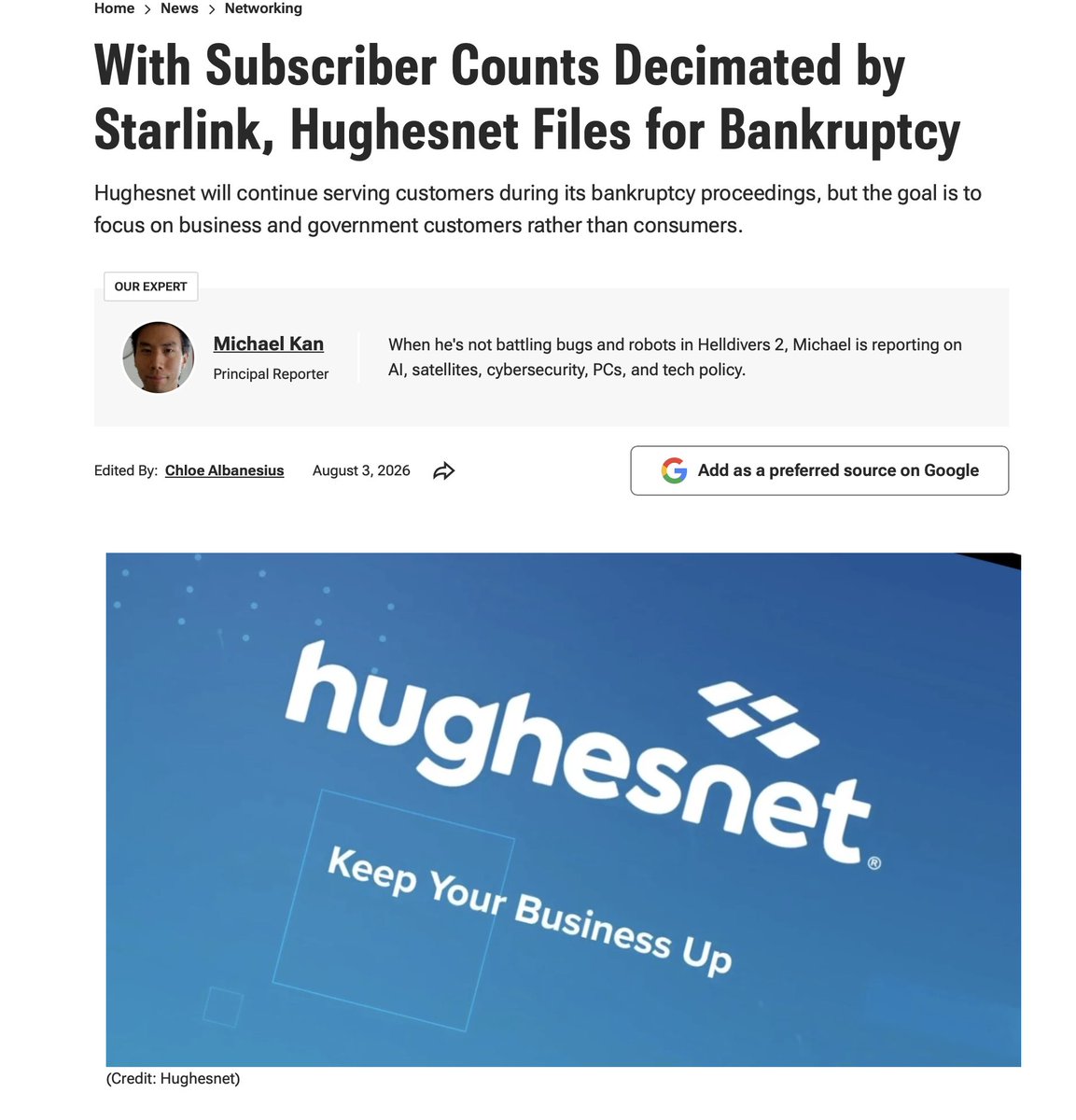
Hughesnet, once the dominant name in US satellite internet, filed for Chapter 11 bankruptcy on August 2, 2026 — and its own filings point directly at Starlink as the primary cause. The collapse of a company that served over 1.5 million subscribers just six years ago is one of the clearest illustrations yet of how quickly SpaceX's satellite network has reshaped the competitive landscape.

The Numbers Behind the Collapse
The scale of Hughesnet's decline is stark. According to court filings, the company's subscriber base stood at approximately 1.56 million in late 2020 — right around the time Starlink launched its US beta. By the bankruptcy petition date, that number had fallen to 641,000. That's a loss of more than half the subscriber base in under six years, with the pace accelerating: a 21.7% decline in the final twelve months alone, from 819,000 subscribers in June 2025 to 641,000 at filing.
EchoStar's Q2 2026 quarterly report, released the day after the filing, put an even finer point on it. The parent company reported broadband subscribers had fallen to 622,000 — a loss of 59,000 in a single quarter — and explicitly attributed the decline to Starlink's competitive pressure.
| Metric | Figure | Context |
|---|---|---|
| Subscribers (late 2020) | ~1,560,000 | Starlink US beta launches |
| Subscribers (June 2025) | 819,000 | 12 months before filing |
| Subscribers at filing (Aug 2, 2026) | 641,000 | –21.7% year-over-year |
| EchoStar broadband subs (Q2 end) | 622,000 | –59,000 in Q2 alone |
| Total debt at filing | $1.5B+ | Matured August 1, 2026 |
| Total assets at filing | $1.9B | Hughes Network Systems LLC + 11 affiliates |
How We Got Here
Hughesnet's business model was built around geostationary satellites — hardware positioned roughly 22,000 miles above Earth. That altitude creates inherent latency that makes real-time applications like video calls and gaming frustrating, a limitation baked into the physics of the system. Starlink's low-Earth orbit constellation, by contrast, operates at around 340 miles altitude, delivering latency figures that are competitive with ground-based broadband in many rural markets.
For the millions of Americans in rural and underserved areas who had no alternative to Hughesnet, Starlink's arrival wasn't a marginal upgrade — it was a generational leap. The subscriber exodus that followed wasn't a slow bleed; it was a structural collapse. Hughesnet's debt load, which had been manageable when the subscriber base was healthy, became fatal as revenue contracted. The $1.5 billion in debt that matured on August 1 couldn't be refinanced or repaid, and the filing came the following day.
What Happens to Existing Customers
According to court filings reported by PCMag and CNET, Hughesnet intends to continue serving customers through the restructuring process. The company is pivoting away from consumer broadband entirely, refocusing on enterprise, government, and defense contracts — markets where Starlink's consumer-grade positioning is less of a direct threat and where long-term procurement relationships provide more stability.
The human cost is significant: 400 of the company's 1,275 employees are being laid off. On the leadership side, COO Paul Gaske has stepped down and transitioned to a senior advisor role, with Robert Del Genio appointed as Chief Restructuring Officer to guide the Chapter 11 process.
The Broader Signal
Hughesnet is not a small operator that got outmaneuvered. It was the market leader in US satellite broadband for years, backed by EchoStar's considerable resources. The fact that it couldn't survive Starlink's competition — and that its own SEC filings name Starlink as the direct cause — is a data point that goes well beyond one company's misfortune.
For SpaceX, this is a concrete validation of the low-Earth orbit bet. Starlink now has documented evidence, in a federal bankruptcy court filing, that it displaced the incumbent at scale. The question now is whether any remaining legacy satellite operators can find a defensible niche, or whether Starlink's trajectory makes that increasingly difficult to sustain. Follow our SpaceX coverage as this story develops.
Sources & reporting notes
The links below identify the material source records used for this report.
- @SawyerMerritt on X (2026-08-03T15:39:41.000Z) — Direct source
Source links are preserved as published or accessed. See our editorial standards and corrections policy.
The BASENOR Editorial Desk covers Tesla, SpaceX, and related technology, curating reporting from primary sources — official accounts, regulatory filings, and software release data. Every article passes source-record and fact-checking review before publication. About the newsroom.
This report was curated by the BASENOR Editorial Desk from the sources listed above. Read our editorial standards or email editorial@basenor.com to report an error.