SpaceX has officially introduced dynamic pricing for Starlink Residential internet plans in select regions, with costs now tied directly to local network capacity and customer demand. The move marks a significant shift from Starlink's historically stable pricing structure — and the first wave of changes is already hitting customers in the US Midwest and UK. Here's what you need to know.

1. Prices Are Now Reviewed Quarterly — Up or Down
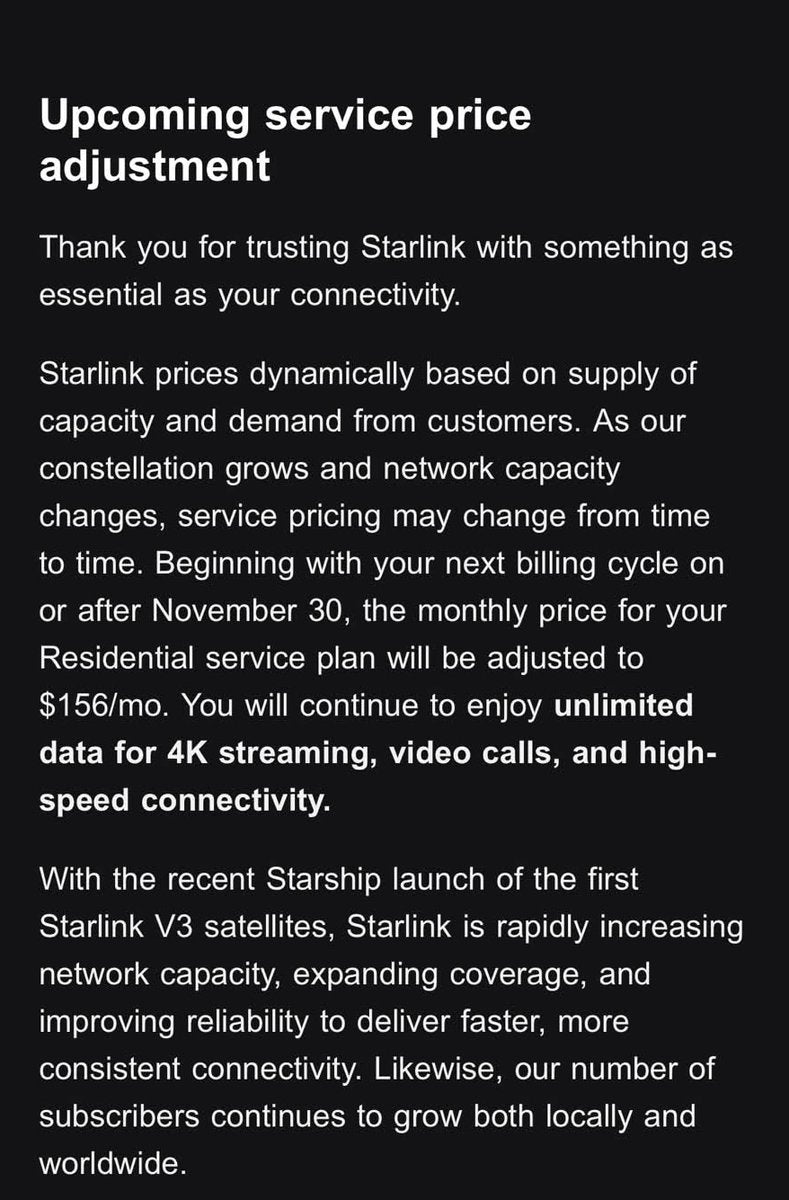
Starlink's new model ties Residential plan pricing to supply and demand in each local coverage area, with reviews happening approximately every quarter. The key nuance: this isn't a one-way ratchet. According to the customer email Starlink sent to affected subscribers, "service pricing may change from time to time" — and that explicitly includes reductions. As the V3 satellite constellation expands and capacity increases in a given area, prices can fall just as easily as they rise.
2. The Cap Appears to Be ±20%
Data pulled from Starlink's website suggests the dynamic pricing model operates within a band of roughly 20% in either direction from a baseline rate, according to PCMag. That's not a trivial swing — on a $130/month Residential Max plan, a 20% increase means an extra $26 per month. But it also sets a ceiling on how aggressively prices can move in a single cycle, which provides at least some predictability for budget-conscious subscribers.
3. Missouri Is Seeing the Steepest Increases So Far
The first concrete examples of price hikes are concentrated in rural Missouri. One customer in the state reported their Residential 100 Mbps plan climbing from $50 to $60.50 per month, effective on or after November 30. Another saw their Residential Max plan jump from $130 to $156. In Rolla, Missouri, the Residential plan on Starlink.com now defaults to the Max tier at $156/month. A separate Warsaw, Missouri customer reported a 10% increase to $143/month. These areas likely reflect high demand relative to current local capacity.
4. Some Areas Are Actually Getting Cheaper
The dynamic model cuts both ways. In Kansas City, Missouri — a denser urban market where Starlink has presumably built out more capacity — Residential plans are now listed at $49.50 (100 Mbps), $76.50 (200 Mbps), and $117 (Residential Max), according to PCMag. Marysville, Kansas goes even lower: $44, $68, and $104 per month respectively. Price reductions have also been observed in the UK. This is the mechanism Starlink is leaning on to argue the model is fair — it's not a blanket increase, it's localized supply-and-demand pricing.
5. The Trigger Is Constellation Growth
Starlink's official framing ties the pricing changes directly to the ongoing deployment of its next-generation V3 satellites and rising subscriber counts. As more satellites come online and more customers join in a given region, the capacity-to-demand ratio shifts — and so does the price. This means subscribers in areas where Starlink is still the only viable broadband option (and demand is high relative to supply) are most exposed to increases, while subscribers in areas receiving new satellite coverage stand to benefit from reductions.
6. Affected Customers Are Being Notified by Email
Starlink is communicating the changes directly to impacted subscribers via email before the new rates take effect. The emails cite the dynamic pricing rationale explicitly and give customers advance notice ahead of the November 30 effective date mentioned in early reports. If you're a Starlink Residential subscriber and haven't received an email yet, your region may not be in the first wave — but checking your current plan rate on Starlink.com against your area's listed price is a straightforward way to see if a change is pending.
The broader question for Starlink's subscriber base is whether quarterly pricing reviews become a source of ongoing uncertainty or stabilize once the V3 constellation reaches maturity. For now, the safest assumption is that your rate is no longer locked in the way it once was — and monitoring your billing cycle ahead of each quarter makes sense. For more on SpaceX's network developments, see our SpaceX coverage.
Sources & reporting notes
The links below identify the material source records used for this report.
- @SawyerMerritt on X (2026-10-30T01:40:39.000Z) — Direct source
- @SawyerMerritt on X (2026-10-30T01:40:40.000Z) — Direct source
Source links are preserved as published or accessed. See our editorial standards and corrections policy.
The BASENOR Editorial Desk covers Tesla, SpaceX, and related technology, curating reporting from primary sources — official accounts, regulatory filings, and software release data. Every article passes source-record and fact-checking review before publication. About the newsroom.
This report was curated by the BASENOR Editorial Desk from the sources listed above. Read our editorial standards or email editorial@basenor.com to report an error.