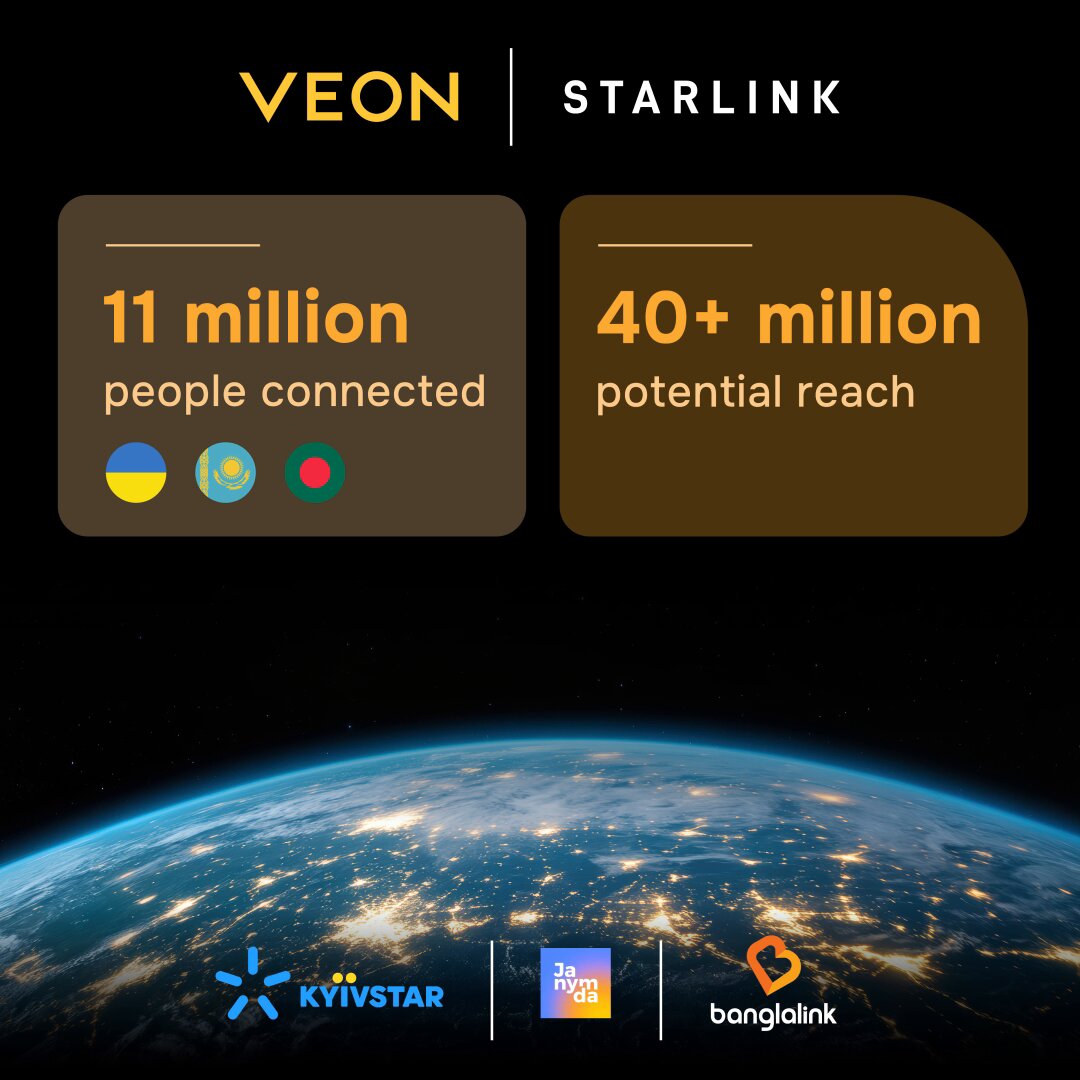
Starlink Mobile has quietly crossed a significant threshold. In less than one year of operation across three markets, the direct-to-device satellite service has connected more than 11 million people — many of them in areas where a cell tower has never existed. The announcement, made jointly by Starlink and telecom group VEON on October 19, 2026, puts hard numbers on a technology that has largely been discussed in theoretical terms.

1. Three markets, three different contexts
The 11 million figure spans Ukraine, Kazakhstan, and Bangladesh — three countries with almost nothing in common except patchy terrestrial infrastructure. In Ukraine, Kyivstar launched the service on November 24, 2025, during an active conflict that has repeatedly knocked out ground-based network equipment. In Kazakhstan, Beeline Kazakhstan came online September 29, 2026, serving a country where vast steppe geography makes tower economics difficult. Bangladesh's Banglalink launched October 9, 2026 — just eleven days before this announcement — and is notable as the first satellite-to-mobile service in all of South Asia. Each market represents a structurally different connectivity problem that ground infrastructure alone cannot solve.
2. No new phone required
The service works on existing LTE-compatible handsets — no hardware upgrade, no satellite-specific device. Users connect through satellite-ready applications and standard SMS. That matters enormously in markets like Bangladesh, where smartphone replacement cycles are long and average selling prices are low. The barrier to entry is essentially zero for anyone already carrying a compatible phone, which helps explain how 11 million connections accumulated as quickly as they did. According to VEON, the use cases include messaging, voice notes, and location sharing — the core functions people reach for when they lose signal.
3. The timeline is compressed
Eleven million users in under a year is a faster ramp than most telecom infrastructure rollouts achieve in a decade. For context, Bangladesh alone joined the service less than two weeks before this milestone was announced, meaning the bulk of those 11 million connections came from Ukraine and Kazakhstan. Kyivstar has had the longest runway at roughly eleven months. The pace suggests demand in coverage-gap regions is not gradual — once the service exists, uptake is immediate.
4. Forty million is the stated ceiling — for now
VEON estimates the addressable population across its footprint in these three markets exceeds 40 million people. At 11 million connected, the partnership is roughly 27 percent of the way to that internal benchmark. Whether the remaining 29 million represent straightforward growth or harder-to-reach users — those with older handsets, limited data literacy, or no existing VEON relationship — will determine how the next phase of expansion unfolds. The gap between 11 million and 40 million is where the real infrastructure story gets written.
5. This is the direct-to-device model proving itself at scale
Direct-to-device satellite connectivity has been a technology promise for years. What this announcement represents is the first time a credible user count has been attached to it in live, commercial deployments. The VEON partnership gives Starlink Mobile a distribution layer — established carrier billing relationships, local regulatory approvals, and existing subscriber bases — that pure satellite operators typically lack. According to VEON's official announcement, the service is designed to complement terrestrial networks rather than replace them, activating only where cell coverage drops out. That hybrid model is likely what makes the adoption numbers plausible: users aren't switching providers, they're gaining a fallback.
The 40 million addressable figure VEON cites covers only three countries. Starlink Mobile's broader partner network extends well beyond VEON's footprint, which means the 11 million number — significant as it is — represents an early data point in a much longer story about what satellite-to-mobile connectivity looks like at genuine global scale. For our SpaceX coverage, the trajectory here is worth watching closely.
Sources & reporting notes
The links below identify the material source records used for this report.
- @Starlink on X (2026-10-20T01:09:08.000Z) — Direct source
Source links are preserved as published or accessed. See our editorial standards and corrections policy.
The BASENOR Editorial Desk covers Tesla, SpaceX, and related technology, curating reporting from primary sources — official accounts, regulatory filings, and software release data. Every article passes source-record and fact-checking review before publication. About the newsroom.
This report was curated by the BASENOR Editorial Desk from the sources listed above. Read our editorial standards or email editorial@basenor.com to report an error.