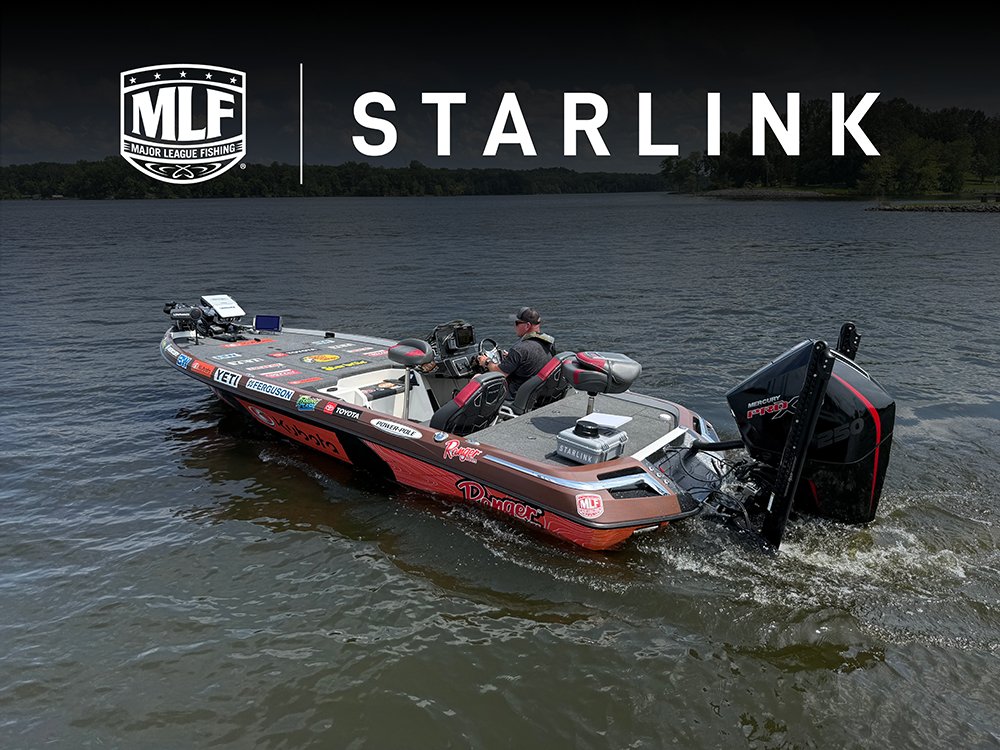
Starlink has landed a sports partnership that puts its satellite internet technology to work in some of the most connectivity-challenged venues imaginable — lakes, rivers, and reservoirs scattered across the United States. Major League Fishing announced on July 16, 2026 that Starlink will serve as its primary internet provider across more than 150 live events annually, replacing the patchwork of terrestrial infrastructure that has historically made remote tournament coverage a logistical headache.

What the Deal Actually Covers
This isn't a branding arrangement — Starlink is being integrated into MLF's core production and fan-engagement infrastructure. According to Major League Fishing, the partnership supports real-time data transmission, broadcast production workflows, and live event coverage for thousands of competitive anglers and millions of fans each year.
Specifically, Starlink's connectivity will underpin three pillars of the MLF digital experience:
- MLFNOW! livestream — the organization's live broadcast product, which requires sustained uplink bandwidth from wherever a tournament happens to be running that weekend
- SCORETRACKER® live leaderboard — real-time scoring data that fans follow during competition
- Starlink Team Series — a tournament format now carrying the satellite provider's name as a title sponsor
The scope is significant. MLF runs events across a wide range of aquatic venues — many of them rural, some genuinely remote — where cellular coverage can be unreliable and fixed broadband simply doesn't exist. Traditional event production in those locations has required expensive satellite uplinks or cellular bonding rigs that still struggle in dead zones. Starlink's low-earth orbit constellation sidesteps that problem with consistent, low-latency coverage regardless of geography.
The Strategic Logic for Starlink
For SpaceX's commercial satellite division, the MLF deal is a visible proof-of-concept for a use case Starlink has been quietly building toward: live sports production in the field. The fishing tournament circuit is a useful proving ground precisely because it's demanding. Events move every week, venues are unpredictable, and the production team can't rely on the infrastructure that a stadium or arena provides.
Boyd Duckett, Co-Founder, President and CEO of Major League Fishing, framed the partnership in terms of sport evolution rather than just logistics. "The future of sports is increasingly shaped by technology, connectivity and real-time engagement," Duckett said in the announcement, describing Starlink as "another step forward in our commitment to pushing the sport ahead."
That framing matters commercially. Starlink has secured connectivity deals with maritime operators, airlines, and emergency services — but live sports is a high-visibility category that carries consumer brand recognition in a way that enterprise contracts don't. A Starlink logo attached to a nationally broadcast fishing tournament reaches an audience that skews rural, outdoor-oriented, and often in exactly the geographic areas where Starlink's residential service competes most directly with slow DSL or fixed wireless alternatives.
What It Means for Live Sports Connectivity Broadly
The MLF partnership is part of a broader pattern. Satellite internet has historically been a backup option for live sports production — the thing you bring when nothing else works, accepted as a compromise on latency and bandwidth. Starlink's low-earth orbit architecture changes that calculus. With latency figures that can approach terrestrial broadband performance, it's increasingly viable as a primary uplink rather than a fallback.
For context on the scale of MLF's operation: 150-plus events per year means roughly three events per week across a full season. Maintaining consistent broadcast-quality connectivity at that tempo, across venues that are chosen for fish habitat rather than telecommunications infrastructure, is a genuine operational challenge. If Starlink executes reliably across that schedule, it builds a reference case that other outdoor and motorsport leagues will notice.
The partnership also signals something about where Starlink is positioning itself in the sports market. Rather than chasing the NFL or NBA — leagues that operate in fixed, well-wired venues — it's targeting the segment where satellite connectivity offers a real competitive advantage: outdoor, mobile, and geographically dispersed events. That's a defensible niche, and MLF is one of the more prominent properties in it.
Whether the MLFNOW! livestream quality improves noticeably for fans this season will be the real test. Announced partnerships are one thing; consistent 150-event execution across two-plus years of a tournament calendar is another. For more on SpaceX's expanding commercial footprint, see our SpaceX coverage.
Sources & reporting notes
The links below identify the material source records used for this report.
- @Starlink on X (2026-07-17T00:36:55.000Z) — Direct source
Source links are preserved as published or accessed. See our editorial standards and corrections policy.
The BASENOR Editorial Desk covers Tesla, SpaceX, and related technology, curating reporting from primary sources — official accounts, regulatory filings, and software release data. Every article passes source-record and fact-checking review before publication. About the newsroom.
This report was curated by the BASENOR Editorial Desk from the sources listed above. Read our editorial standards or email editorial@basenor.com to report an error.