Starlink and NTT Docomo are moving beyond text-only satellite messaging. In a post from the official Starlink account, SpaceX confirmed that when the next-generation V2 service launches in Japan with Docomo, it will deliver 5G-class speeds directly to unmodified mobile phones — enabling streaming, browsing, and voice calls from anywhere the sky is visible. It's a significant leap from the current V1 offering, which already connects more than 6.5 million Docomo customers with basic apps and messaging in remote areas.

From Text-Only to True Broadband
The V1 service — branded as "docomo Starlink Direct" in Japan — launched on April 27, 2026, according to Docomo's own materials, and hit 6.5 million cumulative users within roughly three months. But V1 is deliberately limited: text messaging and lightweight app data only, in outdoor areas where Docomo's 4G and 5G footprint doesn't reach. Voice calls are not supported today.
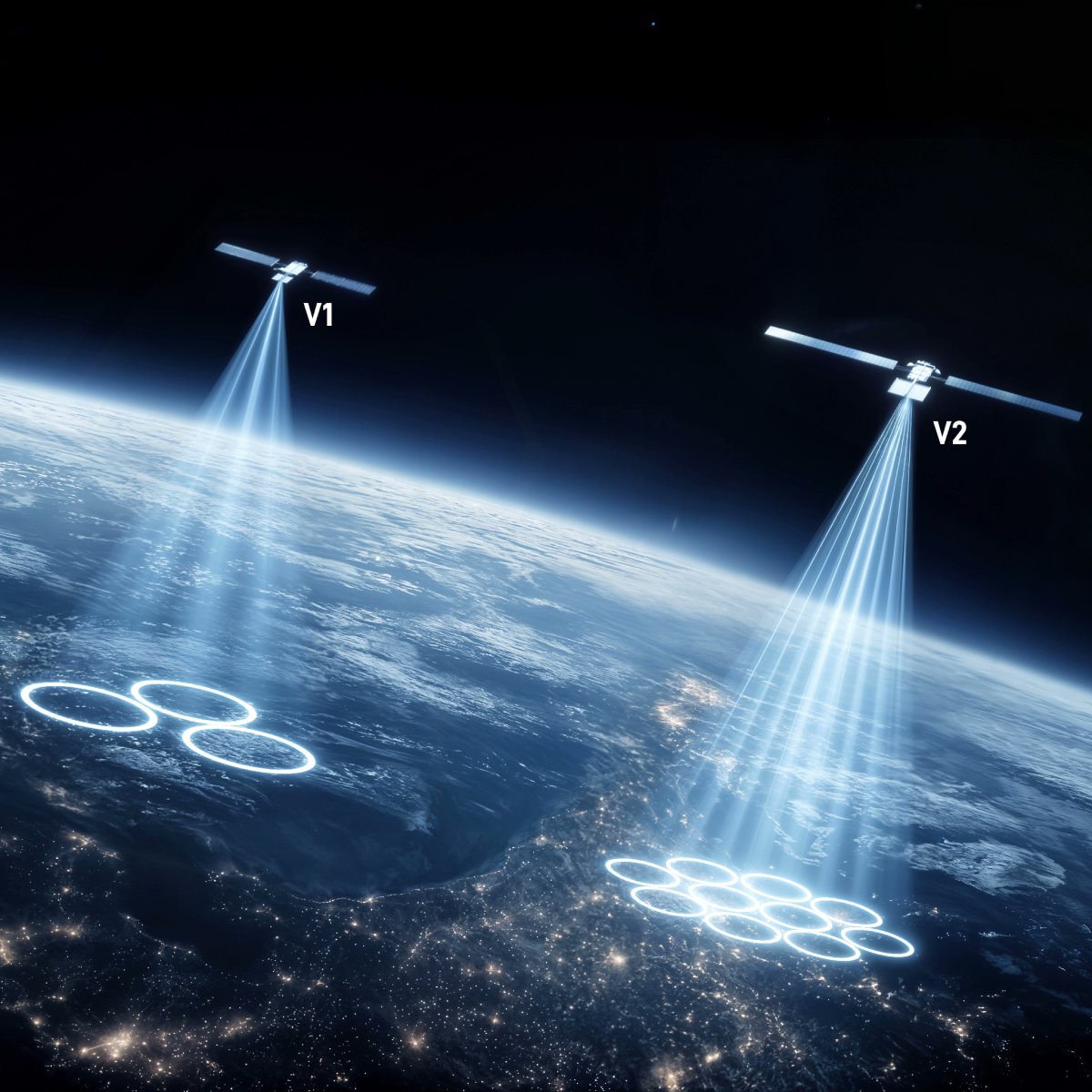
V2 changes the equation. According to SpaceX's technical materials, the second-generation Starlink Mobile satellites are engineered to deliver "5G-level speeds from space," with peak user speeds in the neighborhood of 150 Mbps — comparable to a decent terrestrial 5G connection under ideal conditions. Each V2 satellite is expected to offer roughly 20 times the throughput of a V1 satellite and about 100 times the data density, according to previous SpaceX statements. That's the leap needed to move from "messages get through in the mountains" to "you can actually make a phone call and load a video."
Key Figures
| Metric | V1 (Today) | V2 (Planned) |
|---|---|---|
| Capabilities | Text, some apps | Streaming, browsing, voice |
| Peak speed | Messaging-class | ~150 Mbps (SpaceX) |
| Docomo users connected | 6.5M+ | Expanded rollout |
| Full deployment target | Live since April 2026 | From 2027; voice by FY2028 |
| Phone compatibility | Standard LTE phones | Standard LTE phones |
How We Got Here
Docomo and Starlink Japan G.K. formalized their partnership well before the V1 launch, positioning direct-to-cell satellite service as a way to plug Japan's mountainous coverage gaps without asking users to buy new hardware. The V1 rollout in April 2026 made the service available across all Docomo and ahamo pricing plans free of charge — no application, no sign-up flow, no separate SIM. If your phone is outdoors and out of terrestrial range, it just works for text and light data.
According to Docomo and SpaceX materials, the two companies have now agreed to extend that same "invisible upgrade" model to V2. Docomo customers won't need a new device, a new plan, or a new app — the satellites carry the heavier lifting. Full deployment of the second-generation constellation is expected to begin in 2027, with voice calling and high-speed data on Docomo targeted for fiscal 2028. The V2 architecture, per SpaceX, uses custom silicon and advanced phased-array antennas to hit those throughput numbers, and it's being designed to serve IoT devices as well as phones.
Why This Matters Beyond Japan
Japan is a strategic showcase for direct-to-cell. Docomo is the country's largest carrier by subscriber base, and Japan's terrain — long coastlines, dense mountains, thousands of inhabited islands — is exactly the kind of environment where terrestrial 5G economics break down. If Starlink can demonstrate 150 Mbps peak speeds and reliable voice on ordinary handsets there, it becomes a much easier sell to carriers in Southeast Asia, Latin America, and rural North America facing similar coverage math.
It also puts pressure on competing direct-to-cell efforts. AST SpaceMobile and Lynk Global are pursuing similar architectures, but Starlink already has roughly 650 direct-to-cell-capable satellites in low Earth orbit, according to previous SpaceX statements — a head start that becomes more meaningful once V2 satellites start filling in the constellation.
What to Watch Next
A few concrete signals will tell us whether the V2 timeline holds. First, the cadence of V2 satellite launches through 2027 — SpaceX will need to move a large number of second-generation birds on Falcon 9 and eventually Starship. Second, whether Docomo or SpaceX publishes real-world speed data from Japan once V2 service is live, rather than the theoretical 150 Mbps peak. Third, regulatory approval: direct-to-cell service depends on spectrum agreements with each partner carrier, and Japan's Ministry of Internal Affairs and Communications will have to sign off on any expanded operating parameters.
For now, the announcement is a roadmap statement rather than a service launch. But it's a specific roadmap with a named partner, a named speed target, and a fiscal-year commitment for voice — which is more concrete than most satellite-to-phone promises floating around the industry.
Sources & reporting notes
The links below identify the material source records used for this report.
- @Starlink on X (2026-08-14T20:28:23.000Z) — Direct source
Source links are preserved as published or accessed. See our editorial standards and corrections policy.
The BASENOR Editorial Desk covers Tesla, SpaceX, and related technology, curating reporting from primary sources — official accounts, regulatory filings, and software release data. Every article passes source-record and fact-checking review before publication. About the newsroom.
This report was curated by the BASENOR Editorial Desk from the sources listed above. Read our editorial standards or email editorial@basenor.com to report an error.