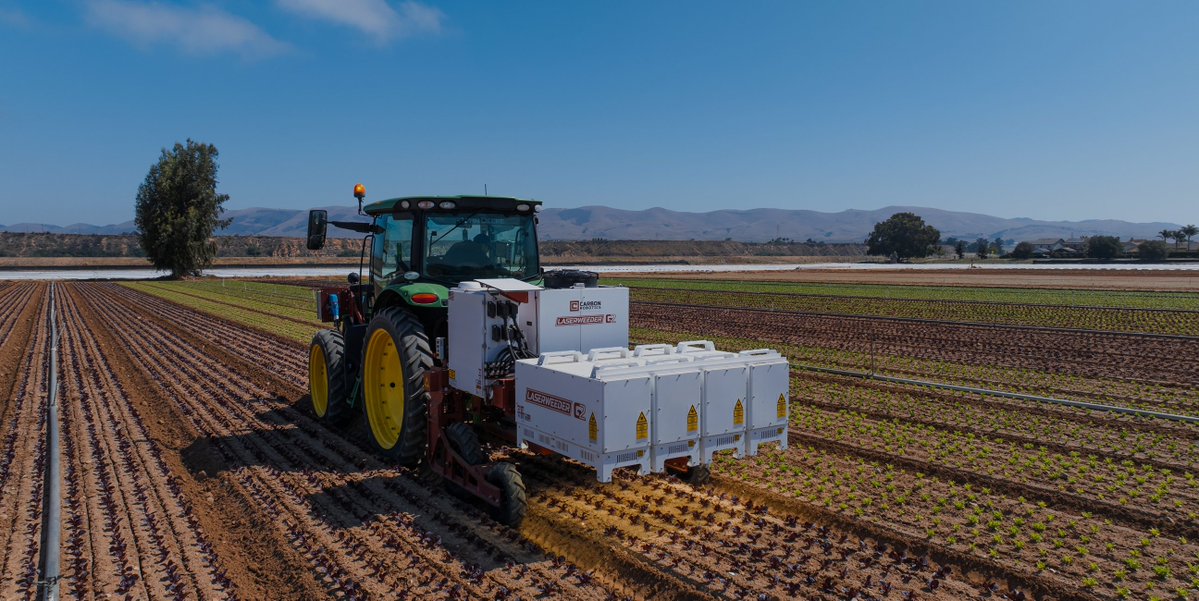
Starlink quietly highlighted one of its most concrete agricultural use cases this week: powering Carbon Robotics' fleet of AI-driven LaserWeeder systems across 15 countries. The numbers behind the partnership — from weed-targeting speed to herbicide reduction — are worth a closer look.

1. Fleet Control Across 15 Countries Depends on Always-On Connectivity
Carbon Robotics' LaserWeeder systems operate in North America, Europe, Australia, New Zealand, and beyond — and every machine needs a live connection back to base. When the onboard AI encounters a plant or obstacle it can't confidently classify, a remote operator needs to intervene in real time. In remote farmland, that kind of reliable uplink is exactly what traditional broadband can't guarantee. Starlink fills that gap, making continuous fleet oversight practical at global scale rather than a theoretical capability.
2. The AI Behind It Was Trained on 150 Million Labeled Plant Images
In February 2026, Carbon Robotics launched what it calls the world's first Large Plant Model (LPM) — a foundational AI model for plant detection and identification, according to the company. The LPM was trained on 150 million labeled plant images, described as the largest and most diverse agricultural dataset ever built. Reliable connectivity isn't just about keeping machines running; it feeds new field data back into that model, tightening accuracy with every acre worked.
3. The LaserWeeder G2 Targets Up to 10,000 Weeds Per Minute
That figure — 10,000 weeds per minute — is the operational ceiling of Carbon Robotics' current hardware, according to company data. At that throughput, the system's ability to distinguish crop from weed in real time is the limiting factor, not the laser itself. The Starlink connection supports remote intervention precisely when the AI hits edge cases the model hasn't fully learned yet, keeping false-positive rates low enough that farmers trust the machine to run unsupervised across large fields.
4. Some Growers Have Cut Herbicide Use by 100%
Starlink's announcement highlighted up to a 50% increase in crop yields for farmers using the LaserWeeder system. But the herbicide story is arguably just as significant: Carbon Robotics reports that some growers have achieved up to a 100% reduction in herbicide use, according to company data. The LaserWeeder targets weeds thermally, leaving soil microbiology undisturbed — a meaningful shift for growers pursuing regenerative agriculture certifications or trying to reduce input costs as herbicide prices climb.
5. Carbon Robotics Crossed $100 Million in Annual Revenue in Early 2026
The partnership isn't a pilot program or a proof-of-concept — it's operating at commercial scale. Carbon Robotics surpassed $100 million in annual revenue for its fiscal year ending January 31, 2026, according to company disclosures. That revenue base reflects real adoption by working farms, not just early-adopter trials. For Starlink, it's a tangible data point in the case that satellite connectivity is infrastructure for precision agriculture, not just a rural internet fallback.
The broader takeaway here is that Starlink's agricultural story is maturing fast. Connecting a laser-wielding robot fleet across 15 countries — and feeding real-time field data back into an AI model trained on 150 million images — is a different value proposition than replacing a farmhouse cable modem. Whether that translates into a dedicated agricultural tier or deeper integration with farm management platforms is the question worth watching as Carbon Robotics scales further.
Sources & reporting notes
The links below identify the material source records used for this report.
- @Starlink on X (2026-07-16T19:58:47.000Z) — Direct source
Source links are preserved as published or accessed. See our editorial standards and corrections policy.
The BASENOR Editorial Desk covers Tesla, SpaceX, and related technology, curating reporting from primary sources — official accounts, regulatory filings, and software release data. Every article passes source-record and fact-checking review before publication. About the newsroom.
This report was curated by the BASENOR Editorial Desk from the sources listed above. Read our editorial standards or email editorial@basenor.com to report an error.