Starship Flight 12: Booster 19 Clears Critical Testing, 33 Raptor 3 Engines Up Next
⚡ 30-Second Brief
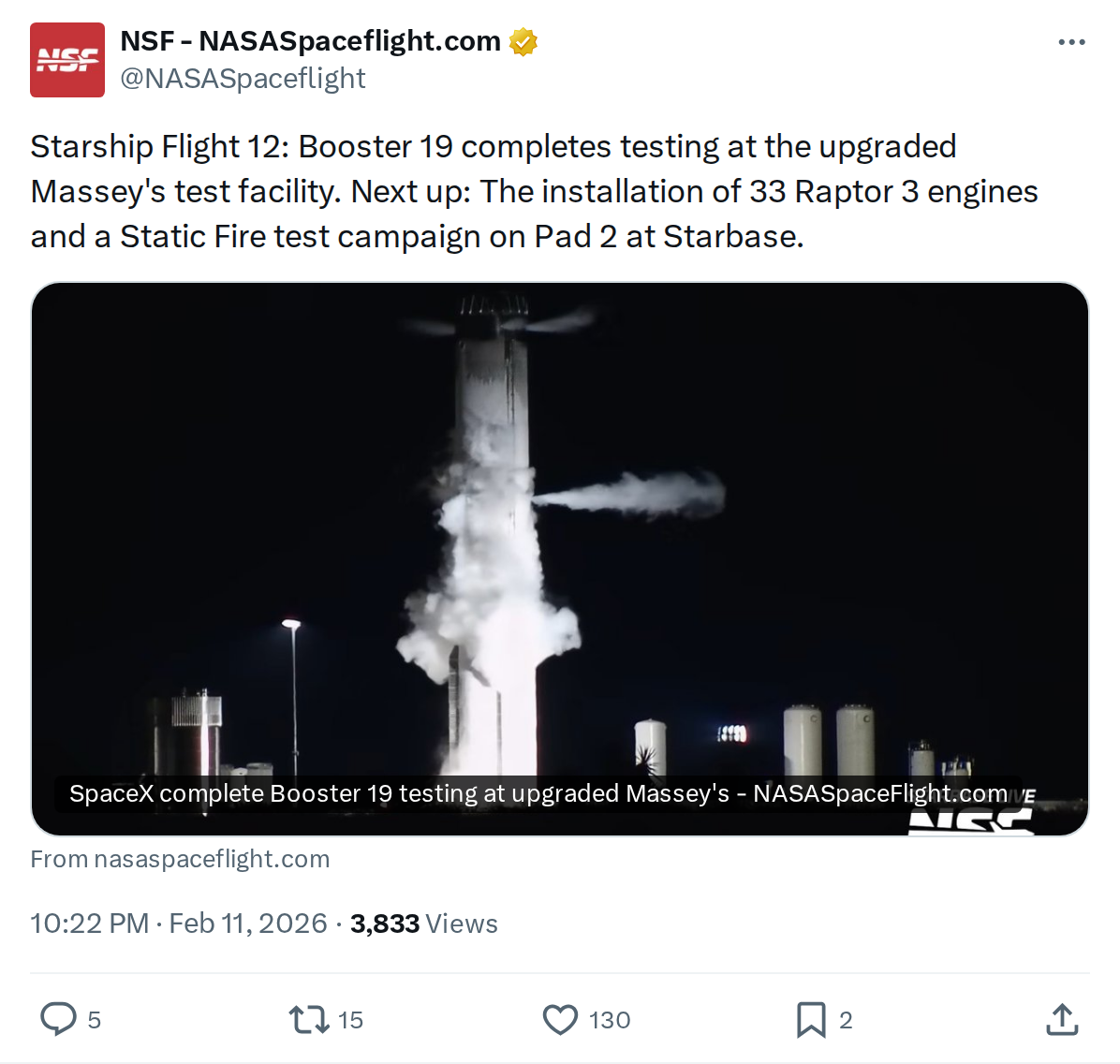
The News: SpaceX has successfully completed cryogenic proof testing for Super Heavy Booster 19 at the upgraded Massey facility, clearing a major milestone for Starship Flight 12.
Why It Matters: Flight 12 represents the debut of SpaceX's V3 vehicle architecture with 33 next-generation Raptor 3 engines — the most powerful methane-fueled engines ever flown. This mission will demonstrate critical upgrades that pave the way for rapid reusability and higher payload capacity.
Source: @NASASpaceflight on X

📊 Key Figures
| Metric | Value | Context |
|---|---|---|
| Raptor 3 Engines | 33 units | Full Super Heavy booster complement |
| Raptor 3 Thrust | 280 metric tons (sea-level) | +22% increase over Raptor 2's 230 tons |
| Engine Weight | 1,525 kg per unit | 75 kg lighter than Raptor 2 |
| Stacking Time | ~2 weeks | Previously took 6 months for V2 boosters |
| Target Launch | Early March 2026 | Q1 2026 timeline confirmed by multiple sources |
| Cryo Tests Completed | 2 tests (Feb 2 & Feb 4) | First successful V3 booster cryo campaign |
🚀 What Just Happened at Starbase
SpaceX has crossed a critical threshold in its Starship Flight 12 preparations. After two successful cryogenic proof tests on February 2nd and 4th, Super Heavy Booster 19 has been cleared from the Massey Outpost testing facility and returned to the production site for final integration work.
This marks the first time a V3-generation Super Heavy booster has successfully completed full-fill cryo testing — a validation process that pumps the vehicle's propellant tanks to capacity with cryogenic methane and liquid oxygen to verify structural integrity under flight-like thermal and pressure loads. Booster 18, the first V3 unit, suffered damage during its cryo campaign and was removed from the flight manifest.
The completion of testing at the upgraded Massey facility signals that SpaceX has resolved the structural and operational challenges that plagued earlier V3 hardware. According to verified reports, the stacking of Booster 19 was completed in approximately two weeks — a 12x improvement over the six-month timeline required for previous-generation boosters.
⚙️ The Raptor 3 Integration Phase
With structural testing complete, Booster 19 now enters its most complex assembly phase: the installation of 33 Raptor 3 engines. This next-generation methane-fueled engine represents a substantial leap in performance and design philosophy.
Each Raptor 3 unit produces 280 metric tons of thrust at sea level — a 22% increase over the 230-ton Raptor 2. The vacuum-optimized variant has demonstrated 306 tons of thrust in testing. Combined, the 33-engine cluster will deliver over 9,000 tons of thrust at liftoff, making it the most powerful rocket stage ever flown.
Beyond raw power, Raptor 3 introduces critical design changes for rapid reusability. The engine weighs 1,525 kg, down from Raptor 2's 1,600 kg, despite the thrust increase. SpaceX achieved this through aggressive integration: most external piping and sensors have been moved inside the engine body, eliminating the need for an external heat shield and reducing maintenance complexity.
The active cooling system and internal routing are designed to support over 100 flights per engine — a target that directly enables SpaceX's vision of airline-like operations for Starship.
🔬 Static Fire Campaign: The Final Hurdle
After engine installation, Booster 19 will be transported to Starbase's Orbital Launch Mount 2 for a Static Fire test campaign. This involves igniting all 33 Raptor 3 engines while the booster remains clamped to the launch mount, validating engine performance, thrust vector control, and ground systems integration.
Static Fire testing is historically where SpaceX identifies integration issues before committing hardware to flight. Given that Flight 12 represents the operational debut of Raptor 3 in a full-stack configuration, the test campaign is expected to be methodical. SpaceX has demonstrated increased caution in its testing protocols following anomalies in previous flight tests.
The company aims to complete Static Fire operations in time for an early March launch window, according to verified reporting from multiple spaceflight tracking sources.
🔭 The BASENOR Take
Timeline Confidence: High (85%)
Impact Level: Critical — V3 architecture validation
What We're Watching: Static Fire results and any engine swap activity
The successful completion of Booster 19's cryo testing is a significant de-risking event for Flight 12. After Booster 18's failure, there were questions about whether the V3 design had fundamental structural issues. The two-test campaign at Massey appears to have resolved those concerns.
The 12x improvement in stacking speed — from six months to two weeks — suggests SpaceX has achieved substantial manufacturing and tooling improvements. This acceleration is essential for the company's goal of launching Starship monthly or more frequently in 2026.
Raptor 3's debut is arguably more significant than the booster itself. If the 33-engine cluster performs as designed, it validates the architecture that will power not just Starship orbital missions, but also lunar landers for NASA's Artemis program and eventually Mars missions. The 100-flight reusability target, if achieved, would represent a paradigm shift in launch economics.
The early March timeline is achievable but tight. Static Fire campaigns can reveal unexpected issues, particularly with new engine variants. SpaceX will likely conduct multiple static fires with progressively longer burn durations before clearing the vehicle for flight.
📰 Deep Dive: Why Flight 12 Matters Beyond the Hardware
Starship Flight 12 represents more than just another test flight — it's the first integrated demonstration of SpaceX's production-optimized architecture. The V3 design isn't a prototype; it's the template for the vehicles that will carry Starlink satellites, NASA payloads, and eventually crew.
The Raptor 3 engine's design philosophy reflects lessons from over a decade of Merlin engine operations on Falcon 9. By internalizing components and eliminating external heat shields, SpaceX is designing for inspectability and rapid turnaround. The goal isn't just reusability — it's inspectionless reusability, where engines can fly again within hours rather than months of refurbishment.
The two-week stacking timeline for Booster 19 demonstrates that SpaceX has successfully industrialized Super Heavy production. This manufacturing velocity is essential for the company's 2026 roadmap, which includes supporting NASA's Artemis lunar missions, deploying Starship-based Starlink V3 satellites, and conducting propellant transfer demonstrations in orbit.
If Flight 12 successfully demonstrates booster recovery at the launch mount — a capability tested on Flight 11 — and Ship 39 completes its suborbital trajectory, SpaceX will have validated the core technologies needed for operational missions. The Static Fire campaign over the coming weeks will be the final technical gate before that demonstration.
🚀 Following the Starship program? See every test flight, official outcome and the next launch window in our SpaceX Starship Tracker.
Sources & reporting notes
The links below identify the material source records used for this report.
- @NASASpaceflight on X (2026-02-11T14:22:35.000Z) — Direct source
Source links are preserved as published or accessed. See our editorial standards and corrections policy.
The BASENOR Editorial Desk covers Tesla, SpaceX, and related technology, curating reporting from primary sources — official accounts, regulatory filings, and software release data. Every article passes source-record and fact-checking review before publication. About the newsroom.
This report was curated by the BASENOR Editorial Desk from the sources listed above. Read our editorial standards or email editorial@basenor.com to report an error.