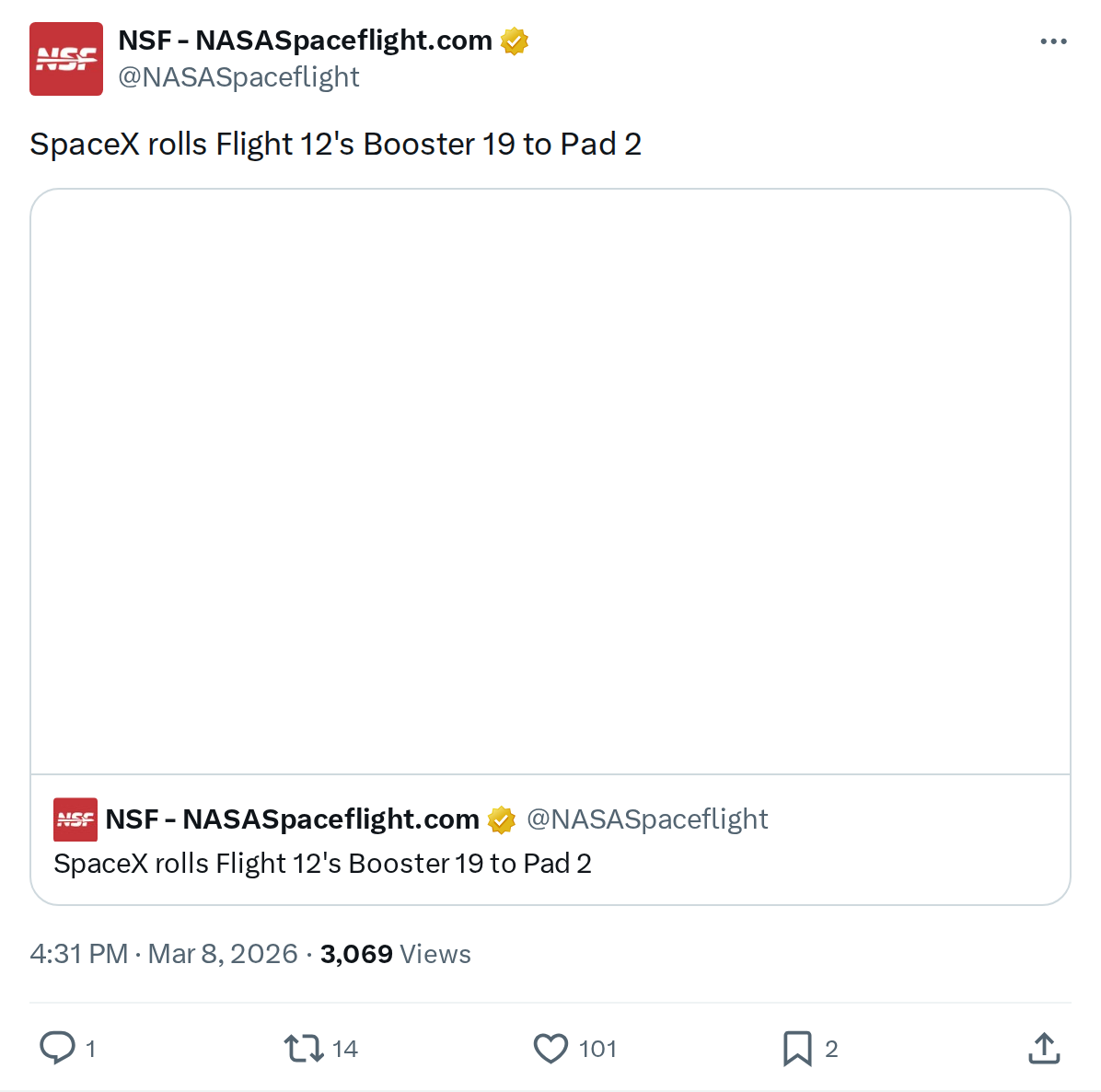
The News: SpaceX rolled Super Heavy Booster 19 — the first Block 3 (V3) Super Heavy booster — to Orbital Launch Pad 2 at Starbase on the night of March 7, 2026, marking a major step toward Starship's 12th integrated flight test.
Why It Matters: With FAA approval already secured and Elon Musk confirming a launch approximately four weeks out, Flight 12 is now in the final stretch of pad preparations. A static fire test is the next critical milestone before stacking and flight.
Source: @NASASpaceflight on X

📊 Key Figures
| Metric | Value | Context |
|---|---|---|
| Flight Number | 12 | Integrated flight test |
| Booster | Super Heavy B19 | First Block 3 / V3 booster |
| Ship | Ship 39 | First Block 3 / V3 ship |
| Raptor 3 Engines | 33 | On Booster 19 |
| Estimated Launch Target | ~April 7–9, 2026 | Musk: ~4 weeks out (Mar 7) |
| FAA Approval | Granted | Flight-safety approval secured |
| Pad 2 Deluge Test | Completed | Full system validated Feb 24 week |
What Got Us Here: The Preparation Timeline
The rollout of Booster 19 to Pad 2 didn't happen overnight. SpaceX has been methodically working through a dense checklist over the past several weeks, and the pace has been notably faster than previous flight campaigns.
Booster 19 completed its full cryogenic proof testing campaign in early February 2026. The sequence ran from ambient pressure tests on February 1, through partial cryo tests on February 2–3, and concluded with full cryo tests on February 4, 6, and 7. Passing all of those without issue cleared the booster for pad operations.
On the ship side, Ship 39 arrived at Masseys Outpost on February 26 and completed a full series of three cryo-proof tests by March 5. SpaceX publicly confirmed Ship 39's cryo testing completion on March 8 — the same day Booster 19 was confirmed at Pad 2. Both halves of the vehicle are now through their ground testing phases simultaneously, which is exactly the kind of parallel progress that keeps a launch campaign on schedule.
Pad 2 itself was also being validated in parallel. A full test of its water-cooled top deck was completed on February 16, followed by a full deluge system test during the week of February 24. The pad is ready to support Booster 19's static fire — the next major milestone in the campaign.
Why Block 3 (V3) Changes the Stakes
Flight 12 isn't just another incremental test. Booster 19 and Ship 39 are the first vehicles of the Block 3 configuration — a significant hardware generation step for the Starship system. Booster 19 is equipped with 33 Raptor 3 engines, SpaceX's latest and most powerful iteration of the Raptor engine family.
The Block 3 designation represents meaningful upgrades in both performance and reliability. Each flight test has progressively demonstrated more of the system's intended operational profile, and Flight 12 is expected to push further on the objectives that Flights 10 and 11 established — particularly around booster catch attempts and ship reentry performance.
🔭 The BASENOR Take
Timeline: Booster 19 at Pad 2 → Static Fire (days away) → Stack with Ship 39 → Flight ~April 7–9, 2026
Impact Level: 🔴 High — First Block 3 hardware, FAA already approved, Musk confirmed ~4-week window
Confidence: High — Both vehicles through cryo testing, pad validated, regulatory hurdle cleared
The single most important signal here is that the FAA approval is already in hand. In previous Starship campaigns, regulatory delays were a consistent source of schedule slippage. With that hurdle cleared and both vehicles through their proof testing, the remaining timeline is almost entirely in SpaceX's hands — and they've been moving fast.
Elon Musk's March 7 statement placing Flight 12 approximately four weeks out aligns precisely with the FCC filing window pointing to April 7, and a broader target of April 9. That's a tight but credible window given where the hardware stands today. The static fire for Booster 19 — which should happen within days of the rollout — will be the clearest indicator of whether that schedule holds.
For the broader SpaceX mission, Flight 12 matters because Block 3 hardware is what the program's long-term objectives — including Artemis lunar missions and point-to-point transport — are built around. Each successful integrated test with the new configuration builds the reliability database that NASA and other customers require before committing to operational missions.
For our SpaceX coverage, this is one of the most well-prepared Starship campaigns to date. Watch for static fire confirmation as the next major data point — if it goes cleanly, an early April launch is very much on the table.
🚀 Following the Starship program? See every test flight, official outcome and the next launch window in our SpaceX Starship Tracker.
Sources & reporting notes
The links below identify the material source records used for this report.
- @NASASpaceflight on X (2026-03-08T08:31:49.000Z) — Direct source
Source links are preserved as published or accessed. See our editorial standards and corrections policy.
The BASENOR Editorial Desk covers Tesla, SpaceX, and related technology, curating reporting from primary sources — official accounts, regulatory filings, and software release data. Every article passes source-record and fact-checking review before publication. About the newsroom.
This report was curated by the BASENOR Editorial Desk from the sources listed above. Read our editorial standards or email editorial@basenor.com to report an error.