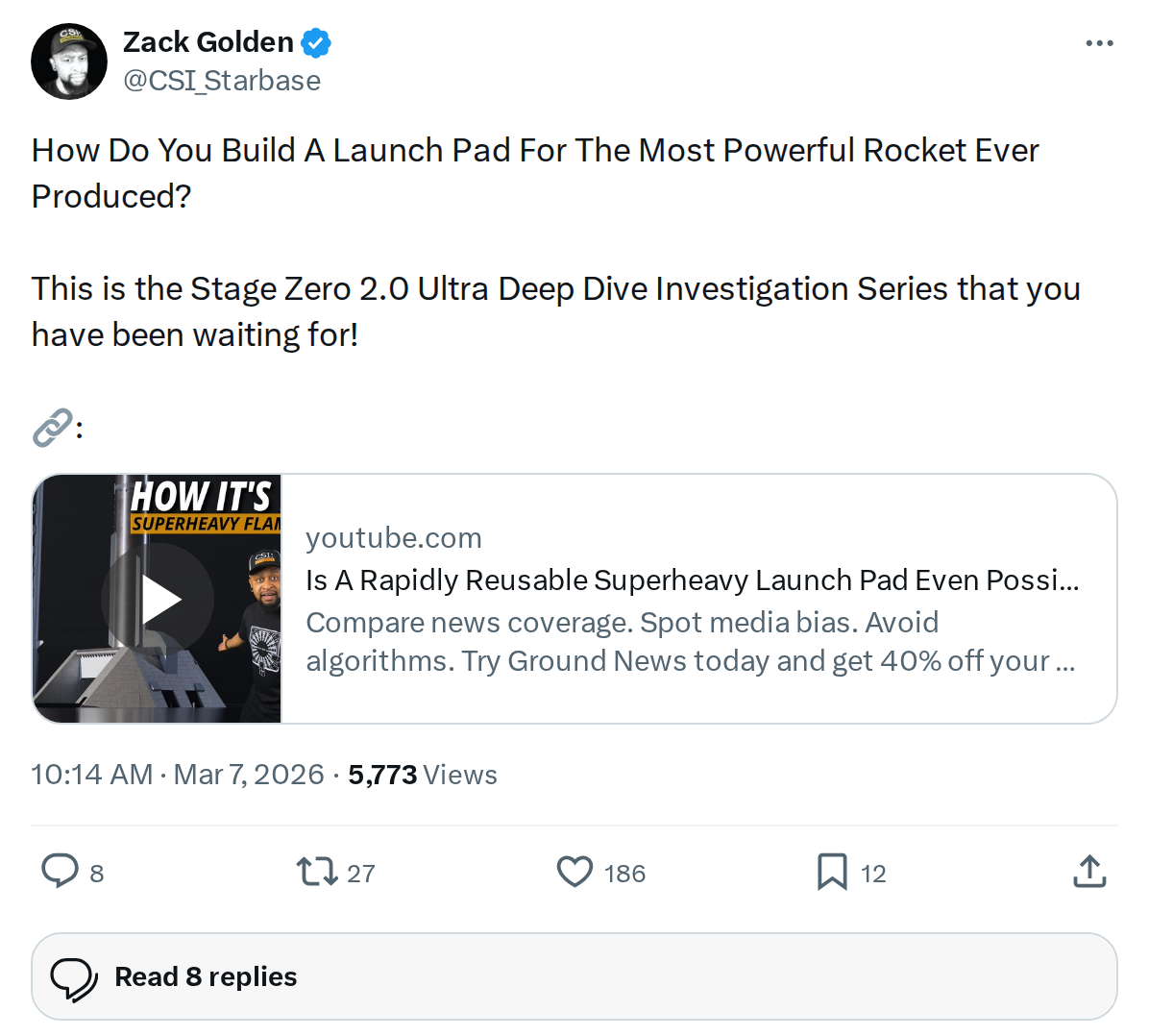
The News: Investigative space journalist Zack Golden (@CSI_Starbase) has released a comprehensive deep-dive series on SpaceX's Starship Stage Zero 2.0 launch pad and Superheavy flame trench — the most ambitious ground infrastructure ever built for a rocket.
Why It Matters: Understanding what SpaceX built — and why — reveals how the lessons of Starship's early, destructive test flights have been engineered into infrastructure designed to survive the most powerful rocket ever produced.
Source: @CSI_Starbase on X
How Do You Build a Launch Pad for the Most Powerful Rocket Ever?
That's not a rhetorical question. When SpaceX first launched Starship from Boca Chica in April 2023, the answer turned out to be: not like that. The original Pad A — a relatively simple stand with no flame trench — was obliterated by the exhaust of 33 Raptor engines firing simultaneously. The resulting crater and debris cloud became one of the most dramatic engineering lessons in recent spaceflight history.
Now, Zack Golden of CSI Starbase has released what may be the most thorough public investigation into how SpaceX responded — and what they built instead. The Stage Zero 2.0 Ultra Deep Dive Investigation Series is a multi-part breakdown of the engineering, construction, and design philosophy behind Pad B (also referred to as OLP-2) at Starbase, Texas.

From Crater to Flame Trench: The Total Redesign
Stage Zero 2.0 isn't an upgrade to the original pad — it's a ground-up rethink. According to verified reporting and the CSI Starbase investigation, the original Pad A was described internally as a "simple stand." What happened on Flight 1 proved that approach catastrophically insufficient. The shockwave and thermal load from 33 Raptors at full throttle excavated the concrete beneath the pad and sent debris raining down across a wide area.
Pad B addresses this at the most fundamental level: it has a dedicated flame trench — a massive engineered channel designed to direct exhaust energy away from the pad structure. According to background research from verified sources, excavating that flame trench has constituted "the bulk of the work" for Pad B's entire construction timeline. That alone tells you the scale of what was missing the first time.

📊 Key Figures: What Stage Zero 2.0 Actually Looks Like
| Metric | Stage Zero 2.0 (Pad B) | Original Pad A |
|---|---|---|
| Flame Trench | Dedicated excavated trench with double-sided flame diverter | None initially; water-cooled steel plate added later |
| Water Deluge Capacity | Up to ~422,000 gallons per activation | Significantly lower volume and pressure |
| Steam Flash (per ignition) | ~300,000+ gallons | N/A |
| Launch Mount Design | Large boxy structure, circular opening, water-cooled deck | Donut-shaped design |
| Booster Clamps | 20 clamps with quick-disconnect system | Different configuration |
| Mount Assembly Time | Nearly one year | Faster, simpler build |
The Flame Trench: Engineering at Extreme Scale
The centerpiece of Stage Zero 2.0 is its flame trench and the "heavily water-cooled double-sided flame diverter" — also called a flame bucket — that sits within it. This dual-sided design is engineered to channel the combined exhaust of 33 Raptor engines in two directions simultaneously, dissipating the thermal and acoustic energy that would otherwise concentrate at the base of the rocket.
The water deluge system feeding this infrastructure is on a different scale entirely from anything at Pad A. Up to 422,000 gallons of water can be activated per event — whether a static fire, launch, or landing. Of that, over 300,000 gallons are expected to flash instantly into steam during a typical ignition event, absorbing acoustic energy that would otherwise transmit destructive vibrations through the vehicle. The remaining water flows as surface runoff or is captured for processing.
One of the more pointed sections of the CSI Starbase investigation asks whether SpaceX initially ignored existing NASA research on flame trench design. It's a fair question — the original pad's lack of a trench was a notable departure from decades of launch infrastructure practice at Kennedy Space Center and Vandenberg. The investigation's timestamp structure suggests this topic is addressed at the 30:24 mark.
What the Timestamps Reveal

The published timestamps give a clear map of what this investigation covers:
- 0:00 — Intro
- 05:33 — Ground News
- 07:50 — The Parking Lot (likely staging and logistics area analysis)
- 15:00 — Lessons Learned from the R&D Launch Mount
- 18:35 — Initial Ground Prep & Flame Trench Reveal
- 22:55 — Further Lessons Learned from the R&D Launch Mount
- 30:24 — Did SpaceX Ignore NASA Research?
- 33:43 — Change of Plans
- 36:00 — CFA Foundation
- 37:40 — (Series continues)
The dual appearance of "Lessons Learned — R&D Launch Mount" at both 15:00 and 22:55 suggests this is a multi-part analysis — likely covering both the structural failures and the operational lessons that fed directly into the Pad B redesign. The "Change of Plans" segment at 33:43 is particularly intriguing: it implies SpaceX made a significant mid-construction pivot, which aligns with reports that the pad design evolved substantially as early flight data came in.
🔭 The BASENOR Take
Timeline: Stage Zero 2.0 construction has been underway since at least 2023, with the flame trench excavation representing the longest single phase of work. The launch mount took nearly a year to assemble.
Impact Level: 🔴 High — This infrastructure directly determines whether Starship can operate at the cadence SpaceX needs for its commercial and NASA Artemis commitments.
Confidence: High — CSI Starbase has a strong track record of accurate, on-site investigative reporting at Starbase. Background research from multiple verified sources corroborates the core technical claims.
Analysis: What makes Stage Zero 2.0 significant isn't just that it's bigger and better than Pad A — it's that SpaceX built it while simultaneously flying and iterating on the rocket itself. That's an extraordinary engineering challenge. The decision to build a proper flame trench, a heavily water-cooled diverter, and a launch mount with 20 booster clamps reflects a maturation from the "move fast and see what breaks" philosophy of early Starship development toward infrastructure designed for operational reliability. The 422,000-gallon deluge system in particular signals that SpaceX is engineering for repeatability, not just survival.
📰 Deep Dive
The CSI Starbase investigation arrives at a moment when Starship's ground infrastructure is arguably as important as the vehicle itself. SpaceX's ability to achieve rapid reusability — the core economic premise of the entire program — depends entirely on a launch pad that can be turned around quickly without requiring extensive repairs after each flight. Pad A's early performance made clear that the original design couldn't support that vision.
The "Did SpaceX Ignore NASA Research?" segment is the most provocative element of the investigation's structure. Decades of NASA experience with Saturn V and Space Shuttle produced a substantial body of knowledge about flame trench geometry, acoustic suppression, and water deluge engineering. The original Pad A's absence of a flame trench was widely noted by spaceflight engineers at the time as an unusual departure from established practice. Whether that was a deliberate calculated risk, an oversight, or a timeline-driven decision is a question this investigation appears to address directly.
The "Change of Plans" timestamp at 33:43 may be the most consequential section for understanding how Pad B evolved. Mid-construction design changes on infrastructure of this scale are expensive and logistically complex — their presence suggests SpaceX received data from early Starship flights that fundamentally altered their assumptions about what the pad needed to withstand. That kind of real-time engineering iteration is rare in the aerospace industry and speaks to the unusual pace at which the Starship program operates.
For those following SpaceX's coverage on this site, the Stage Zero 2.0 story is ultimately about whether the ground can keep up with the rocket. Based on what CSI Starbase has documented, the answer appears to be yes — but only after a significant and expensive course correction from the program's earliest days. See our SpaceX coverage for ongoing updates as Pad B moves toward operational status.
🚀 Following the Starship program? See every test flight, official outcome and the next launch window in our SpaceX Starship Tracker.
Sources & reporting notes
The links below identify the material source records used for this report.
- @CSI_Starbase on X (2026-03-07T02:14:12.000Z) — Direct source
- @CSI_Starbase on X (2026-03-07T02:14:12.000Z) — Direct source
- @CSI_Starbase on X (2026-03-07T02:14:13.000Z) — Direct source
Source links are preserved as published or accessed. See our editorial standards and corrections policy.
The BASENOR Editorial Desk covers Tesla, SpaceX, and related technology, curating reporting from primary sources — official accounts, regulatory filings, and software release data. Every article passes source-record and fact-checking review before publication. About the newsroom.
This report was curated by the BASENOR Editorial Desk from the sources listed above. Read our editorial standards or email editorial@basenor.com to report an error.